
DUBAI, United Arab Emirates — Iran launched an attack on a tanker in the Strait of Hormuz early Tuesday morning, compelling its crew to evacuate the vessel, even as the United States carried out yet another round of airstrikes against Iran — the tenth night in a row of such strikes.
Despite a week and a half of continuous U.S. military action, Iran has not relaxed its hold on the strait, a critical passage through which roughly one-fifth of the world’s crude oil and natural gas once flowed during peacetime.
Even as the two nations edge closer toward full-scale war, Iran’s interior minister made his way to Pakistan — a key player in mediation efforts — for diplomatic discussions. Still, it remains uncertain what kind of agreement could bring the hostilities to an end.
A temporary ceasefire deal reached last month that was intended to halt the fighting has since collapsed. Shipping through the Strait of Hormuz has largely ground to a halt, and as the conflict grows more intense, both sides have struck civilian infrastructure that millions of people depend on.
The U.S. State Department issued a fresh warning to American citizens, stating: “Iran and groups supportive of Iran may target other U.S. interests overseas or at locations associated with the United States and Americans throughout the world.”
The escalating tensions have driven oil prices upward in recent weeks. Benchmark Brent crude was trading above $88 per barrel on Tuesday, while average regular gasoline prices across the U.S. climbed to $4 per gallon — adding financial strain on American households ahead of this fall’s midterm elections.
In a separate development, the U.S. military released the names of two soldiers killed in Jordan during attacks that also left a third person unaccounted for. Additionally, the military confirmed another fatality in Iraq on Saturday during what was described as the “controlled detonation” of a downed Iranian drone. President Donald Trump took to social media Monday with a stark warning: “Every time Iran kills an American Soldier they will pay for that killing many times over!”
Trump was scheduled to attend a ceremony Tuesday evening at Dover Air Force Base, where the remains of at least one service member were expected to arrive.
U.S. Central Command announced Tuesday that its forces had struck “Iranian military command centers, maritime capabilities, missile and drone launch sites and air defense systems,” releasing additional footage of the bombings. The command added: “American forces remain postured and prepared to hold Iran accountable for unwarranted aggression toward civilian mariners seeking to freely and openly transit the strait.”
Despite those efforts, vessel traffic through the strait has nearly stopped. The British military’s United Kingdom Maritime Trade Operations center reported that a tanker was attacked early Tuesday in the strait near Oman, forcing the crew to abandon ship. Iran’s paramilitary Revolutionary Guard took responsibility for that attack, as well as two additional assaults on ships in the waterway the previous day.
The route skirting Oman is the one U.S. military officials have been directing ships to take in order to avoid Iranian-controlled areas. Nevertheless, Iran also struck U.S.-allied nations across the broader Middle East. Jordan’s military said Tuesday that five Iranian drones targeted the country, though all five were intercepted and shot down.
The Pentagon’s chief spokesperson said close to 100 American service members have been injured since the U.S. resumed strikes on July 7, with 96 percent of those individuals having returned to duty. “The vast majority of injuries experienced were minor concussions,” Sean Parnell posted Monday on X, responding to a New York Times report that the Pentagon had withheld injury data from the public. He denied that the military was concealing information. However, as of Monday night, the Defense Casualty Analysis System — the military’s official tracker for conflict-related deaths and injuries — had not been updated to reflect the latest incidents.
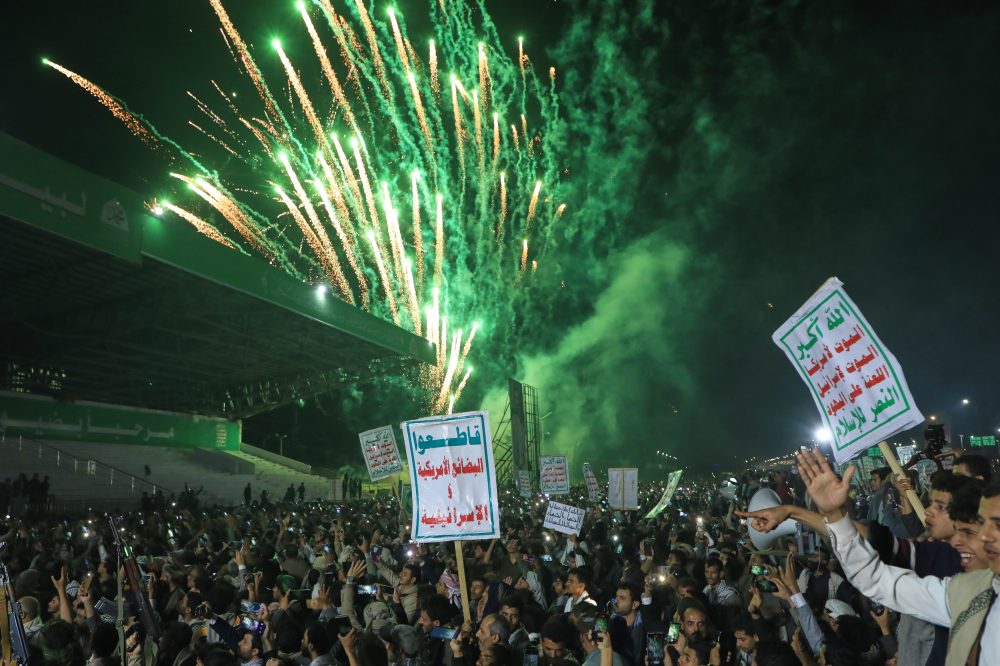
Yemen’s Houthi rebels, who receive backing from Iran, declared a maritime embargo against Saudi Arabia on Monday. The group announced it would block shipping between the Red Sea and the Gulf of Aden by targeting the Bab el-Mandeb — another critical maritime chokepoint similar to the Strait of Hormuz — in retaliation for an attack on Sanaa International Airport last week that the Houthis attributed to Saudi Arabia.
With the Strait of Hormuz largely blocked, Saudi Arabia has been using an overland pipeline to the Red Sea to move millions of barrels of oil to market. The Houthis previously proved capable of disrupting shipping in that region when they targeted vessels for months during the Israel-Hamas war in Gaza, striking more than 100 ships.
Saudi Arabia’s military vowed to keep the waterway open. “All Houthi threats against transiting vessels will be dealt with swiftly and firmly, as such threats are a blatant violation of international law and fall under acts of maritime piracy,” said Maj. Gen. Turki al-Malki, a Saudi military spokesman.
Pakistan has been ramping up its diplomatic efforts in recent days in hopes of reviving the collapsed interim agreement. Iranian Interior Minister Eskandar Momeni arrived in Islamabad on Monday for two days of meetings with Prime Minister Shehbaz Sharif and other officials.
On Sunday, U.S. Secretary of State Marco Rubio told reporters the United States remains willing to negotiate with Iran, but emphasized that “it has to be real.” “If the door opens to diplomacy — if the guys that want to do something productive for Iran win and take control of that system, or take control of the negotiations — that’ll be a very positive development,” Rubio said. “That’s not where we are tonight, unfortunately.”
Iranian officials reported Sunday that at least 50 people have been killed and 517 others wounded in the most recent rounds of U.S. airstrikes. Since the conflict began on February 28, a total of 17 U.S. service members have lost their lives.