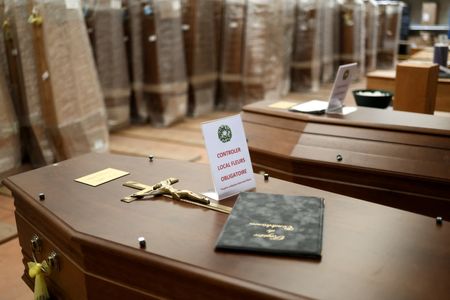

Gautier Caton has spent nearly 25 years in the funeral business, but nothing prepared him for France’s record-shattering heatwave at the end of June. He was forced to rent five refrigerated containers just to handle the flood of bodies arriving at up to three times the usual rate.
A fifth-generation funeral director who grew up surrounded by coffins in his parents’ garage, Caton entered the family business just weeks after a notorious 2003 heatwave that contributed to nearly 15,000 excess deaths across France. But this summer brought something new — his Orléans funeral homes took in four bodies from overwhelmed firms in Paris, a two-hour drive away, for the very first time.
“The Paris region was hit extremely hard, they were in crisis,” he said. “And then it spread to us in Orléans, where our funeral facilities became severely overcrowded. It hit us with full force.”
France’s summer of 2026 has become a grim collision of three forces reshaping the nation: a planet growing hotter, a population growing older, and a government stretched too thin financially to fund the changes needed to adapt.
Temperatures reaching historic highs — and arriving earlier in the year than ever before — have triggered unprecedented wildfires near Paris, forced schools to close, and pushed under-equipped hospitals to their limits. The extreme heat has also hastened the deaths of vulnerable elderly people living in sweltering homes and care facilities.
French authorities reported 2,025 excess deaths during the late-June heatwave, when temperatures climbed as high as 43.8 degrees Celsius — about 110 degrees Fahrenheit. Deaths surged nearly 65% in Paris and nearly 50% in the Centre-Val de Loire region, where Caton’s business operates. Officials caution those figures are preliminary, based on roughly 60% of all recorded deaths, and are expected to climb as more complete data becomes available.
Francois Bourdillon, who led France’s public-health agency from 2016 to 2019, acknowledged that the country had made real progress since the 2003 catastrophe. That earlier disaster caught authorities off guard and led to the creation of a warning system that uses forecasting, public alerts, and protections for at-risk individuals to soften the worst impacts of future heatwaves.
Still, Bourdillon argued that France had failed to address deeper structural weaknesses in its cities, hospitals, schools, and care homes. He said the country now needs a multi-year strategy, led by the prime minister’s office, “to transform the country to deal with heat epidemics.”
The issue hit close to home for him when his sister-in-law recently had heart surgery at a leading Paris hospital that had no air conditioning. His brother brought her a fan.
“The lesson of 2003: We were blind. We’re no longer blind, that’s certain. We have indicators and we sound the alarm,” Bourdillon said. “The lesson of 2026: Well, it’s not enough. We are in a sort of dystopia in which we can deal with the effects of the heatwave … but we forget the structural issues.”
French Prime Minister Sebastien Lecornu has pledged hundreds of millions of euros to install cooling systems in hospitals and nursing homes. But critics — including the Greens, who launched an unsuccessful no-confidence vote over Lecornu’s handling of the crisis — say the commitment falls short. The government is caught between the need to invest in heat resilience and the pressure to cut the deficit while maintaining spending in areas such as defense.
Matthieu Glachant, an environmental economics professor at Mines Paris – PSL, said he believes France’s brutal summer has built public momentum for a stronger government response. “The shocks we’ve experienced have been so severe that they will … influence political decisions well beyond the next two months,” he said.
When Caton’s team was called to a local nursing home this month, they found staff had wheeled residents into the TV room — the only space with air conditioning — while white bedsheets hung from corridor windows to block the sun. A 94-year-old woman had died there.
“I don’t look at the weather forecast any more,” said the home’s chief nurse, Beatrice Noyer. “It depresses me.”
Residents had been kept cool using wet towels and water mist, though some needed intravenous fluids, Noyer said. While most spent their days in the cooled TV room, others refused to leave their bedrooms.
A survey published last year by France’s Health Ministry found that 41% of nearly 3,000 elderly care facilities did not have a shared air-conditioned space. Fewer than 10% had air conditioning in residents’ individual rooms.
Noyer said urgent investment in staff and facilities was desperately needed. “But for now, nothing is moving, and I’m not sure it will,” she said. “Elderly people do not matter to our politicians.”
The spike in excess deaths could yet force a political reckoning. The preliminary count of 2,025 deaths does not fully capture fatalities at home — a category that rose more than 91% between June 22 and 28. Caton said home deaths normally make up about 25% of his firm’s funerals, but during the heatwave that figure jumped 80%.
“They were not necessarily people who were completely ready to die or whose death was expected,” Caton said. His firm was receiving the remains of people who had died alone in their homes more than two weeks earlier, with no one having checked on them.
“They die in total anonymity,” he said.