
DUBAI, March 1 – When Iran launched hundreds of drones and missiles toward Gulf nations in response to American and Israeli military actions, Dubai residents found themselves witnessing something many thought impossible in their adopted safe haven.
Social media influencer Hofit Golan captured the shock felt by many as she filmed smoke billowing from an explosion near Palm Jumeirah, the artificial island that represents Dubai’s luxury lifestyle.
“Oh my god … this is the view from my balcony,” Golan said with evident disbelief in her voice. “This is in front of my home. Oh my god,” she shared with her millions of online followers.
For years, Dubai has attracted residents fleeing regional conflicts and Westerners seeking low taxes and stability, all viewing the emirate as insulated from Middle Eastern turmoil.
That perception suffered a major blow when Iranian projectiles caused damage at Dubai’s most recognizable landmarks, despite most being successfully intercepted by defense systems.
The affected locations included the iconic Burj Al Arab hotel and Palm Jumeirah, where luxury resorts and upscale residences house many social media personalities who shared their panoramic views of the attack.
RESIDENTS DESCRIBE FEAR
Dubai-based trader Daniel Holmes, who has a substantial Instagram presence, said missile interceptions woke him and were visible from his apartment.
“All the locals are like ‘nah bro you’ve got nothing to worry about, it’s all good,’” Holmes posted online. “I’m like … there is genuine war around where you live here in Dubai. I’ve never dealt with that before.”
Similar conversations occurred throughout the city, which serves as the Middle East’s primary commercial and tourist center. While some residents discussed temporary departures, others maintained confidence in the UAE’s security capabilities.
Foreign nationals comprise approximately 90% of the UAE’s population.
A Western mother with two elementary-age children described feeling unsettled after hearing multiple explosions in rapid succession.
“They are really keeping us on our toes,” she messaged Reuters. “It’s almost as if their only purpose is to maintain the panic and fear.”
Another Dubai resident with experience in previous Middle Eastern wars said he never anticipated hearing drone interceptions in the UAE.
“I was not mentally prepared. I was terrified, I was actually (hiding) in the bathroom,” he said, requesting anonymity due to Dubai’s restrictive media policies.
However, Yamen Fadel, a 36-year-old Syrian living in Dubai, expressed confidence in government protection and communication efforts.
“I am seeing that there’s nothing much, just a few minor things,” Fadel said. “Nothing scary … because the government here, thank God, is protecting everyone.”
Dubai’s media office announced Saturday that outdated fire footage was circulating on social platforms and warned of legal consequences for sharing such material.
Several influencers reportedly removed their initial posts about the incidents.
CITY SHOWS STRAIN
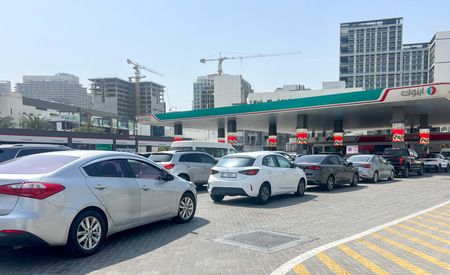
By Sunday, as Iran’s retaliation expanded throughout the Gulf region, Dubai appeared noticeably quieter than usual, with typically congested weekend roads showing sparse traffic in many areas. The UAE’s human resources ministry advised private sector remote work through Tuesday.
Numerous small neighborhood businesses including barbershops, convenience stores, and local service providers remained closed.
Residents reported extended supermarket lines, delayed grocery deliveries, and unusually empty store shelves.
Social media platforms saw heated exchanges about emergency stockpiling.
“STOP! You are leaving no essentials for others,” one user wrote in a Dubai residents’ Facebook group.
“My husband was in the queue at are (sic) local shop and the person in front of him had 15 baguettes in their trolley, and there was absolutely no meat left,” another posted.
A third user responded: “During the war there are no rules. Each one for himself.”
Dubai’s leadership projected normalcy and continuity.
Saturday evening saw the emirate’s ruler attending Dubai’s premier horse racing event, Emirates Super Saturday, which state media described as “a special evening marked by thrilling races and strong competition.”
But Robyn, a British tourist who had stayed at the Fairmont Hotel earlier in the week before it sustained damage Saturday, said the attacks provided perspective.
“I always thought in the back of my mind that something will kick off someday and spread to the UAE and surrounding areas,” she said.
“But the fact that it happened is definitely very grounding, and you realize that not all that glitters is gold.”