
DJERBA, Tunisia — International worshippers cautiously returned to one of Africa’s most ancient Jewish pilgrimages this spring, gathering at Tunisia’s historic El-Ghriba Synagogue despite heightened security following last year’s fatal shooting.
Approximately 500 participants traveled to the Mediterranean island of Djerba between April 30 and May 6 for the Lag B’Omer celebration at the 2,600-year-old sacred site. The group included pilgrims from France, China, Ivory Coast and Italy, with France’s ambassador to Tunisia making a symbolic appearance after two French nationals were killed in the 2023 incident.
The previous year’s festival was marred when a national guardsman opened fire at the synagogue, killing five people and creating widespread fear among Tunisia’s Jewish community and international visitors.
Within the synagogue walls, worshippers maintained traditional rituals, lighting candles, studying religious texts and inscribing wishes on eggs before placing them in a sacred cave believed to grant blessings. The atmosphere combined reverence with social connection as participants engaged in conversations and spiritual practices.
Redj Cahen, a Tunisian-Italian worshipper who had skipped the previous year’s gathering, expressed his joy at returning. “We are back, and we are proud to be Tunisian Jews,” Cahen stated. “It is a feeling you cannot explain. Only those who come here understand.”
The pilgrimage has historically served as a bridge between communities, welcoming both Jewish visitors and Muslim observers as a demonstration of religious tolerance. Tunisia’s Jewish population traces back to Roman times, making this annual gathering a cornerstone of the nation’s small but enduring Jewish heritage.
Security forces maintained a careful but noticeable presence around the synagogue, with more intensive measures at island entry points. Authorities established police checkpoints and barriers, conducting vehicle searches and thorough identification checks. Extra protection was concentrated in Hara Seghira and Hara Kebira, the island’s primary Jewish neighborhoods.
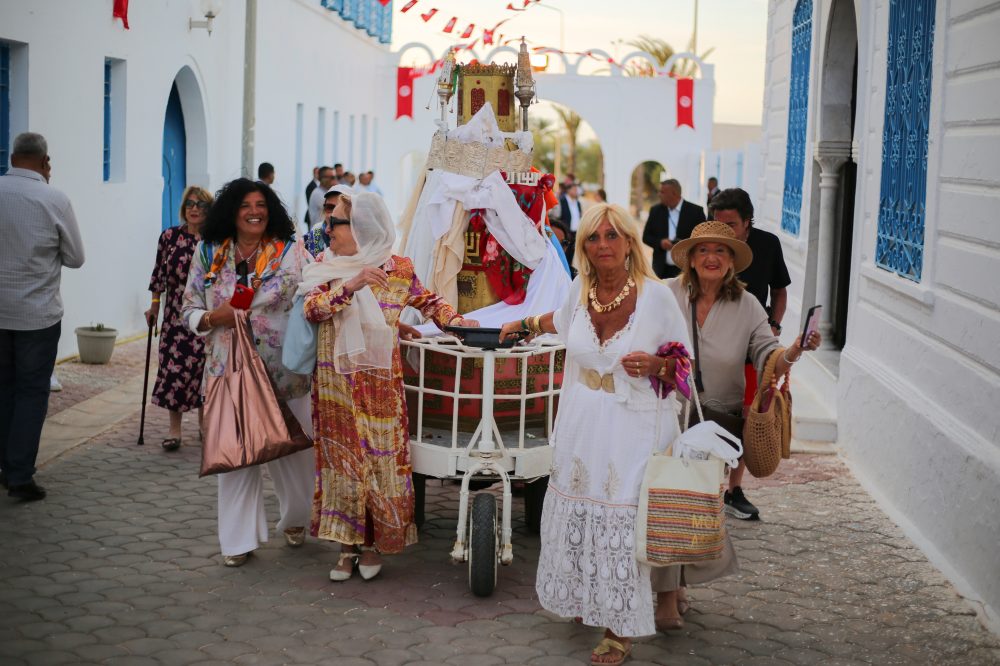
For the first time since the 2023 attack, organizers proceeded with the traditional “Minara” ceremony, suggesting a gradual return to normalcy. This ritual centers around a pyramid-shaped golden and silver tower placed within the synagogue, which women adorn with vibrant scarves symbolizing prosperity, fertility and matrimonial blessings.
The ceremony includes a customary auction featuring paintings and Jewish religious artifacts to raise funds for synagogue upkeep. Following the auction, the decorated Minara is loaded onto a cart and paraded outside accompanied by traditional darbuka drumming, singing and candy distribution before returning to the synagogue to complete the ritual.
This pilgrimage represents one of Africa’s oldest religious journeys, historically attracting thousands of international visitors. Attendance plummeted after the 2023 shooting, which also recalled the 2002 al-Qaida truck bombing that claimed approximately 20 lives at the same location.
Former Tourism Minister René Trabelsi characterized this year’s event as progress toward recovery. “This year’s Ghriba pilgrimage marks a gradual return,” Trabelsi commented. “We are returning little by little.”
Trabelsi noted that Tunisian officials worked to preserve the pilgrimage despite ongoing security concerns, recognizing its significance for the regional economy.
Khedir Hnaia, who has served at the synagogue for over thirty years, expressed satisfaction at seeing familiar faces return. “We would like to reflect a good image to the world, to bring back the glory of Ghriba and make it even better than how it used to be,” Hnaia said.
Haim Haddad, a member of the pilgrimage organizing committee from Zarzis, emphasized the community’s dedication to their homeland. “We need to stand up for our country, we love Tunisia very much and in the same way our country stood up for us we will always stand up for it,” Haddad declared.