
SANTA CLARA, Cuba — For years, Yudelaimys Barrero Muñoz endured grueling three-hour waits alongside busy highways, desperately waving cash at passing motorists while trying to hitchhike the 43-mile journey from Cienfuegos to Santa Clara. The mother of two made these arduous trips to purchase goods for resale to support her family.
The distance proved too far for her husband’s bicycle, which was once their sole means of getting around. Even after acquiring an electric three-wheeled vehicle, the battery couldn’t handle the complete round-trip journey.
Everything changed this past April when a local entrepreneur launched what’s considered Cuba’s inaugural solar-powered charging facility, offering completely free access to electricity. Cuban residents quickly began visiting the “solinera,” as locals call it, bringing electric cars, household devices, and even UV nail equipment for charging.
Cuba’s leadership has accelerated solar panel installations across medical facilities and government buildings while creating solar energy farms to combat persistent electrical outages and a critical fuel crisis caused by U.S. energy sanctions.
Solar and other renewable sources now generate approximately 10% of Cuba’s electrical power, a significant jump from just 3.6% in 2024. However, access remains restricted, and most Cubans cannot afford private solar systems. Worldwide, renewable energy sources like solar, wind, and hydroelectric power produce slightly more than 30% of electricity, according to research organization Ember.
With gasoline extremely scarce, Cuban citizens travel considerable distances to reach the Santa Clara solar facility using electric motorcycles and three-wheeled vehicles. Some arrive on foot, carrying depleted cell phones, rice cookers, pressure cookers, and countless other electronic devices and appliances requiring power.
“They have solved many problems for many people,” Barrero Muñoz said.
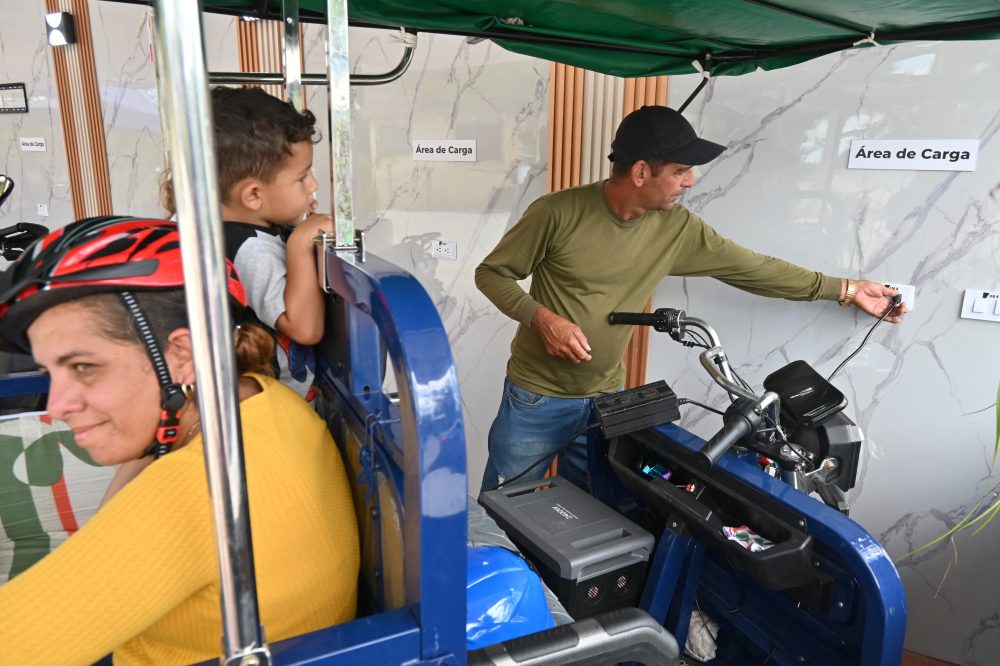
She and her spouse, accompanied by their 3 and 4-year-old children, now make regular trips to Santa Clara since gaining the ability to charge their three-wheeled transport at the solar facility.
“If it hadn’t been for this, I wouldn’t have been able to keep selling,” she said.
Barrero Muñoz can now purchase rice, sugar, hot dogs, mortadella, soap, shampoo, deodorant, and other products without worrying about weight restrictions, since everything fits in her vehicle rather than the two bags and backpack she previously carried when hitchhiking.
“I have more clients because I have more merchandise,” she said with a smile.
Automobiles are rarely seen on the highway connecting Havana to Santa Clara, while horse-drawn carriages frequently appear in countryside areas where Cuba’s economic difficulties create the greatest hardship.
Home to nearly 250,000 residents, Santa Clara ranks among Cuba’s largest urban centers, famous as the city associated with “Marta and El Che.”
El Che — Ernesto Guevara de la Serna — commanded a crucial battle in Santa Clara during Cuba’s 1959 Revolution, and his remains rest in a memorial there.
The city also honors Marta de los Ángeles González Abreu y Arencibia, a renowned humanitarian who championed Santa Clara and Cuba’s independence movement.
Santa Clara residents include Danailys Arboláez Pérez, a 32-year-old mother of two who operates a home-based business selling sandwiches, coffee, beer, and cigarettes. Her house sits within walking distance of the solar charging facility.
“Almost everyone in this neighborhood goes there,” she said.
Arboláez Pérez has prepared rice and beans and even fried fish at the solar station, sometimes choosing it over her home kitchen even when electricity is available to reduce natural gas expenses.
She also powers two fans that keep her 2-year-old son’s and 7-year-old daughter’s rooms cool as Cuban temperatures climb, remembering last year’s power failures as “apocalyptic.”
She appreciates no longer having to leap from bed when electricity suddenly returns, forcing her to cook or do laundry at inconvenient times, including 2 a.m.
“We’re not running around so much,” she said. “I cook slowly, calmly. … If the power goes out, I’ll just take the pot there.”
Alexander Gutiérrez Altuve works at the adjacent business that helped fund and establish Santa Clara’s solar charging station.
While the project’s exact cost remains undisclosed, he explained that the business owner, who wasn’t available for comment, collaborated with government officials to install solar panels generating 30 kilowatts of power and a 60-kilowatt battery system. This capacity could power a typical American household for one full day.
The facility features 20 electrical outlets for equipment charging, 16 spaces for vehicles, and 12 cooking stations.
“This is something that hadn’t really been done before,” Gutiérrez Altuve said.
Some visitors remain hesitant to try the service.
“They are truly surprised when you tell them that it’s free,” said Lisandra Couto Pérez, who works alongside Gutiérrez Altuve monitoring facility usage.
During a recent afternoon visit, Lorenzo Ravelo, Barrero Muñoz’s husband, drove his three-wheeled vehicle into the station and connected it to a charger while his wife and two small children climbed out.
Before purchasing their small three-wheeler, Ravelo would borrow money from neighbors to rent vehicles when their children required medical attention, “and later make payments however you can and whenever you can.”
With only a bicycle available then, he couldn’t take his family on enjoyable excursions to escape Cuba’s daily struggles. Now they can even drive their own vehicle to the beach, he said, becoming emotional.
“It’s a great solution,” he said.