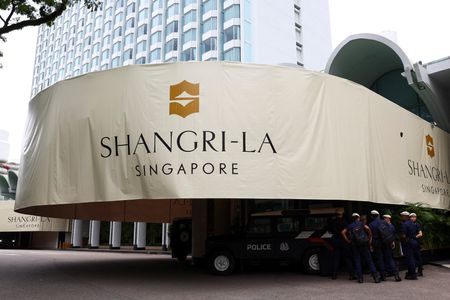

International tensions surrounding the war in Iran, America’s strategic focus in Asia, and escalating disputes over Taiwan are expected to take center stage at Singapore’s premier defense conference this week.
The Shangri-La Dialogue, scheduled for May 29-31, brings together defense ministers, military leaders, intelligence officials, diplomats, policy experts and defense contractors for both public presentations and private discussions at the annual gathering.
Vietnam’s President To Lam will present Friday evening’s main address, but attention will center on U.S. Defense Secretary Pete Hegseth as he speaks amid ongoing efforts to resolve the Iranian conflict.
President Donald Trump announced Sunday that he had instructed his negotiators to avoid rushing into any agreement with Iran, as his administration tempered expectations for a quick resolution to the three-month conflict.
The American naval blockade of Iranian vessels in the Strait of Hormuz will “remain in full force and effect until an agreement is reached, certified, and signed,” Trump posted on Truth Social. Iran has effectively closed the strait since fighting began February 28, blocking a crucial shipping route that normally handles approximately 20 percent of worldwide oil and gas transport.
Regional partners are anticipated to closely watch Hegseth for indications that President Trump’s government is stretched too thin, drawn into Middle Eastern warfare, engaged in European disputes including German troop withdrawals, and therefore less focused on Asian concerns.
“There will likely be some continued anxiety over the unpredictability and volatility of U.S. policy, and the consequences for stability,” said Chong Ja Ian, a political scientist at the National University of Singapore.
“The most pressing issue for Asia would be the U.S.-Israel-Iran conflict and its effects on energy supply.”
The Iranian conflict has disrupted the worldwide economy through significantly increased oil costs that fuel inflation and stress supply networks for everything from fertilizer to food products, creating particular challenges for Asia’s import-reliant nations.
Uncertainty remains over China’s participation after Beijing declined to attend last year’s forum, allowing Washington to dominate the proceedings while China later criticized Hegseth for “vilifying” the country.
China’s defense ministry has not announced whether Defense Minister Dong Jun will participate or which other representatives might attend. The ministry did not reply to Reuters’ inquiry.
Hegseth’s appearance follows the recent summit between Chinese President Xi Jinping and Trump in Beijing, occurring during heightened Taiwan-related tensions.
China has intensified pressure on Taiwan through expanded military activities near the island, maintaining Taipei’s alertness for additional Chinese actions after the leadership meeting.
China considers democratically ruled Taiwan part of its territory, a stance Taiwan’s government disputes.
“In the aftermath of the summit, I suspect he will tread carefully on China,” said Bonnie Glaser, head of the Indo-Pacific Program of the German Marshall Fund think-tank, adding that Hegseth might further push allies and partners to spend more on defence.
Military representatives indicate the Chinese delegation will likely encounter direct questions about how extensive anti-corruption campaigns targeting senior officers are impacting Chinese military preparedness.
Experts anticipate discussions on how smaller nations manage U.S.-China competition, along with attention on maritime conflict zones in the South China Sea and Strait of Malacca, plus defense expenditures.
Vietnam’s Lam is expected to emphasize Hanoi’s neutral stance as it strengthens relationships with both Washington and Beijing while asserting its territorial claims against China.
Recently appointed to both Communist Party leadership and the presidency, Lam represents Vietnam’s most influential leader in recent decades and is positioned to assume a greater diplomatic presence.