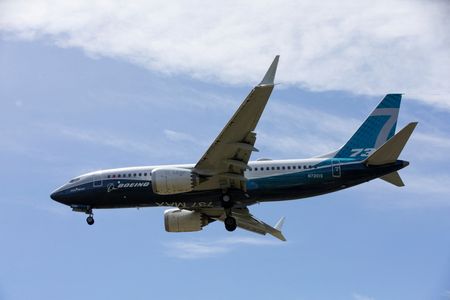

Boeing is in the final stretch of obtaining regulatory approval for a fix to the engine anti-ice system on its 737 MAX aircraft, a development that could open the door for deliveries of the long-stalled MAX 7 and MAX 10 versions, company executives announced.
The redesigned system corrects a problem that could lead to engine overheating and potential failure. That issue has been the primary roadblock preventing certification of both the smallest and largest variants of Boeing’s top-selling commercial jet.
According to aviation analytics company Cirium, Boeing has already manufactured roughly 30 MAX 7s and nine MAX 10s that are sitting in storage awaiting delivery. The MAX 10 alone represents at least 28% of all outstanding MAX orders.
The U.S. Federal Aviation Administration announced in May that it anticipated certifying the smaller MAX 7 this summer. Southwest Airlines holds the largest number of orders for that particular version.
The MAX 10, which generates more profit per unit, has completed 98% of its required certification flight testing, executives revealed to reporters before next week’s Farnborough Airshow.
“We have two flight tests left, and we should be done real soon here,” said Chris Payne, Boeing’s vice president and general manager for 737 MAX development programs.
Certification of both the MAX 7 and MAX 10 is running years behind its original schedule, a delay that has given European aircraft manufacturer Airbus the opportunity to extend its advantage in the narrowbody jet market.
Boeing has faced a more rigorous certification process following two deadly crashes involving the MAX 8 in 2018 and 2019, as well as heightened scrutiny of its manufacturing and quality control operations after a mid-air cabin panel blowout in January 2024 on a nearly new Alaska Airlines MAX 9.
When the anti-ice system problem was first identified in 2021, regulators permitted the MAX models already flying commercially — the MAX 8, MAX 8-200, and MAX 9 — to continue operating and allowed Boeing to keep building them, while holding back certification of the newer variants.
Beyond solving the heating issue, the fix also reduces engine noise and helps prevent fan flutter, based on results from testing conducted at GE Aerospace’s facility in Ohio, according to Mike Sinnett, Boeing’s senior vice president of product strategy, product development, and development programs.
“It was kind of win-win all around,” Sinnett said.
The 737 MAX uses the LEAP-1B engine, which is built by CFM International — a joint venture between GE Aerospace and France’s Safran.
For aircraft already in service, Boeing says the bulk of the engine anti-ice retrofit can be completed within a single maintenance shift, though it also involves installing new wiring that requires more extensive work. Executives said Boeing is coordinating with regulators on a timeline that would let airlines perform the repair when planes are already undergoing scheduled heavy maintenance, limiting disruption and keeping costs down.
The MAX 10 will also feature an upgraded flight crew alerting system — called an enhanced angle-of-attack system — to meet safety standards that Congress required following the two MAX crashes, which together killed 346 people and grounded the aircraft for 20 months starting in 2019.
The updated system simplifies the cockpit warnings that stem from a malfunctioning angle-of-attack sensor. In both the Indonesia and Ethiopia crashes, pilots were overwhelmed with excessive alerts triggered by that sensor failure.
“It’s an IOU from the return-to-service requirements after the very unfortunate accidents,” said Bill Quashnock, Boeing’s 737 deputy chief pilot.
Quashnock added that all 737 MAX jets currently in service will have the new system installed within two years of it receiving regulatory certification.
In other Boeing certification news, the company has surpassed the halfway point in flight testing for its 777-9 widebody jet and remains on schedule to begin deliveries of that aircraft next year, said Terry Beezhold, Boeing’s vice president and general manager of the 777-9 program. Several major certification steps still remain, including approval for extended-range flights over routes with limited airport options along the way.