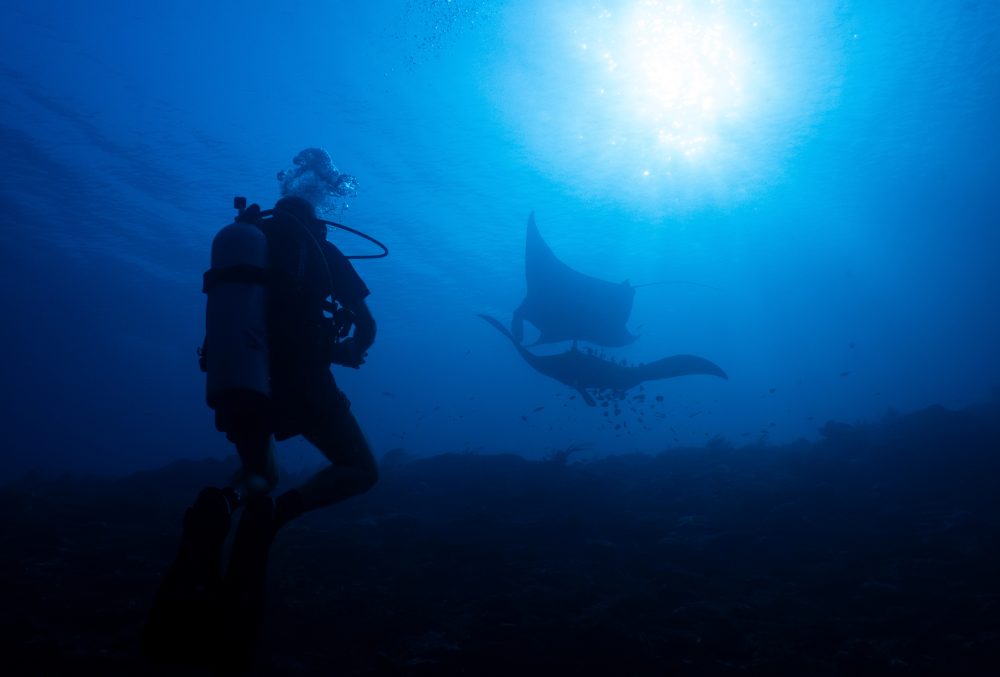

MISOOL, Indonesia — Beneath the waters of Raja Ampat, a distant island chain in eastern Indonesia, an underwater spectacle unfolds where sharks, manta rays and sea turtles swim through coral gardens found nowhere else on Earth, creating a vibrant tapestry of marine life.
“There’s nowhere on Earth that has as many fish, corals and everything else packed into one small place,” said Mark Erdmann, an American coral reef biologist who has spent more than two decades studying the region and became a central figure in building Raja Ampat’s conservation model.
This internationally celebrated diving destination lies within the Coral Triangle in southwestern Papua, where strong ocean currents deliver nutrients that support what researchers consider the planet’s most biodiverse marine environment.
Despite its reputation as a worldwide benchmark for marine conservation, Raja Ampat’s ecosystems face mounting challenges from expanding nickel extraction operations and a boom in international tourism.
The coral formations weren’t always as pristine as they appear now. During the early 2000s, fishing crews from across Indonesia and Southeast Asia deployed explosives and massive nets, destroying coral structures, wiping out shark communities and forcing local fishermen to venture up to 10 kilometers offshore to find adequate catches.
At that time, government officials relied primarily on mining and timber harvesting to drive regional economic growth.
This direction started changing in 2023 when Conservation International conducted a marine evaluation that initiated discussions between community leaders and conservation organizations about how protecting Raja Ampat’s marine environment could provide food security and sustainable tourism income while preserving a crucial ocean ecosystem.
“We brought some leaders to visit more developed areas such as Bunaken and Bali with the hope that they could see for themselves up close the benefits of natural resource management,” said Syafri Tuharea, a conservation expert who heads the Raja Ampat Marine Conservation Area.
These collaborative efforts established the foundation for 10 marine sanctuaries created starting in 2007, encompassing 2 million hectares across 45% of Raja Ampat’s coral formations, seagrass meadows and mangrove systems.
Currently, local residents monitor the waters, implement fishing regulations and oversee tourism activities, funded primarily through tourism income, including a 700,000 Indonesian rupiah ($40) marine park entrance fee.
Following twenty years of conservation efforts, the outcomes are remarkable. A 2024 study from the Misool Foundation, representing one of the protected islands, discovered that fish biomass increased by 109% — a metric that indicates ecosystem vitality.
These same waters now support 2,007 documented reef mantas, an impressive population given the species faces extinction threats from overfishing throughout the Indo-Pacific region.
This conservation achievement coincides with a global shift toward renewable energy, creating rapidly growing demand for nickel resources.
Government authorities approved new nickel extraction permits in 2025 for three northern Raja Ampat islands, including areas within a designated UNESCO Global Geopark and close to premier diving locations.
Nickel serves as a crucial element in electric vehicle batteries and remains essential for constructing wind and solar energy infrastructure. The mineral has become fundamental to Indonesia’s economic strategy — the nation contains approximately 43% of global reserves, according to U.S. Geological Survey data.
Extraction activities have created community conflicts, as residents rely on fishing and tourism industries that face potential disruption.
After widespread public opposition last summer, authorities canceled four permits, though one continues on Gag Island, where mining operations began in 2017.
“The heavy machinery, excavators, bulldozers — they’re still there (in the islands),” said Timon Manurung, director of Indonesian environmental group Auriga Nusantara.
He noted that no entity has accepted responsibility for addressing existing environmental damage.
Nickel extraction poses heightened environmental dangers due to the islands’ steep terrain and heavy precipitation, creating conditions that can wash sediment from mining operations directly into ocean waters.
“In the end, it will cause coral reefs to die,” said Tuharea, the marine park manager.
The impacted area also lies along an essential migration route for reef manta rays, among the archipelago’s primary tourist attractions.
Beyond its marine wealth, the region contains vast seagrass beds and mangrove forests — coastal environments covering just 0.1% of ocean floors and 1% of global tropical forests, according to U.N. Environment Program data. These systems serve as powerful natural carbon storage facilities that help regulate climate patterns.
Research conducted in March by Manurung’s environmental organization revealed that forest clearing has already affected nearly 1,000 hectares.
“It might not seem much for Indonesia, but it is a lot for small islands,” he said.
From observation platforms overlooking Raja Ampat’s Waigeo Barat islands, visitors from France, Spain and the United States observe vessels navigating between varying shades of turquoise and blue waters.
Tourist arrivals have remained consistent over the past decade, but visitor demographics have changed significantly. International travelers now represent 95% of approximately 42,000 annual visitors to Raja Ampat. Domestic tourism has dropped by more than two-thirds during the past decade, based on Raja Ampat Regency statistics.
Foreign tourists predominantly choose liveaboard vessels for week-long diving expeditions. These trips have expanded rapidly over the past decade, according to Kristanto Umbu Kudu, who has guided divers through these waters for 25 years.
Conservation specialists warn this trend increases pressure on coral systems through anchoring practices, along with waste and sewage disposal.
“Our data shows that in 2024, there were 218 tourist ships,” Tuharea said. “Can you imagine how many square meters of coral reef will be destroyed because of the anchors?”
Officials are now evaluating mooring infrastructure and potential vessel number limitations.
At Blue Magic, among the archipelago’s premier diving locations, previously clear waters now contain pink jellyfish entangled in debris.
“That’s something which still breaks my heart every time I see these big rafts of floating plastic,” Erdmann said.
For divers who have explored reefs worldwide, Raja Ampat remains exceptional. Pol Ramos, a Spanish marine biologist and co-founder of Odicean, a project combining ocean education with diving expeditions to the region, described its ecosystems as truly extraordinary.
“It is one of the few places in the world, alongside the Amazon, where biodiversity actually increases from year to year,” he said.
Raja Ampat hosts approximately 75% of known hard coral species globally and over 1,700 fish species, according to Erdmann.
However, what faces potential loss extends beyond ecosystems to include the genetic diversity they harbor. Each species contains millions of years of evolutionary data within its DNA, which Erdmann characterizes as nature’s solution library.
“As we go into a more and more uncertain future with climate change,” Erdmann said, “it’s that genetic diversity that’s what we have to work with in terms of how we adapt.”