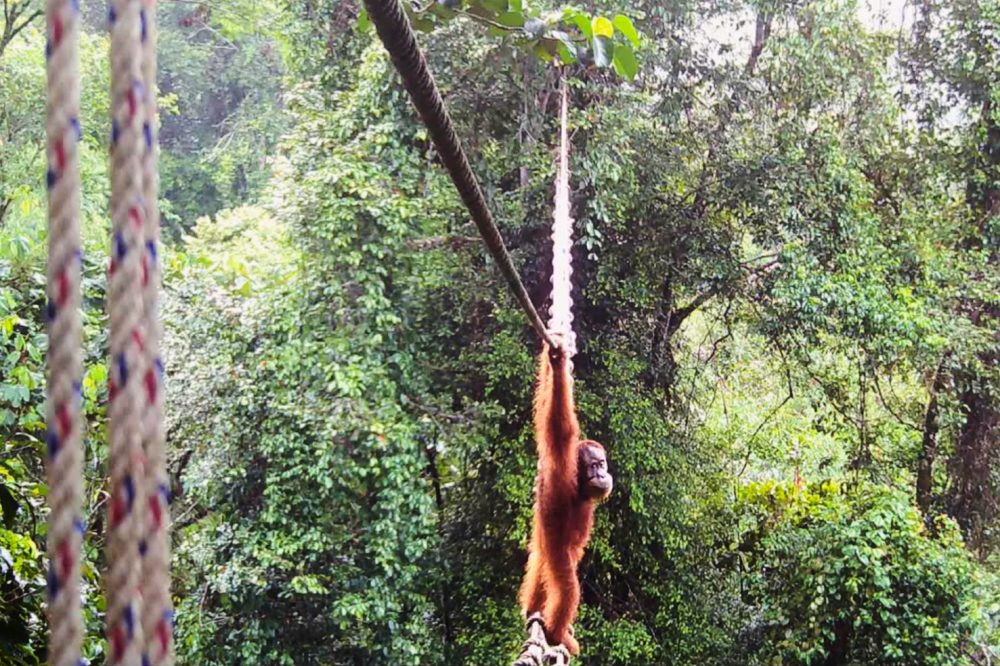

JAKARTA, Indonesia (AP) — Wildlife conservationists celebrated a historic breakthrough Monday after motion-activated cameras documented a critically endangered Sumatran orangutan successfully navigating an artificial rope bridge over a busy public roadway.
The remarkable footage shows the young primate hesitating at the forest boundary before carefully grasping the rope structure and venturing into the open space above the road. The orangutan paused midway across to peer down at the traffic below before completing the journey to the opposite side.
This groundbreaking event represents the first recorded instance of this near-extinct species utilizing a man-made crossing structure over a public thoroughfare, according to wildlife protection experts.
“This was the moment we had been waiting for,” Erwin Alamsyah Siregar, executive director of Indonesian conservation group Tangguh Hutan Khatulistiwa, or TaHuKah, told The Associated Press. “We are very grateful that the canopy here provides benefits for orangutan conservation efforts.”
The crossing structure stretches across the Lagan–Pagindar road in Pakpak Bharat district, an essential transportation route linking isolated communities to educational facilities, medical care, and government offices. However, this same roadway slices through critical orangutan territory, dividing approximately 350 individuals between two separate forest sections: the Siranggas Wildlife Reserve and the Sikulaping Protection Forest.
Road improvements completed in 2024 expanded the forest gap even further, destroying the natural pathways that tree-dwelling animals previously used for movement between habitats.
“Development was necessary for people,” Siregar said. “But without intervention, it would have left orangutans trapped on either side.”
TaHuKah partnered with the Sumatran Orangutan Society, or SOS, along with regional and federal agencies to implement an innovative approach: suspended rope pathways connecting trees on both sides, enabling arboreal species to travel safely above vehicle traffic.
Conservation teams installed five separate bridge structures, each equipped with surveillance cameras and strategically placed following comprehensive studies of nesting patterns, forest coverage, and wildlife movement corridors. Engineers designed the bridges to accommodate the substantial weight of these massive tree-dwelling mammals.
Researchers maintain constant surveillance through camera monitoring systems on each crossing point and conduct regular inspections to prevent illegal forest encroachment. Wildlife experts remain optimistic that additional orangutans will follow this trailblazer’s example.
The team waited two full years before witnessing the first orangutan crossing attempt. Initially, only smaller wildlife species utilized the structures, with cameras documenting squirrels, langur monkeys, and macaques, followed eventually by gibbons — indicating growing acceptance among primates.
The orangutan’s behavior showed much more caution, constructing sleeping nests in proximity to the bridge, spending time at the crossing edges, and gradually testing the rope strength over extended periods.
“They observe,” Siregar said. “They don’t rush. They watch, they try, they retreat. Only when they’re certain it’s safe do they move.”
Eventually, the breakthrough moment arrived when one individual completed the full crossing — marking not only a Sumatran first, but the initial documented case worldwide of the species traversing a public roadway via artificial means, according to conservation organizations.
While similar crossing structures have facilitated orangutan movement in other locations, these typically span waterways or private logging roads. Public highways present significantly greater obstacles due to constant noise, heavy traffic, and unpredictable conditions, conservationists explain.
The consequences of habitat isolation are severe for orangutan populations. Separation results in inbreeding, genetic deterioration, and ultimate population extinction. Reconnecting fragmented territories provides essential survival opportunities.
These great apes once inhabited extensive regions throughout southern Asia but currently exist only on Sumatra and Borneo islands. Current population estimates indicate fewer than 14,000 Sumatran orangutans survive in natural habitats, along with approximately 800 Tapanuli orangutans and roughly 104,700 Bornean orangutans, based on conservation data.
“These bridges allow orangutans to move, to mix, to maintain healthy populations,” Siregar said. “It reduces the risk of extinction.”