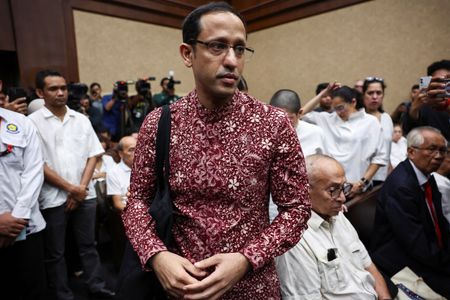

A court in Jakarta is set to deliver its verdict Tuesday in a closely watched corruption case against Nadiem Makarim, the 41-year-old former Indonesian education minister and co-founder of the country’s largest tech startup, Gojek. Prosecutors accuse him of abusing his official authority to line his own pockets.
The ruling brings to a close a legal battle that has stretched on for months, attracting attention from prominent international figures and stoking fears that Indonesia’s judicial system may be serving political interests rather than justice.
According to prosecutors, Makarim personally profited from irregular laptop procurement deals carried out during the COVID-19 pandemic, resulting in roughly $125 million in losses to the Indonesian government.
Prosecutors are pushing for an 18-year prison term and demanding he pay approximately 5.6 trillion rupiah — equivalent to around $314 million — in fines and restitution. If convicted, this could rank among the most significant legal proceedings ever brought against a former Indonesian cabinet minister.
Makarim stepped down as chief executive of Gojek in 2019 to take on the role of education minister, a position he held until 2024. Prosecutors allege that between 2020 and 2022, he steered the procurement of Chromebook laptops and Chrome OS software for Indonesian schools in a way that enriched him by approximately 809 billion rupiah, or around $46.33 million.
Prosecutors further claimed that Makarim crafted tender requirements designed exclusively for the Chrome platform in order to, in their words, “make Google the sole controller of the education ecosystem in Indonesia.” They also argued that Google’s investment in Gojek’s parent company played a role in the laptop procurement decisions.
Google has not been charged in the case. Makarim has denied any connection between Google’s investment in Gojek and the procurement process. In January, Google stated that its investments in Gojek-related companies took place between 2017 and 2021 — before Makarim was appointed education minister.
Legal experts have raised serious doubts about the case. Tim Lindsey, a law professor at the University of Melbourne who has spent years studying Indonesia’s legal system, said the charges — which allege Makarim’s decisions caused losses to the state — rely on a legal standard that is frequently applied too broadly, blurring the line between corruption and simply taking risks or being inefficient.
“This is a huge expansion of the notion of corruption, way beyond what most people and most legal systems would consider corrupt,” Lindsey said.
He also cautioned that allowing politics to seep into legal proceedings is damaging Indonesia’s standing on the world stage. “These sorts of prosecutions, combined with the increasing intrusion of the state into the commercial sector, are contributing to damage to Indonesia’s reputation among investors,” he added.
The case has drawn sharp criticism from international figures. British billionaire Richard Branson wrote on LinkedIn that Makarim “should be celebrated for what he achieved, not prosecuted on trumped-up charges that seem politically motivated.”
In a recent interview, Makarim — a Harvard Business School graduate — maintained that he is innocent and described his situation as a warning to others. “My case is scary for young people, for public officials, for procurement officers, for investors,” he said.
Makarim, who was arrested in September, reflected on his ordeal in a LinkedIn post last week, writing through his legal team: “It’s been more than nine months since this nightmare began.”
He has said he will appeal if the court finds him guilty, adding: “I’m ready for the worst.”
($1 = 17,835 rupiah)