
NEW DELHI (AP) — What started as a joke on the internet has transformed into one of the most significant youth-led protest movements India has seen in years, with young people pushing for sweeping changes to the country’s political establishment and holding the government responsible for what they see as widespread failures.
Young Indians who call themselves the “Cockroaches” are directing their frustration over a broken education system into a wider campaign demanding government accountability — and in the process, they have mounted one of the most visible public challenges in recent memory to Prime Minister Narendra Modi’s Hindu nationalist government.
Here is a breakdown of what’s happening and why it matters:
The protests were ignited by public outrage over alleged leaks of some of India’s most fiercely competitive entrance exams, which determine admission to medical schools and access to government jobs. For millions of Indians, these exams represent a route to stable careers and a better life. When allegations of advance leaks surface, authorities are often forced to cancel or reschedule the tests, leaving students who spent months or even years preparing with nothing but uncertainty.
The movement’s origins trace back to May, when India’s Supreme Court Chief Justice Surya Kant, during an unrelated court proceeding, compared certain unemployed young people to “cockroaches.” The comment ignited a fierce backlash online, which led Boston University student Abhijeet Dipke to launch what he called the Cockroach Janta Party — or Cockroach People’s Party.
Rather than being insulted, many young Indians reclaimed the label as a symbol of toughness and survival. The campaign spread rapidly across social media, drawing more than 21 million Instagram followers in just a matter of days. Supporters flooded platforms with memes, mock political slogans, and sharp satire directed at Modi’s government over unemployment, scarce job prospects, and economic hardship.
The movement shifted from online to the streets in June, when Dipke returned to India from the United States and began organizing demonstrations at cities and university campuses that drew crowds of hundreds. A planned sit-in at Jantar Mantar — a well-known protest location in New Delhi — captured attention across the country.
Since that point, protesters have called for the resignation of Education Minister Dharmendra Pradhan, demanded reforms to the examination system, and sought compensation for the families of students who died by suicide following the exam paper leak scandals.
The New Delhi sit-in started with a few hundred daily participants but eventually swelled into the thousands. The movement gained additional momentum when prominent activist Sonam Wangchuk joined the demonstration and began a hunger strike that stretched more than three weeks. Police forcibly removed Wangchuk and transferred him to a hospital over the weekend.
As the protests have grown, they have come to represent deeper frustrations about government accountability and the future facing young people in India. Many demonstrators say they no longer trust key institutions — including the education system, political leadership, the courts, and the press.
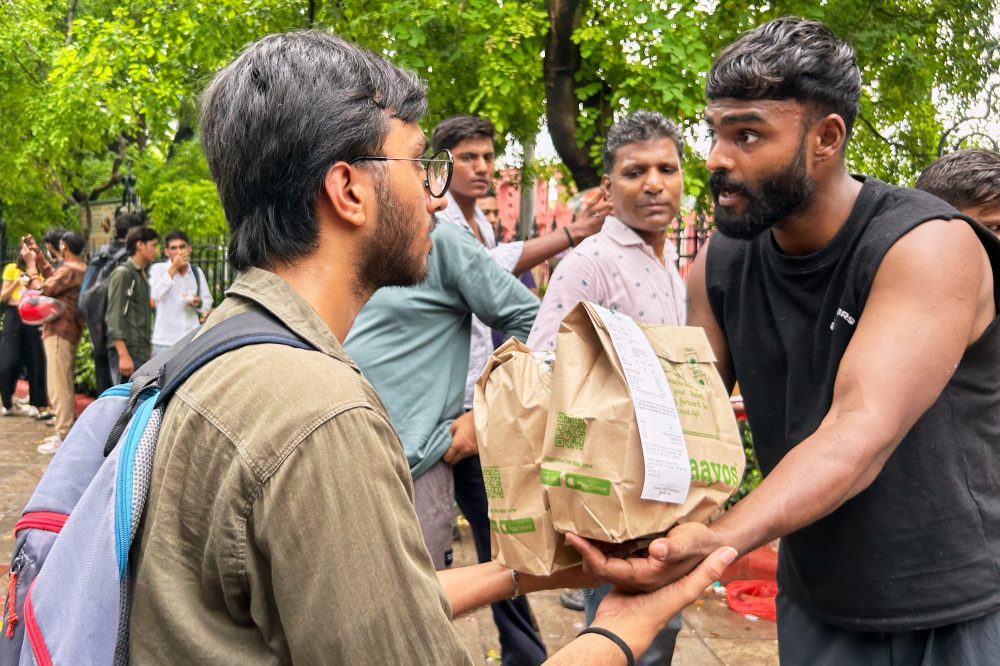
The movement has also drawn in professionals and parents who are not part of the core student base. Supporters from around India have even ordered food online and instructed delivery services to share it with anyone gathered at the protest sites.
Part of the movement’s broad appeal comes from the fact that it operates without a traditional political party structure. Organizers say participants pay their own way to protests and rely on social media rather than any central organization for coordination.
Initially, the government dismissed protesters’ demands and refused to engage in talks. Pradhan, the education minister, accused demonstrators of acting against the national interest and argued the crisis had already been resolved by ordering new examinations.
That official position began to change only after tensions escalated. Police deployed tear gas and batons after thousands of protesters on Monday attempted to push through security barriers during a march toward Parliament, which had just reconvened for its monsoon session.
The crackdown fueled public anger. A government minister eventually met with movement representatives in the first sign of outreach from officials, but the discussions failed to calm the situation.
Pressure intensified further after opposition leader Rahul Gandhi staged his own sit-in outside Modi’s residence on Tuesday, pushing the Cockroach movement to the forefront of India’s political debate.
Facing mounting pressure, Pradhan stated that the government was committed to “addressing every genuine concern of our youth” during the current Parliament session, though he stopped short of saying whether he would step down — which remains the protesters’ central demand.
The rapid expansion of the movement beyond student circles reflects a deepening sense of frustration among India’s young people and mirrors a broader pattern across South Asia, where youth have been at the heart of anti-government movements in recent years.
Although India’s opposition parties remain fractured and room for political dissent has narrowed under Modi, his government now faces the unusual challenge of confronting a leaderless, decentralized movement of young people rather than a traditional political opponent.
Opposition parties and rights advocates have expressed support for the campaign, framing it as a fight for democratic accountability and the freedom to protest peacefully. The movement has also handed India’s opposition a powerful platform to connect with younger voters while putting pressure on Modi’s government from multiple directions.
With hundreds of millions of voters under the age of 35 — including millions casting ballots for the first time — India’s youth represent a critical voting bloc. Their growing disillusionment could carry significant political consequences heading into future elections.