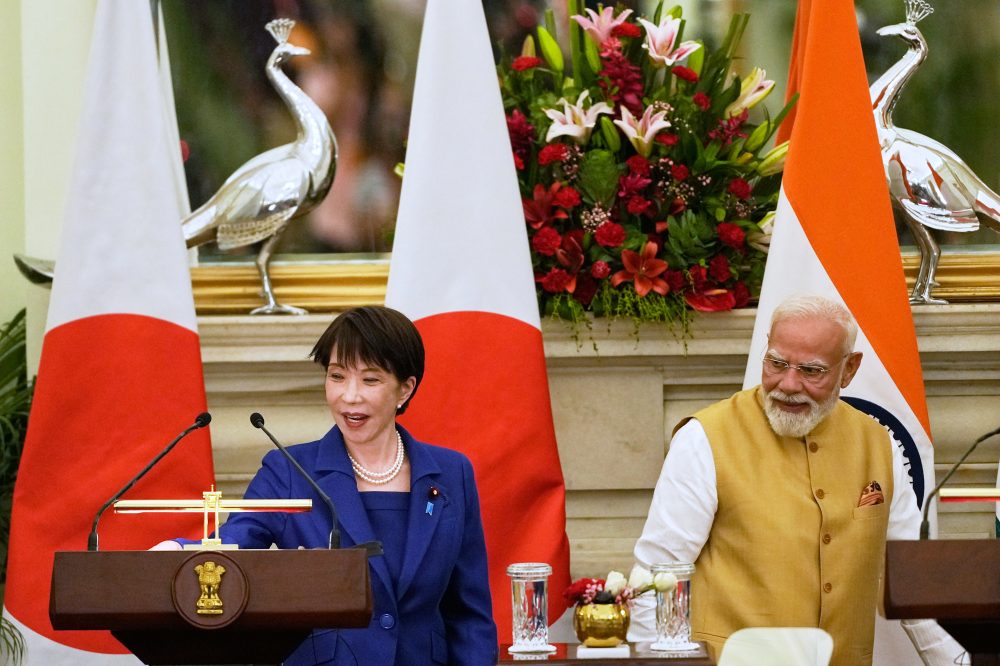

NEW DELHI (AP) — India and Japan have announced a set of new agreements aimed at deepening their cooperation in defense, economic security, and maritime affairs following high-level talks held Thursday in New Delhi between Indian Prime Minister Narendra Modi and Japanese Prime Minister Sanae Takaichi.
After the meeting concluded, Modi told reporters that the two nations would work together on naval radio antenna systems and had adopted a joint road map focused on economic security. He added that both leaders agreed to boost cooperation across several sectors, including artificial intelligence, shipbuilding, biogas, semiconductors, and other critical technologies.
“India and Japan view economic security as a shared security interest,” Modi said.
Japan ranks among India’s biggest foreign investors and has supported major infrastructure developments in the country, including a high-speed rail line connecting Mumbai and Ahmedabad. Roughly 1,400 Japanese companies currently operate in India, with nearly half of them engaged in manufacturing.
According to Indian government figures, trade between the two countries reached $27.5 billion during India’s 2025-26 fiscal year, while Japanese investment totaled $3.2 billion between April and December 2025.
Takaichi traveled to New Delhi for a three-day visit centered on the 16th annual India-Japan summit. The visit builds on momentum from Modi’s trip to Tokyo last year, during which Japan committed to more than doubling its investment in India to over $61 billion across the next decade. Both nations are looking to strengthen their partnership throughout the Indo-Pacific region.
India and Japan are both members of the Quad, alongside the United States and Australia. The grouping focuses on regional security, maritime cooperation, and defense matters, particularly in response to China’s expanding influence in the Indo-Pacific.
Takaichi emphasized that both New Delhi and Tokyo are committed to a free and open Indo-Pacific, grounded in freedom of navigation and respect for international law. “Expansion of maritime security cooperation is especially important for regional peace and stability,” she said.
When asked about the initiative, Chinese Foreign Ministry spokesperson Guo Jiakun responded Thursday that certain countries were promoting “freedom and openness” while actually pursuing “confrontation and division.” He argued that such an approach contradicts what the region truly wants.
“Asia-Pacific needs stability, not turmoil; focus on cooperation, not division,” Guo said during a regular press briefing held in Beijing.