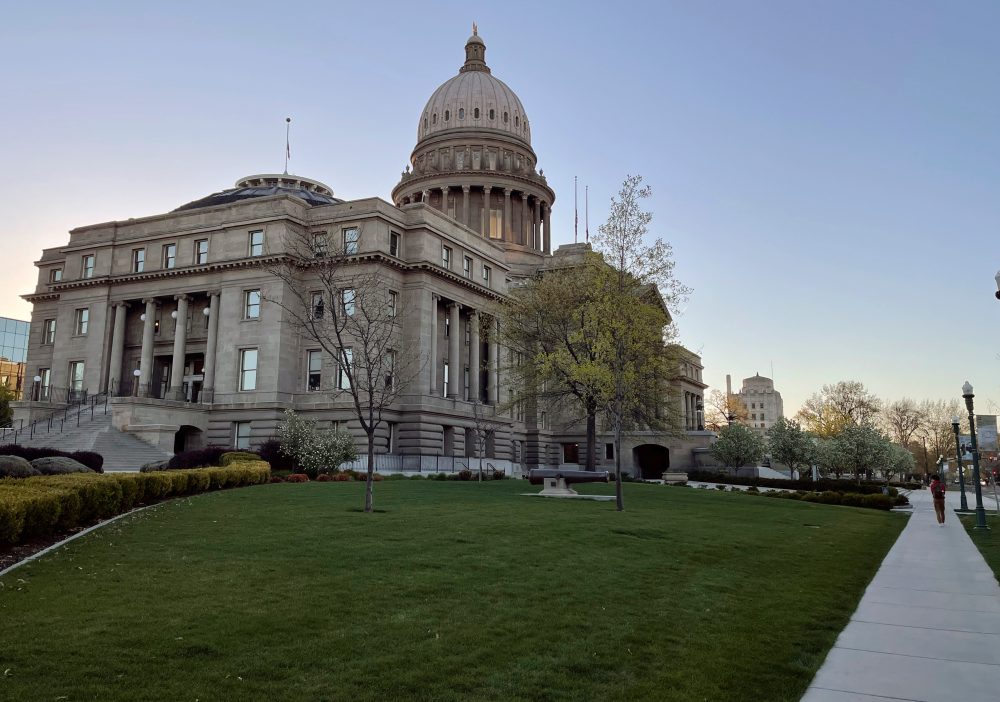

BOISE, Idaho — Idaho’s legislature is weighing legislation that would establish criminal penalties for transgender individuals who use restrooms corresponding to their gender identity, extending the reach into privately-owned establishments.
While 19 states, including Idaho, have already enacted restrictions preventing transgender people from accessing bathrooms and changing facilities that correspond to their gender in educational institutions and some government buildings, this proposed Idaho measure goes further. According to tracking data from the Movement Advancement Project, an LGBTQ+ advocacy group, only Florida, Kansas and Utah have established criminal consequences for violating such restrictions.
However, Idaho’s proposal stands apart by encompassing any “place of public accommodation,” which includes virtually any business or establishment serving customers. The Republican-dominated Senate is anticipated to decide this week whether to advance the measure to Governor Brad Little.
Should the legislation become law, individuals entering restrooms or locker rooms designated for the opposite sex would face up to one year behind bars for an initial misdemeanor violation, with subsequent offenses carrying felony charges punishable by up to five years imprisonment. These penalties exceed Idaho’s sentencing guidelines for first-time DUI offenses or public display of obscene materials.
Republican Senator Ben Toews defended the measure before a Senate panel last week, describing the protection of these spaces as essential for “safety” and “decency.”
“Private spaces such as restrooms, changing areas and showers are sex-separated for a reason,” Toews said. “Individuals in these vulnerable settings have a reasonable expectation of privacy and security.”
The legislation includes specific exemptions for athletic coaches, emergency responders, corrections personnel overseeing inmates, maintenance workers, and individuals assisting children with bathroom needs. An additional provision allows bathroom use by someone “in dire need” when no other facility is reasonably accessible.
Multiple law enforcement organizations, including the Idaho Fraternal Order of Police and Idaho Chiefs of Police Association, have voiced opposition to the bill. They argue it would create impossible enforcement scenarios, requiring officers to make visual determinations about biological sex or assess someone’s level of urgent need. The Idaho Sheriff’s Association requested that lawmakers mandate asking suspected violators to leave before involving police, but this suggestion was rejected.
Heron Greenesmith, deputy policy director at Transgender Law Center, criticized the “dire need” exception as particularly problematic and dehumanizing, questioning the practicality of emergency-only restroom access.
“How does one prove that one was going to poop on the floor?” they asked.
John Bueno, a transgender University of Idaho student and Queer Inclusion Society member, acknowledged that campus single-use facilities help address logistical concerns but warned the legislation would increase unwanted scrutiny of all individuals, transgender or not.
“It’s this cultural attitude of getting other Americans to habitually be narcing on one other and doing this sort of ‘transvestigating’ — that is what these kinds of bills promote,” Bueno said.
Bueno characterized the effort as targeting transgender people for disenfranchisement.
“This will increasingly deter queer individuals from Idaho universities and the state as a whole,” she said. “Which to be fair, is probably the primary purpose.”
Nikson Matthews, a bearded transgender man, testified before lawmakers that the legislation would compel him to use women’s facilities, where his masculine presentation could provoke hostile reactions from others who perceive him as an intruder.
“It creates a crime — but that is not based on conduct or harm,” Matthews said. “It is based on presence, and to justify that you have to accept that someone’s presence alone is traumatizing and harmful enough to criminalize.”
Boise resident Laura Volgert highlighted workplace implications for transgender employees.
“People might be able to hold it for an hour if they’re at a restaurant for lunch or at a grocery store,” she told lawmakers during a committee hearing. “They can’t be expected to hold it for a full eight-hour shift.”
Greenesmith suggested this represents the intended outcome of such legislation, designed to “make it untenable to go to the movies, to go to the doctor, to go to the bank.”
Supporters reject this characterization.
Sandpoint resident Suzanne Tabert argued the bill focuses on “maintaining, clear, enforceable boundaries” to ensure women and children feel secure.
“If we lose the ability to protect based on biological sex, we lose our most effective tool for preventing harassment, voyeurism and other sex crimes before they occur,” she said.
She later continued, “This legislation is not about how an individual identifies, nor does it seek to target or malign the transgender community. Rather it upholds a universal standard of privacy.”
Restroom restrictions represent just one area where legislators have imposed limitations on transgender individuals under the banner of protecting women and girls. At least 25 states prohibit transgender women and girls from participating in certain women’s athletic competitions, while 27 states have enacted laws limiting or prohibiting gender-affirming medical care for minors.
President Donald Trump has indicated support for expanding these policies nationwide.
The sole widely documented arrest under transgender bathroom restrictions occurred during a Florida protest last year.