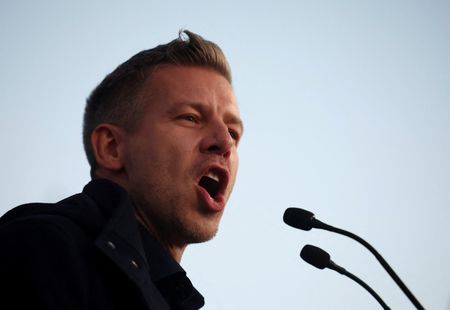

Hungary’s April 12 election represents a critical decision point for the nation’s future direction, according to opposition leader Peter Magyar, who frames the choice as one between European integration and alignment with authoritarian governments.
Magyar leads the centre-right Tisza party, which polling shows has gained ground against nationalist Prime Minister Viktor Orban, who has maintained control for 16 years while promoting what he terms “illiberal democracy.”
Speaking during a campaign stop in Salgotarjan, a former mining community, Magyar criticized Orban’s close relationships with Russia and former Soviet nations like Kazakhstan and Azerbaijan. He also questioned Hungary’s decision to gain observer membership in the Organisation of Turkic States.
“This will be a referendum: I think it is clear that the choice is between Europe or the Turkic council and dictators,” Magyar stated following a rally that drew hundreds despite cold conditions. “It is about whether Hungary continues these 16 years of decline … or we set off to Europe and development, joining the Poles, Slovenians, Czechs and the Baltic states.”
Orban has defended his approach by positioning Hungary as a connector between “Eastern traditions and Western institutions,” arguing for pragmatic pursuit of economic opportunities.
A major campaign issue involves approximately 17 billion euros in European Union funding that has been withheld due to concerns about rule-of-law violations under Orban’s administration. Nearly 11 billion euros remains available under the EU’s Recovery and Resilience Facility, but access expires at the end of August.
Magyar pledged that his administration would quickly negotiate with Brussels to unlock these suspended funds by addressing rule-of-law requirements. “I very much hope that we will be able to sign a deal quickly and after an agreement in principle, perhaps even before the legislation is approved, they can start disbursing the funds,” he explained.
Financial markets have responded positively to the possibility of a Tisza victory, with Hungary’s forint currency strengthening partly due to expectations of renewed EU funding access, according to analysts.
Regarding international relations, Magyar promised to pursue “constructive and friendly” ties with the United States under the Trump administration. “Europe is in a very difficult situation economically, socially and in security policy, so we must work together with the Trump administration … and I will seek the same,” he said.
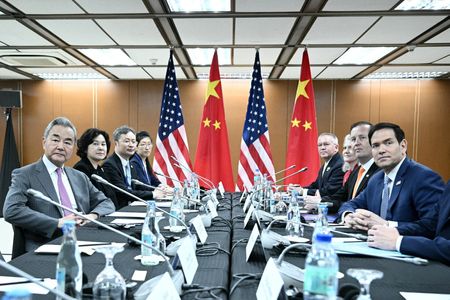
President Trump has publicly backed Orban as “a truly strong and powerful Leader,” while Secretary of State Marco Rubio described U.S.-Hungary relations under Orban as entering a “golden era.”
On the Ukraine conflict, Magyar expressed optimism about achieving a ceasefire “perhaps even before the Hungarian elections,” followed by a comprehensive peace agreement with international security guarantees for Ukraine. However, ongoing Trump administration mediation efforts between Moscow and Kyiv have not yet produced signs of ending the four-year war.
Orban has characterized the election as a fundamental choice between “war or peace,” claiming through state-controlled television that Tisza would involve Hungary in the Ukraine war. Magyar’s party disputes this characterization.
Magyar clarified that while a Tisza government would not deploy troops or weapons to Ukraine, it “would support the peace process.”
The election outcome will also serve as an indicator for far-right movements across Europe as the EU confronts challenges including an increasingly aggressive Russia, the ongoing Ukraine war, and diplomatic complexities arising from Trump’s “Make America Great Again” agenda.