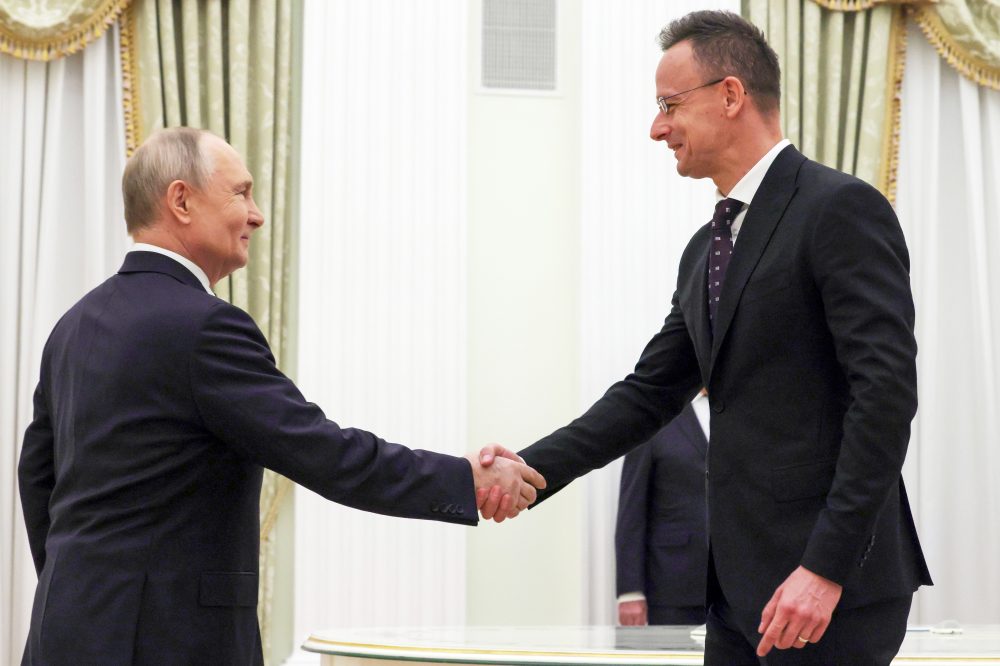

BUDAPEST, Hungary — Hungary’s Foreign Minister Péter Szijjártó leveled accusations against Ukraine on Friday, claiming the neighboring country is attempting to meddle in Hungary’s upcoming elections where Prime Minister Viktor Orbán confronts his most significant political challenge to date.
Szijjártó delivered his remarks to hundreds of demonstrators gathered outside Ukraine’s embassy in Budapest. The rally was coordinated by a mysterious pro-government group connected to Orbán’s Fidesz party, occurring on the same day Hungarian authorities arrested seven employees of a Ukrainian state bank and confiscated two armored vehicles transporting approximately $80 million in cash. Ukrainian officials condemned the action as unlawful hostage-taking.
During his address to the crowd, Szijjártó presented multiple unproven claims, including assertions that Ukraine had been working alongside the European Union and Orbán’s political opponents to prevent Russian oil deliveries to Hungary through the Druzhba pipeline.
The crowd responded with outrage when Szijjártó claimed Ukraine was attempting to sway Hungary’s April elections to install a government more sympathetic to Ukrainian interests.
“This is something that will not happen in Hungary. There will be no pro-Ukraine government, and Hungary will not have a pro-Ukraine prime minister,” Szijjártó declared.
“Ukraine is fighting for itself, not for us and not in place of us, so we owe absolutely nothing to Ukraine,” he stated.
The rally, featuring speeches from additional ruling party officials, unfolded amid deteriorating relations between Hungary and Ukraine, as both nations remain locked in a contentious dispute over Hungary’s access to Russian petroleum through a pipeline traversing Ukrainian soil.
Petroleum deliveries via the Druzhba pipeline have been halted since January 27. Ukrainian officials report that Russian drone attacks damaged pipeline infrastructure, with repairs posing safety hazards to workers. They noted that even if restored, the system would remain susceptible to additional Russian strikes.
Hungarian leadership has blamed Ukraine for intentionally blocking Russian crude deliveries and pledged severe countermeasures against Kyiv until petroleum flows restart.
Orbán, who has preserved strong ties with the Kremlin while intensifying an aggressive anti-Ukraine campaign before next month’s election, has labeled Ukraine Hungary’s “enemy,” and claimed Ukrainian President Volodymyr Zelenskyy is attempting to trigger an energy crisis to influence the April 12 vote.
The Hungarian leader has previously halted diesel exports to Ukraine, blocked new EU sanctions against Russia, and prevented a substantial 90-billion-euro ($106-billion) loan to Kyiv in response to the oil supply disruption. He has also positioned military personnel at crucial energy facilities throughout Hungary, alleging Ukraine is planning sabotage operations.
Currently behind in most polling data against a well-regarded center-right opponent, the populist Orbán has centered his campaign on persuading voters that Ukraine represents a fundamental threat to Hungarian security.
Serving since 2010, the European Union’s most tenured leader has argued that losing the election would result in the EU forcing Hungary into financial ruin by eliminating Russian energy imports, and that Hungarian young people would face death on Ukrainian battlefields.
Szijjártó, Hungary’s foreign minister, visited Moscow on Wednesday for a friendly meeting with Russian President Vladimir Putin, seeking assurances from Russian officials that Hungary would maintain access to Russian oil and gas despite disruptions from the Middle East conflict and Druzhba pipeline interruptions.
On Friday, he characterized Ukraine as imposing an “oil blockade” designed to benefit Orbán’s electoral opponent ahead of the vote.
“They know precisely that if there is a crisis in Hungary’s oil supply … it is bad for the government,” he remarked.