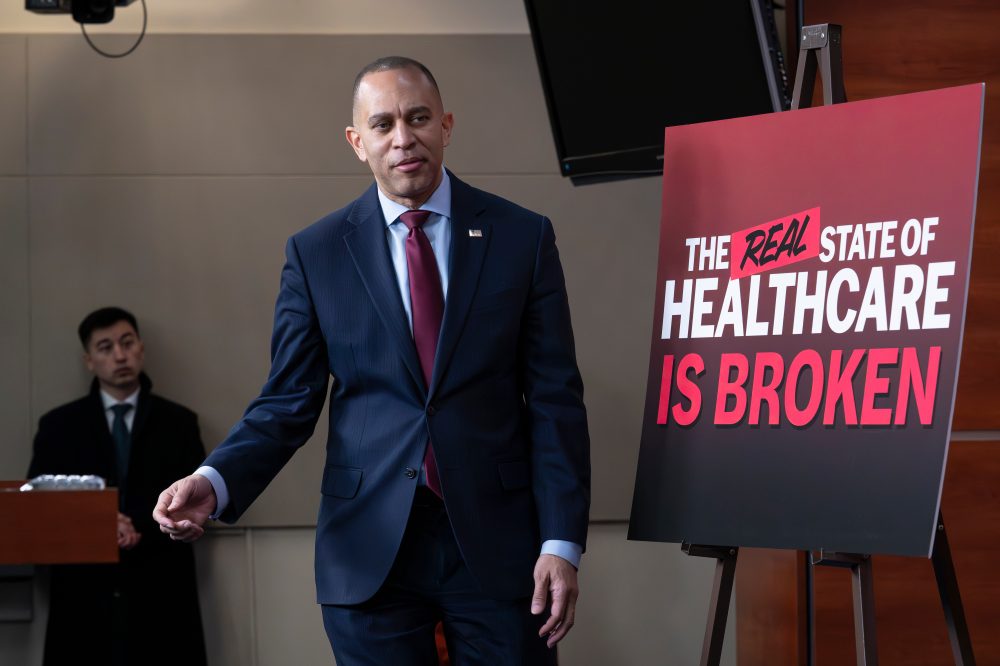

At a Virginia resort this week, House Democrats projected optimism about their chances of winning back control in November while working to craft their legislative priorities.
“We’re here at this issues conference to talk amongst each other and with outside stakeholders and experts about a bold, meaningful, transformational path forward,” House Democratic leader Hakeem Jeffries of New York stated.
Following a difficult 2024 election cycle, many Democratic lawmakers believe rising living expenses and public dissatisfaction with President Donald Trump’s second administration have created favorable conditions for them to regain the House majority. However, behind their optimistic outlook lies a significant challenge: creating a cohesive policy platform that can unite a party experiencing both generational shifts and ideological divisions.
Should Democrats win control, they would immediately gain subpoena authority to investigate the Republican administration – power they currently lack as the minority party. Yet while members align on key voter concerns including affordability, immigration enforcement, and countering Trump, divisions persist between the party’s progressive and moderate factions.
“We can’t be just anti-Trump,” Michigan Rep. Debbie Dingell, the caucus’ policy leader, emphasized. “We have to have an agenda.”
Internal party disagreements became apparent during the 2024 campaign and afterward as Democrats debated messaging strategies on immigration, economic issues, and foreign policy matters. However, these disputes diminished when Trump assumed office and began rapidly advancing his priorities, prompting Democrats to unite in opposition.
House Democrats have coordinated their resistance to Trump’s initiatives, successfully pushing votes against tariffs and demanding the public release of Justice Department documents concerning Jeffrey Epstein.
“We have become the most effective minority party in U.S. history,” California Rep. Ted Lieu, vice chair of the House Democratic Caucus, declared.
After spending over three years in the minority, Democrats argue the political landscape is changing in their favor. They cite November’s California ballot measure on congressional redistricting and strong Democratic gubernatorial showings in Virginia and New Jersey as positive indicators.
Democrats also point to recent victories, including flipping a Texas state Senate seat this month in a district Trump carried by 17 points in 2024.
“It’s going to be a sprint” to November 3rd Election Day, Jeffries noted. “House Democrats are on the verge of a takeover.”
Regaining House control would grant Democrats immediate oversight capabilities. Committee chairpersons would obtain subpoena power and authority to compel witness testimony – tools leadership pledges to use aggressively in examining the administration.
“Make no mistake, oversight will be muscular and significant,” Colorado Rep. Joe Neguse, a House Judiciary Committee member, stated.
California Rep. Pete Aguilar, House Democratic Caucus leader, described the oversight opportunities as “a target-rich environment” while acknowledging that investigations alone won’t suffice.
The Department of Homeland Security funding dispute has demonstrated how opposition can unite the caucus, with Democrats maintaining solidarity while leveraging their position to demand accountability measures.
Nevertheless, internal divisions persist.
Progressive members including Reps. Alexandria Ocasio-Cortez of New York, Ilhan Omar of Minnesota, and Ayanna Pressley of Massachusetts have advocated eliminating U.S. Immigration and Customs Enforcement entirely. Party leadership and centrist members prefer substantial reforms instead, creating potential friction points.
“We cannot allow a federal agency — one that was created for one purpose to terrorize — to function as an occupying force in our communities,” Omar said during House floor remarks this month. “Real accountability starts with abolishing ICE.”
Previous government shutdown negotiations highlighted how compromise can test party unity. When Democratic senators agreed to reopen government without securing health care subsidy extensions, progressive members responded with sharp criticism.
“The American people asked us over and over to fight for health care and to lower our costs overall,” Sen. Elizabeth Warren, D-Mass., said at the time. “Obviously that broke apart at the end.”
The week’s policy gathering concluded with limited concrete details about the “bold, meaningful, transformational path forward” Jeffries initially described. Instead, members focused on broad priorities – reducing costs, preserving health care, and contrasting with Trump – while deferring specifics.
“That’s the work that we’re still to do,” Illinois Rep. Nikki Budzinski responded when asked about potential first legislation under Democratic control. “We’ve rolled out nine different frameworks. All of them are equally important, I think, to address affordability, which is our coalition’s goal. It’s hard to say that there’s one silver bullet.”
Historical precedent shows Democrats often finalize campaign messages closer to elections. Their “Six for ’06” platform wasn’t revealed until fall 2006, weeks before winning the majority. In 2018, the party campaigned on “For the People” themes months before converting them into legislation.
“I expect to refresh our core message frame ahead of a closing argument for this fall,” Illinois Rep. Lauren Underwood explained. “The closing argument was 6 for ’06. Closing argument in 2018 was ‘For the People,’ right? So, we’re going to have a closing argument message frame that you all be delighted and wowed by as we head into the fall election season.”
As Democrats grow more confident about reclaiming the majority, developing their agenda becomes increasingly urgent. While oversight may provide immediate tools for a new majority, maintaining power and influencing the party’s long-term direction will require more comprehensive strategies than investigations alone.
“What we tell our members and what we tell candidates who are running is we have to do all of the things,” Aguilar concluded. “We have to do oversight and accountability, and we have to talk about the affordability agenda and how we’re going to make life better for people if we are given the opportunity to lead.”