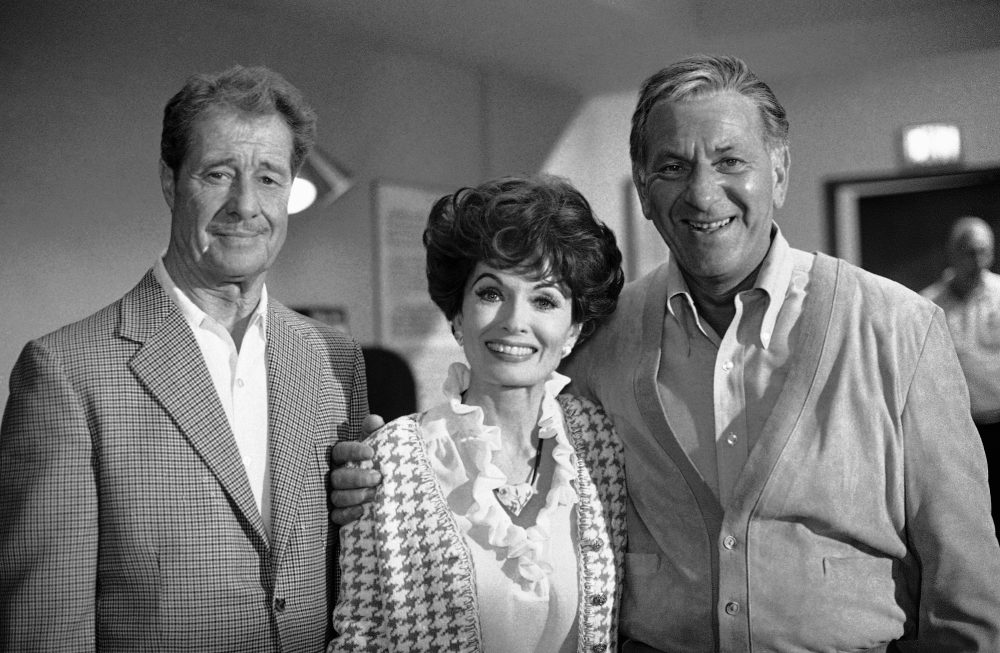

LOS ANGELES — Ann Blyth, a gifted actress and singer who earned an Academy Award nomination at just 17 years old for her unforgettable performance in “Mildred Pierce” alongside Joan Crawford, has passed away. She was 98 years old.
Her daughter, Eileen McNulty, confirmed that Blyth died Wednesday from natural causes at her residence in Rancho Santa Fe, California. Her family was gathered around her at the time of her passing.
Considered one of the final living links to Hollywood’s golden studio era, Blyth built a remarkable career that spanned youth pictures, dramatic films, and big-screen musicals. She shared the screen with some of cinema’s biggest names, including Bing Crosby, Gregory Peck, and Robert Mitchum. By the close of the 1950s, she had stepped away from film to focus on raising her children, though she continued performing in television productions, concert tours, and stage musicals ranging from “Show Boat” to “The Sound of Music.”
Her path to stardom began early. At 13, she landed her first major role as Paul Lukas’s daughter in Lillian Hellman’s anti-Nazi stage play “Watch on the Rhine,” which also featured Bette Davis. She spent nearly a year performing the show on Broadway, followed by another year on a national tour.
When the production traveled to Los Angeles, Universal Studio took notice and signed her to a contract at $175 per week. The dark-haired young actress with a naturally melodic singing voice went on to appear alongside a young Donald O’Connor in modest musical productions such as “Chip Off the Old Block” and “Bowery to Broadway.” It was a loan-out to Warner Bros. for “Mildred Pierce” that truly launched her career into a higher orbit and opened the door to more mature roles.
Much like “Double Indemnity,” which Billy Wilder adapted for the screen in 1944, “Mildred Pierce” was rooted in a James M. Cain thriller built around themes of revenge and scheming. Crawford took home the 1945 Oscar for Best Actress, playing a waitress who climbs her way to restaurant ownership. Blyth received a supporting actress nomination for her portrayal of Mildred’s spoiled and calculating daughter, Veda, who seduces her mother’s second husband — played by Zachary Scott — and then shoots him in a fit of jealous fury.
The film was directed by Michael Curtiz, the same filmmaker behind “Casablanca,” and stands as a celebrated example of film noir, set largely in shadowy nighttime scenes. For Blyth, the role was a sharp departure from the lighthearted musicals that had defined her early work — especially striking given that magazine profiles of her had carried titles like “Incorruptible!”, “Angelic Annie,” and “Ann Blyth: Success Without an Enemy.”
In 1946, her career was nearly derailed when she broke her back in a toboggan accident. She endured seven months confined to a body cast and another seven months in a wheelchair. During that difficult stretch, she leaned heavily on her Roman Catholic faith.
“The busy, exciting world I had known faded away, and my life slowed down to little things,” she once told The Associated Press. “But even here I found myself blessed, for a new sense of prayer began to unfold to me.”
After her recovery, she returned to the screen in a series of films, including roles opposite Sonny Tufts in “Swell Guy,” Howard Duff in “Brute Force,” and Mickey Rooney in the boxing picture “Killer McCoy.” She also demonstrated her dramatic range playing a young woman in love with a man suspected of murdering his wife — portrayed by Charles Boyer — in “A Woman’s Vengeance.”
Her most compelling post-“Mildred Pierce” dramatic work came in “Another Part of the Forest,” Lillian Hellman’s prequel to her celebrated drama “The Little Foxes.” Blyth took on the role of a young Regina Hubbard, a character previously brought to life on Broadway by Tallulah Bankhead and on film by Bette Davis.
Her career shifted direction again in 1951 when she starred opposite Mario Lanza in “The Great Caruso.” Her bright soprano voice proved a natural complement to his powerful tenor, and the two were set to reunite for “The Student Prince.” However, the notoriously difficult Lanza withdrew from the project after recording his musical numbers, leaving British actor Edmund Purdom to appear on screen while lip-syncing to Lanza’s recordings. Blyth also co-starred with Howard Keel in “Rose Marie” and “Kismet.”
Among her other notable films were “Top o’ the Morning” with Bing Crosby, “The World in His Arms” with Gregory Peck, and a reunion with Donald O’Connor in “The Buster Keaton Story.” Her final film appearance came in 1957 with “The Helen Morgan Story,” which starred Paul Newman alongside her.
Blyth was born in 1928 in Mount Kisco, New York, to an Irish mother and an English father who worked as a valet. She grew up in New York City. After her father left the family, her mother — known as Nan Blyth — supported herself and her two daughters by taking in laundry and working in beauty parlors.
Nan Blyth had high aspirations for her daughter’s future in entertainment, and by age 5, young Ann was already performing on a New York radio program. She continued as a radio performer and spent three years studying and performing with the San Carlo Opera Company.
Reflecting on those early years after achieving fame, Blyth once said: “I’d become blue and despondent when I failed to get a job, and my mother’s encouraging words made me want to try again.” Tragically, her mother died of cancer before she witnessed her daughter’s breakthrough in “Mildred Pierce.”
In 1953, Blyth married Dr. James McNulty, the brother of tenor and comedian Dennis Day. The couple had five children and remained together until Dr. McNulty’s death in 2007. In a memorable moment in television history, Blyth performed the song “Secret Love” at the Academy Awards ceremony just weeks before the birth of her son Timothy in 1954 — visibly pregnant as she sang the lyrics, “Once I had a secret love … and my secret love’s no secret anymore.”