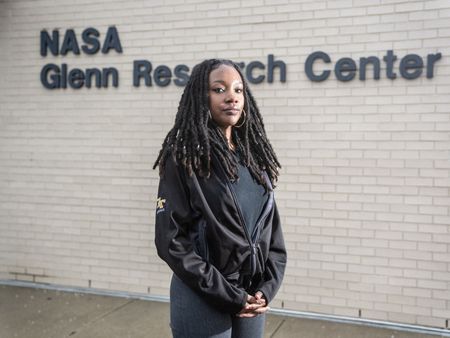

When Naia Butler-Craig was just 12 years old, she set her sights on becoming an astronaut. Every Sunday at St. Mark AME Church in Orlando, Florida, she would gaze at the framed photograph of Mae Jemison, the first Black woman to journey to space, reinforcing her dreams of reaching the stars.
Sixteen years later, now holding a PhD and working as a NASA aerospace engineer, Butler-Craig had the opportunity to meet Victor Glover, who would make history as the first Black man to pilot a spacecraft on a lunar mission. During their January 17 encounter, she told him about her aspirations to follow his path.
“Most people worry about making the right choice,” Butler-Craig remembered Glover telling her. “Make the choice right.”
Nearly three months after that conversation, Glover blasted off as part of NASA’s Artemis II mission, joining three other crew members on a journey that took them farther from Earth than any humans have ever traveled. The mission successfully circled the moon before returning safely.
For Butler-Craig, witnessing Glover’s achievement validated her own dreams and those of countless Black Americans who historically faced barriers in reaching the pinnacle of scientific and academic success due to racial discrimination.
“To see him live all of those facets of identity at the same time when that’s exactly the tension and the constant dichotomies I’m facing is incredibly validating,” she explained about Glover’s impact. “It just makes me feel like he’s paved the exact road for someone like me.”
Breaking Barriers Beyond Earth
While the current Trump administration moves to eliminate diversity, equity and inclusion initiatives throughout government and private industry, Glover’s historic achievement has generated widespread celebration on social media platforms. Many have highlighted its symbolic significance and historical importance in the ongoing story of Black excellence in aviation and space exploration.
“It’s a source of pride and joy because when you look at aerospace and space exploration, yes, we have some representation, but we don’t have enough representation,” explained Tennesse Garvey, a Boeing 777 pilot for United Airlines.
Garvey leads the board of the Organization of Black Aerospace Professionals, a nonprofit organization that has been mentoring and training minorities for aerospace and aviation careers since 1976. According to Garvey, two of Glover’s daughters previously participated in the organization’s inaugural week-long space academy program in Houston.
“It’s really inspirational to many other young children that are actually dreaming that dream,” he noted.
Since NASA announced its original seven Mercury astronauts in 1959, the agency has selected only 20 Black astronauts, comprising approximately 6% of all astronauts chosen by the space agency.
A Legacy of Achievement
Prior to his lunar voyage, Glover had already established himself in space exploration, spending nearly five and a half months in orbit starting in 2020 as the pilot for NASA’s Crew-1 mission, which marked the first operational International Space Station flight using SpaceX’s Crew Dragon spacecraft.
His background includes an extensive U.S. Navy career, during which he piloted more than 40 different aircraft and served in combat operations in Iraq. Throughout his military service, he logged approximately 3,000 flight hours, executed over 400 aircraft carrier landings, and completed 24 combat missions.
Despite being recognized as a groundbreaking figure, Glover expressed hope before the Artemis launch that “we are pushing the other direction, that one day we don’t have to talk about these firsts.”
Glover continues the tradition established by earlier Black aviation pioneers, including Lieutenant Colonel John William Mosley Jr., who served with the legendary Tuskegee Airmen, the segregated military unit that opened doors for Black Americans in U.S. military aviation.
“We’re all standing on the shoulders of the previous generation,” said William Eric Mosley, John’s son and a retired United Airlines pilot. “In my case, and I believe also in Captain Glover’s case, he would believe the same.”
Glover and his fellow crew members safely returned to Earth on Friday, splashing down in the Pacific Ocean near San Diego. Their successful mission establishes the foundation for the first crewed lunar landing since 1972, currently scheduled for 2028, and future space exploration endeavors.
While waiting for the crew’s safe return, Butler-Craig said she would be reflecting on the Bible verse tattooed on her arm from James 1:12.
“Blessed is the one who perseveres under trial because having stood the test, they will receive the crown of life.”