
BRUGES, Belgium (AP) — The sounds of rolling luggage on stone streets, motor boats navigating waterways, and tourists speaking multiple languages create the typical atmosphere of one of Belgium’s most visited destinations.
However, approximately two dozen women have discovered a peaceful retreat from the city’s chaos just beyond a small bridge, beneath a decorative archway bearing the Latin inscription “sauvegarde,” meaning “safe place.”
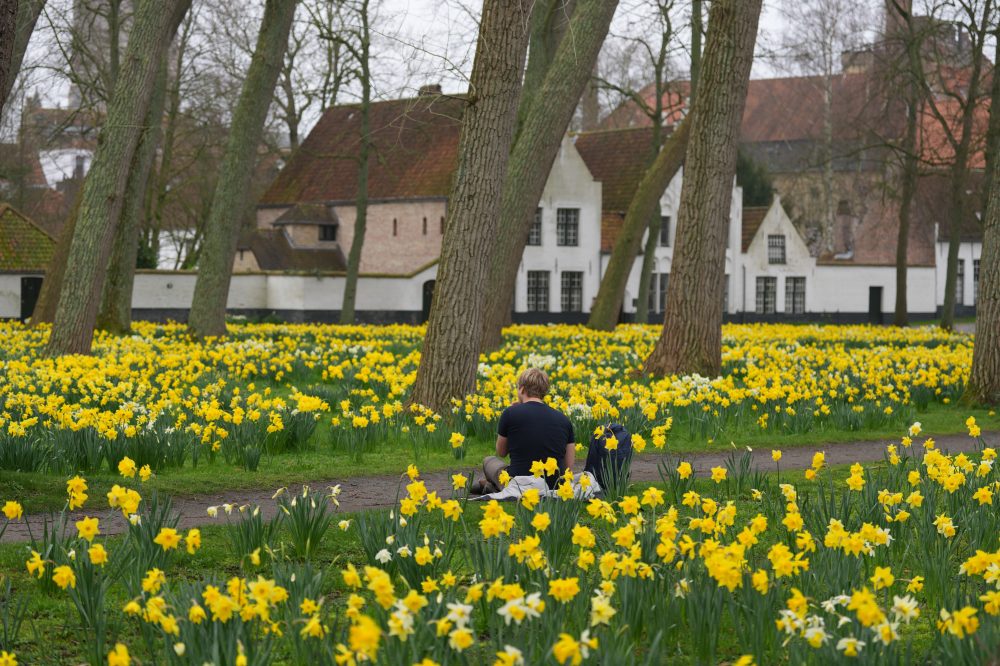
Surrounded by bright yellow daffodils sits a peaceful haven established in 1245: the Princely Beguinage Ten Wijngaerde of Bruges.
Trees Dewever has made this beguinage her residence for 22 years. She describes it as providing “an overwhelming feeling of calm and I think we need that in this world.”
Jo Verplaetsen, who has lived in the beguinage for 23 years, describes the medieval refuge’s atmosphere as both peaceful and welcoming.
“Each day you are thankful to be here,” she said.
Despite their current peaceful nature, beguinages originated after the 12th century as a response to tragedy.
Medieval warfare decimated men, leaving numerous widows and unmarried women seeking stability. Many preferred the flexible lifestyle of beguinages over the rigid requirements of convents, explained Michel Vanholder, a volunteer at the Grand Beguinage Church of Mechelen.
“They didn’t want to go become nuns but nevertheless they wanted to live together without men because there were not enough men to marry,” he said.
Residents known as beguines couldn’t marry while living in these communities, but maintained freedom to leave, could possess personal property, and weren’t bound by religious vows of celibacy and poverty required of nuns in nearby convents.
“Women who didn’t want to become real nuns or religious could have an in-between form, becoming a beguine,” said Brigitte Beernaert, who relocated to the Bruges beguinage over two decades ago.
Beguinage residents typically worked tending to ill and impoverished people, while also generating income through needlework and lace creation. Some residents invested their earnings back into their communities.
The Vatican’s relationship with beguinages fluctuated between acceptance and persecution throughout history. Marguerite Porete, a notable French Christian mystic and beguine, was declared a heretic and executed by burning in 1310.
Authors Ken Follett, Charlotte Brönte and Umberto Eco have featured beguines and their male equivalents, beghards, in their literary works.
Structurally, beguinages were created to house like-minded women in comfortable, peaceful, and secure environments, featuring small gardens within accessible pathways or surrounding central squares with homes overlooking shared courtyards. A chapel or church typically served as each community’s focal point.
Currently, UNESCO designates 13 beguinages in Flanders, Belgium’s Dutch-speaking northern region, as world heritage locations.
Biata Weissbaeker, a German visitor touring Bruges with her spouse Achim, emphasized the continued importance of such spaces.
“Women need a place like this: a safe place that gives them the possibility to go inside themselves.”
Although Belgium’s final beguine, Marcella Pattijn, passed away in 2013 at age 92, the fundamental principles of beguinage communities have endured for eight centuries.
“Once you are in here, you are safe — that was of course literal in the Middle Ages, once you lived here, the law couldn’t take you away,” she said. “Today it’s more like a safe place for women alone.”
The Bruges beguinage continues its women-only policy today, though the city now owns and maintains the property, with residents paying rent to municipal authorities.
Belgian beguinages host public events designed to build internal community through gardening activities and external connections via open house events.
Several Bruges residents recently installed raspberry plants along the canal wall and maintain beehives for honey production. “The world is terrible for the moment, and this gives us the impression that it’s still safe here,” said Beernaert. “This gives Bruges already a little bit of a small paradise, if you want. And living inside that paradise feels unbelievable.”