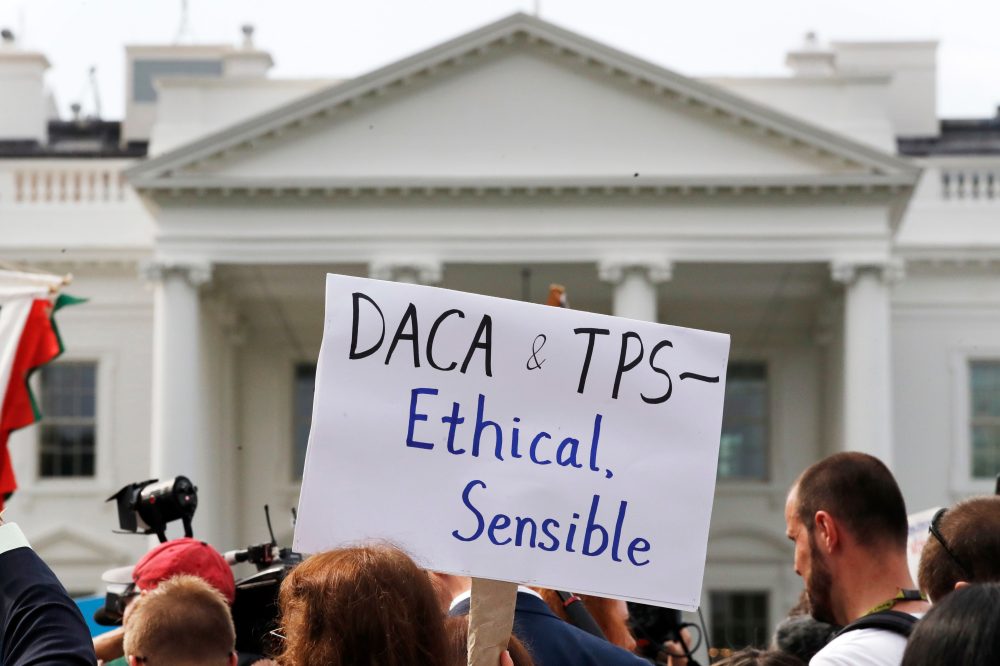

WASHINGTON — The nation’s highest court examined arguments Wednesday regarding the Trump administration’s effort to terminate legal safeguards for migrants from Haiti and Syria who fled violence and disasters in their homelands.
Citizens from Haiti and Syria were part of a group from 17 nations covered by Temporary Protected Status, a program that permits migrants currently in America to remain with employment authorization for 18-month periods, provided the Homeland Security Secretary determines their home country remains too dangerous for return.
Following President Donald Trump’s inauguration for his second term, the Department of Homeland Security has terminated protections for 13 nations, leaving their migrants vulnerable to removal proceedings.
The legal challenge centers on whether officials appropriately evaluated circumstances in Haiti and Syria before ending TPS and whether the decision discriminated against non-white immigrants.
The legal action initially targeted Kristi Noem, Trump’s first Homeland Security secretary during his second term. However, following her dismissal and Markwayne Mullin’s appointment as the new DHS chief, he became the named defendant in all related litigation.
Legal challenges typically follow agency leadership, so when personnel changes occur, incoming secretaries inherit responsibility for ongoing lawsuits, regardless of when the cases began. This pattern continues across different administrations. Immigration rights groups initially sued Trump’s first presidency over TPS termination efforts, naming DHS Secretary Kirstjen Nielsen. By the case’s conclusion six years later, Biden’s DHS Secretary Alejandro Mayorkas had become the named defendant.
Conservative critics of TPS frequently argue that programs designed as temporary solutions effectively become permanent fixtures. Republican lawmakers often cite TPS designations that receive repeated extensions long after the original crisis has passed.
El Salvador’s TPS designation, established in 2001 following catastrophic earthquakes, serves as a prime example of this concern.
However, immigration rights supporters maintain there are no statutory time limits on TPS usage, arguing the administration seeks to return people to nations still experiencing upheaval.
The United Nations High Commissioner for Refugees reports that Syria’s current situation reflects both large-scale returns and ongoing humanitarian challenges. According to the agency, 15.6 million Syrians needed assistance as of March 2026, while more than 1.5 million refugees and 1.8 million internally displaced individuals have returned since December 2024.
“Internal displacement remains high (5.5 million), underscoring that returns are occurring within a still-fragile system with strained absorption capacity,” the UN agency stated in its report.
Haiti has operated without a president since Jovenel Moïse’s assassination at his residence in July 2021. While officials hope to conduct initial elections before year’s end, experts consider this timeline unrealistic given escalating gang violence.
A recent International Rescue Committee evaluation identified “grave protection risks and rapidly shrinking access to public services” for Haitian civilians, describing the nation as facing one of the world’s most severe humanitarian emergencies.
The assessment warns that conditions may worsen as political instability persists and clashes between gangs and security forces continue.
“Millions of people in Haiti continue to face a compounding crisis of food insecurity, forced displacement, deadly disease outbreaks, and surging violence,” stated Alice Ribes, emergency country director for the IRC in Haiti. “Public services in many areas have collapsed under gang rule, leaving people with limited or no access to clean drinking water, food, medical care, and education.”
On April 16, the House achieved rare bipartisan cooperation by passing legislation extending TPS for Haitians. The measure, advanced by House Democrats with Republican support despite GOP leadership opposition, would mandate a three-year TPS extension by the Trump administration, protecting hundreds of thousands of qualifying immigrants from deportation.
The bill faces uncertain prospects in the Senate, and President Trump would likely attempt a veto.
Democratic Senator Edward J. Markey and Congresswoman Ayanna Pressley of Massachusetts, Senator Lisa Blunt Rochester of Delaware, and Congresswoman Debbie Wasserman Schultz of Florida urged the Supreme Court Tuesday to reject the administration’s termination efforts.
They joined a coalition including representatives from the American Business Immigration Coalition and the National Domestic Workers Alliance, among other organizations.
“TPS holders serve as a backbone for families and our economy—caring for our elders and loved ones through illness, strengthening our communities, and making innumerable contributions daily,” Pressley said. “Our message to the Supreme Court today is simple: do your job, uphold the law, save lives, and protect our communities.”
The administration maintains that TPS recipients can safely return to their home countries, where circumstances have improved since protections were initially granted.
Immigration advocates dispute claims that safe conditions exist for returnees. They highlight a contradiction, noting the State Department advises U.S. citizens against travel to Haiti or Syria due to violence, instability, and limited basic services.
“These terminations have come without credible evidence that conditions have improved,” said Krish O’Mara Vignarajah, president and Chief Executive Officer of Global Refuge, among the largest faith-based refugee assistance organizations.
“The administration is essentially arguing two things at once: that these countries are too dangerous for American tourists, but safe enough to deport families to. Policy makers cannot credibly hold both positions at the same time,” Vignarajah explained.
Immigration advocates contend the administration’s TPS termination decision ignores actual conditions in origin countries. Instead, they argue it represents part of a comprehensive deportation strategy targeting not only unauthorized immigrants but also hundreds of thousands of legal residents.
“By trying to kill TPS, they are attacking people who are living and working here legally, paying fees and taxes, following all the rules,” said José Palma, coordinator at the National TPS Alliance. “They are de-documenting people… it’s cruel, arbitrary, pointless, needless, and wrong.”
Viles Dorsainvil, Co-Founder and Executive Director of the Haitian Support Center and a Haitian TPS holder, explained: “TPS provides dignity, stability, and hope… TPS represents more than protection. It represents the ability of families to stay together.”
The Public Rights Project, a non-governmental organization assisting local governments with litigation, submitted an amicus brief detailing economic, workforce and public service consequences cities would experience if TPS ends.
Filed April 13, the brief represented a coalition of 47 local governments, mayors and community leaders nationwide urging the Court to maintain TPS.
The court allocated 80 minutes for arguments, though proceedings could extend to two hours or longer.
Following post-pandemic protocols, other justices permit 77-year-old Justice Thomas, the court’s longest-serving member, to ask initial questions before general questioning begins. During a second round, justices pose questions by seniority order, with Chief Justice John Roberts, seated centrally as the most senior, leading off.
Before arguments commence, justices will handle routine business, issuing at least one decision from fall or winter arguments. The majority opinion author will read a summary from the bench. The court will then ceremonially admit lawyers to the Supreme Court bar before livestreaming begins.