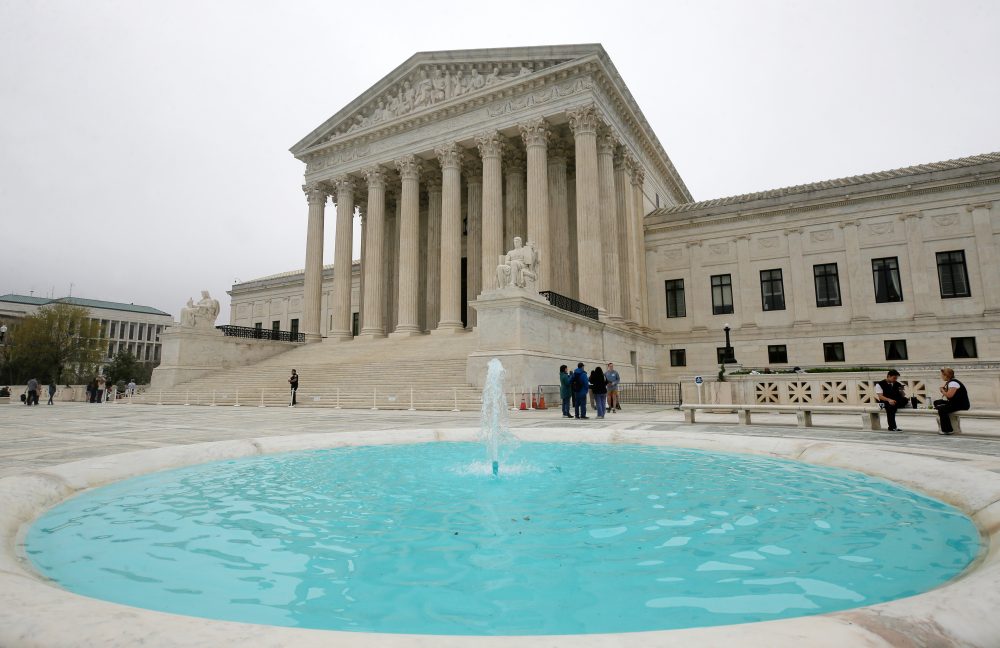

WASHINGTON — In a unanimous decision Wednesday, the U.S. Supreme Court handed Michigan a victory in its ongoing battle to shut down a contentious oil pipeline running beneath the Great Lakes.
The nation’s highest court determined that Michigan’s legal challenge against the aging pipeline will continue in state court after Enbridge energy company failed to meet a crucial deadline for transferring the case to federal jurisdiction.
Justice Sonia Sotomayor authored the court’s opinion, stating that Enbridge had exceeded the time limit for attempting to relocate the proceedings to federal court.
The legal battle centers on a complex dispute involving a pipeline that has transported crude oil and natural gas liquids from Superior, Wisconsin, to Sarnia, Ontario, for more than seven decades since beginning operations in 1953.
In June 2019, Michigan’s Attorney General Dana Nessel filed suit in state court, demanding the cancellation of the easement permitting Enbridge to operate a 4.5-mile stretch of pipeline beneath the Straits of Mackinac, where Lake Michigan and Lake Huron connect. The Democratic attorney general successfully obtained a restraining order from Ingham County Judge James Jamo in June 2020 that temporarily halted pipeline operations, though Enbridge later resumed activities after satisfying safety conditions.
Two years later, in 2021, Enbridge attempted to transfer the lawsuit to federal court, claiming the case impacts trade relations between the United States and Canada. However, a three-judge panel from the 6th U.S. Circuit Court of Appeals rejected this move in June 2024, determining the company had missed the required 30-day window for changing court jurisdictions.
The disputed pipeline segment, known as Line 5, has faced mounting scrutiny since 2017 when Enbridge engineers disclosed they had been aware of damage to the section’s protective coating since 2014. Safety concerns intensified in 2018 after a boat anchor struck the underwater section, raising alarm about potential environmental disasters from a rupture.
Under Democratic Governor Gretchen Whitmer’s administration, Michigan’s Department of Natural Resources canceled the straits easement for Line 5 in 2020. Enbridge has responded by filing a separate federal lawsuit challenging this revocation.
Currently, the company is pursuing permits to construct a protective tunnel around the underwater pipeline section. While the Michigan Public Service Commission approved necessary permits in 2023, Enbridge still awaits authorization from the U.S. Army Corps of Engineers and Michigan’s Department of Environment, Great Lakes and Energy.
The pipeline controversy extends beyond Michigan’s borders into Wisconsin, where a federal judge in Madison last summer ordered Enbridge to cease operations within three years on Line 5 sections crossing the Bad River Band of Lake Superior’s tribal lands. The company has proposed rerouting the pipeline away from the reservation and has challenged the shutdown order before the 7th U.S. Circuit Court of Appeals.