
Federal investigators have released new details about a deadly helicopter crash off Hawaii’s Kauai island last month, revealing the pilot’s account of the terrifying moments before the aircraft plunged into the ocean, claiming three lives.
A preliminary report from the National Transportation Safety Board, made public Friday, describes how the pilot told investigators he felt intense vibrations coursing through the helicopter that “came in waves and became stronger each time” during the March 26 sightseeing tour.
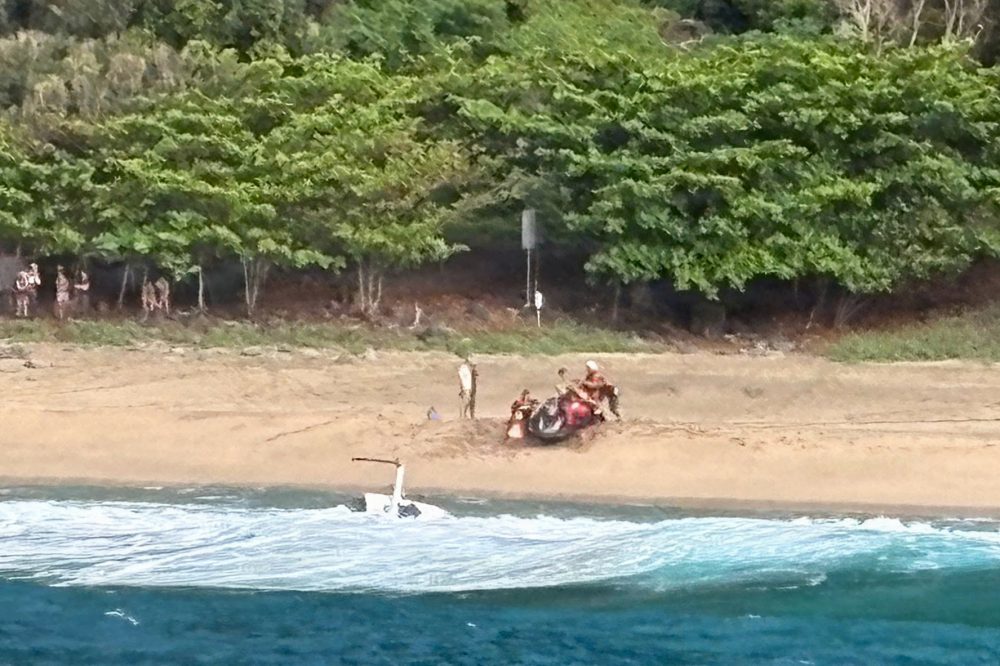
The aircraft was carrying five people total when it went down near the remote Kalalau Beach along the Na Pali Coast on Kauai’s North Shore. This rugged area, accessible only through an 11-mile trek on foot or by watercraft, features towering coastal cliffs and jagged mountain peaks that create dangerous flying conditions with unpredictable weather and turbulent air currents.
Both the pilot and one passenger suffered severe injuries but survived the crash.
The pilot’s account details how the trouble began during a routine left turn away from the coastline. The helicopter suddenly started rotating rapidly in a clockwise direction, prompting him to execute an autorotation maneuver that uses airflow rather than engine power to keep the rotors spinning. This technique successfully halted the dangerous spinning motion. The pilot issued a mayday distress call before the aircraft struck the water approximately 75 yards from shore.
Upon impact, the helicopter tilted onto its right side and became partly submerged. The preliminary findings do not explain how two occupants managed to survive or specify the seating arrangement of the surviving passenger.
An eyewitness pilot flying in the vicinity observed the accident and told investigators the helicopter looked undamaged before hitting the water and breaking into pieces.
The three fatalities have been identified as Margaret Rimmler, 65, and Patrick Haskell, 59, both residents of Massachusetts, along with 40-year-old Ukrainian citizen Oksana Pihol.
Airborne Aviation operated the doomed aircraft, offering scenic tours showcasing Kauai’s dramatic canyons, coastline, and cascading waterfalls. The company markets a “doors-off thrill seekers adventure tour” accommodating up to four passengers. Helicopter excursions remain a favored method for experiencing the spectacular cliffs, pristine beaches, and waterfalls that define the Na Pali Coast.
Aviation safety specialist Jeff Guzzetti suggests the described vibrations and sudden rotation indicate a mechanical malfunction, potentially involving the tail rotor system, though determining the exact cause remains premature.
“Certainly it seems to lead to a mechanical failure in the helicopter, which would point the investigation to maintenance and design issues,” explained Guzzetti, a former crash investigator for both the NTSB and Federal Aviation Administration.
Guzzetti praised the pilot’s response, noting that while he successfully stopped the spinning, insufficient time and altitude prevented reaching the safety of the beach.
This tragedy adds to a troubling pattern of fatal helicopter accidents that has haunted the tourism industry for years. Hawaii has witnessed at least 16 helicopter crash deaths over the past seven years, including two separate incidents in 2019.
Similar deadly crashes have occurred in other tourist destinations nationwide. New York has experienced several fatal incidents, including a Hudson River crash last year that killed a pilot and five Spanish tourists, a 2018 “open door” charter flight that claimed five lives in the East River, and a 2009 mid-air collision between a plane and tourist helicopter over the Hudson that resulted in nine deaths.