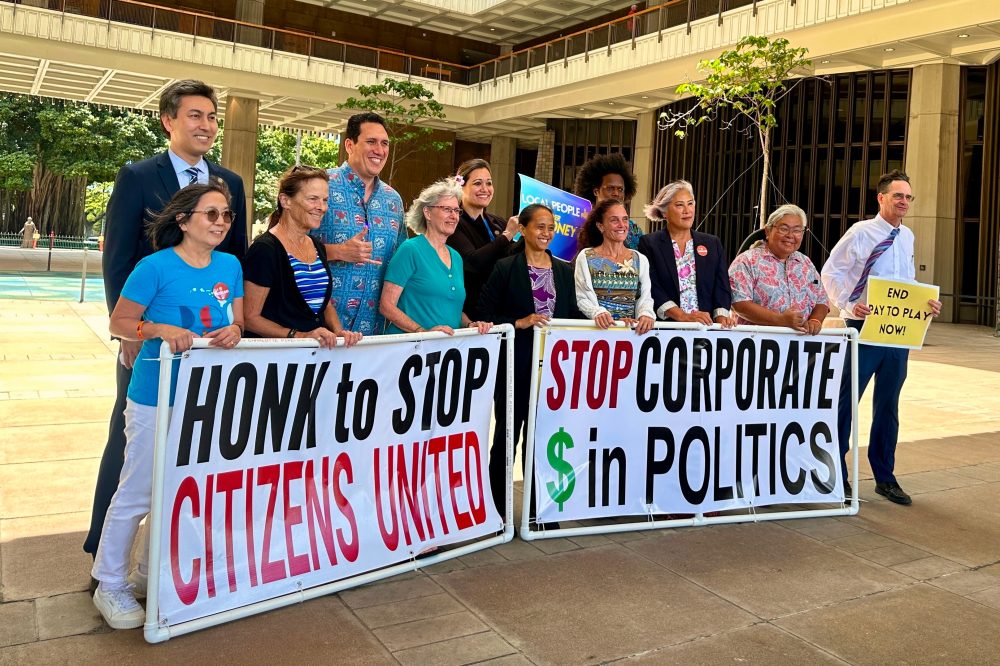

Two states are pioneering an innovative strategy to diminish corporate influence and anonymous “dark money” spending in elections, which has flourished since the U.S. Supreme Court’s landmark 2010 Citizens United v. Federal Election Commission decision.
Hawaii’s legislature approved legislation on Friday and forwarded it to Governor Josh Green that would restructure the legal definition of corporations to prevent them from participating in election spending. Meanwhile, volunteers in Montana are collecting petition signatures to place a comparable measure before voters this November.
Advocates argue that citizens oppose corporate and undisclosed money in electoral processes, and these initiatives address that concern. Critics contend that states cannot enact legislation to circumvent Supreme Court precedents they oppose.
Comparable bills have been proposed in at least 14 additional states beyond Hawaii, though none have advanced significantly through their respective legislatures.
The Citizens United case originated when the conservative organization sought to air television advertisements promoting its documentary critical of Hillary Clinton during her 2008 presidential campaign. The Supreme Court’s 2010 decision essentially eliminated restrictions on corporate and union electoral expenditures, provided they avoid direct campaign contributions.
This decision has aided both major political parties. According to OpenSecrets, a campaign finance monitoring organization, outside political expenditures exceeded $4 billion during the 2024 federal elections — nearly 12 times the amount spent in 2008.
A portion of these funds originated from dark money organizations that face no donor disclosure requirements. The Brennan Center for Justice calculated a record $1.9 billion in such spending during 2024, with dark money also influencing various state-level contests.
Justin Levitt, a campaign finance law expert at Loyola Law School, suggested that restricting corporate electoral spending might not substantially alter political funding patterns, emphasizing that wealthy individuals like Elon Musk contribute far larger amounts.
Tom Moore, a former Federal Elections Commission attorney now serving as a senior fellow at the Center for American Progress, believes Americans support overturning the Citizens United ruling. The Washington, D.C.-based organization advocates redefining corporations to prohibit campaign spending while preserving their lobbying rights.
The restrictions would encompass nonprofit organizations engaged in dark money activities as well.
“This is a genuinely new approach to getting Citizens United out of America’s politics that is based on absolutely foundational corporation law,” Moore stated.
Moore indicated that if even one state implements this approach, it would face judicial scrutiny.
Democratic Governor Josh Green of Hawaii has not announced his position on the legislation. He must declare any veto intentions by June 30.
“This is an instance where a small state has a chance to make big waves on the national scene,” said Democratic state Senator Karl Rhoads, who sponsored the bill. “I think we should take advantage of it.”
Hawaii Attorney General Anne Lopez’s office, led by the Democratic official, opposed the measure, citing concerns about the difficulty and expense of court defense.
In Montana, volunteers are collecting signatures to place the corporate redefinition concept — called The Montana Plan — before state voters in November.
Montana’s Supreme Court decided in April that the initiative could move forward despite Republican Attorney General Austin Knudsen’s assertion that it violates single-subject requirements for ballot measures.
“It really resonates with citizens,” said Jeff Mangan, former Montana state commissioner of political practices who leads the ballot campaign. “They probably see it because they live it.”
Bradley Smith, a Republican former Federal Election Commission member, believes Moore’s proposal will likely fail in court.
“The mistake I think supporters of this are making is thinking you can ignore the substance of a Supreme Court ruling by semantic lawyerly tricks,” Smith explained.
Smith argued that lower courts would probably reject measures designed to bypass Supreme Court decisions and would likely dismiss laws that connect general government services to recipient behavior.
Should these measures become law, Smith suggested corporations might exit states rather than limit their political activities.
Loyola’s Levitt expressed uncertainty about the effort’s success but knows who would make the final determination.
“The one thing I am absolutely sure of is if it got the signatures and is passed by the Montana public and is approved by the Montana courts, that the Supreme Court will want a crack at it,” Levitt noted. “There are a lot of steps between here and there.”