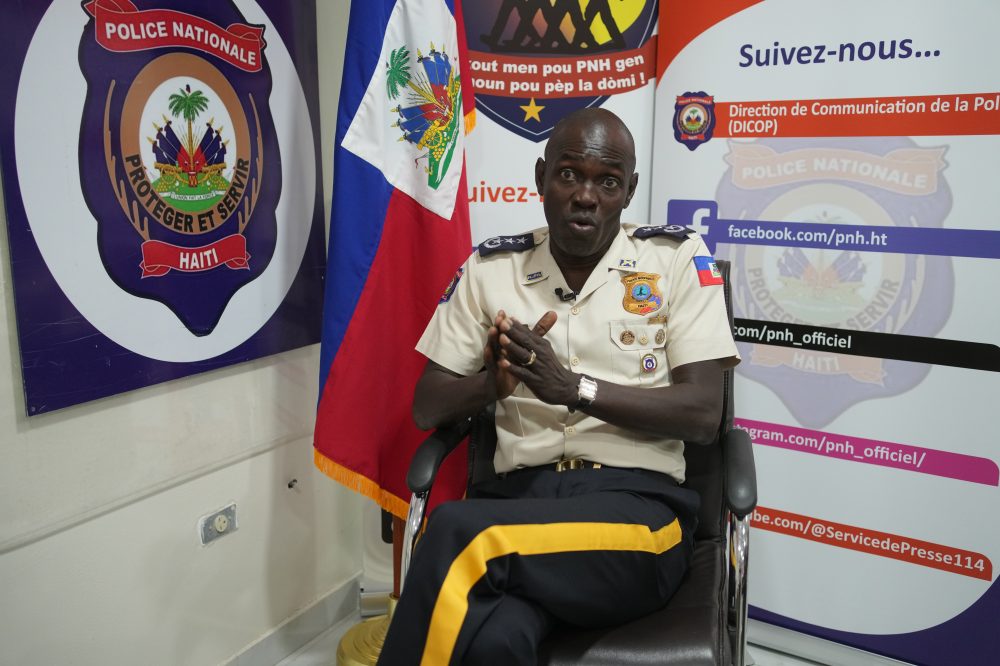

PORT-AU-PRINCE, Haiti — Haiti’s interim police chief revealed Friday that law enforcement officials are developing strategies to conduct general elections safely this year, even as criminal gangs continue terrorizing the Caribbean nation.
André Jonas Vladimir Paraison, who took over as temporary head of the National Police in August, declined to share specifics but promised additional details would be released shortly.
“We have a plan for the election, but it’s still in the kitchen and has not finished cooking yet,” he said.
When pressed about whether Haiti would be prepared to conduct elections in 2024, Paraison avoided giving a direct answer.
Government officials have announced intentions to conduct general elections in late August, followed by runoff voting in early December. The Provisional Electoral Council stated Friday that political party and candidate registration will begin March 2 and continue through March 12.
The troubled nation hasn’t conducted general elections in more than ten years, with criminal violence escalating dramatically following President Jovenel Moïse’s assassination at his home in July 2021.
Paraison described Haiti’s current situation as having “exploded,” while emphasizing that law enforcement personnel are working to restore security and allow citizens to return to normal life.
Criminal organizations have forced a record 1.4 million residents from their homes in the nation of nearly 12 million people, with armed groups maintaining control over approximately 90% of Port-au-Prince and claiming large portions of the country’s central areas.
The widespread violence has shuttered thousands of businesses and forced hundreds of schools to close their doors.
United Nations data shows more than 5,900 people lost their lives last year, with over 2,700 others suffering injuries.
Paraison expressed hopes of increasing officer numbers to better safeguard Haitian citizens. He recently supervised the graduation of nearly 900 new cadets but acknowledged that additional personnel are necessary.
U.N. representatives have noted that Haiti in recent years maintained fewer than two officers per 1,000 residents, falling significantly short of international benchmarks.
Even with limited resources, Paraison has directed recent missions into gang-controlled areas, successfully reclaiming locations such as Carrefour-Aéroport, an important intersection.
Law enforcement agencies are also releasing more frequent updates about suspected gang members eliminated during these operations.
Paraison observed that criminal groups possess extensive weaponry and ammunition supplies. “Don’t forget, Haiti doesn’t make weapons. The weapons here come from somewhere else,” he said.
Security analysts have previously estimated that up to half a million small arms may be present in Haiti, while a 2023 U.N. investigation discovered that increasingly advanced weapons, including .50 caliber sniper rifles and belt-fed machine guns, are being smuggled into the country primarily from the United States, particularly Florida.
Haiti’s National Police are collaborating with a U.N.-supported mission headed by Kenyan officers that remains inadequately funded and staffed while battling criminal organizations. A specialized gang suppression unit is anticipated to take over the mission’s responsibilities in the coming months.