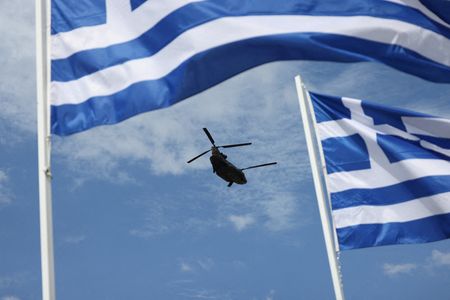

ATHENS — Greece’s national security council, known as KYSEA, is poised to give its final green light Thursday for the acquisition of a multi-layered air defense system from Israel worth as much as €3.5 billion — roughly $4 billion — along with several categories of drones, according to two sources who spoke with Reuters.
KYSEA had already granted preliminary approval earlier this year, and a government official familiar with the agreement told Reuters that the council is now expected to formally authorize the procurement contracts.
The system, which Greece has named “Achilles Shield,” is designed to provide overlapping protection against ballistic missiles, aircraft, and drones. At its core will be radar systems and missiles produced by Israeli defense firms Rafael and IAI.
Greece has outlined an ambitious military modernization plan, with the government committing to spend approximately €28 billion by the year 2036. That plan includes acquiring up to 40 new F-35 fighter jets from the United States, as well as frigates from France and Italy.
The country currently dedicates nearly 3.5% of its gross domestic product to defense spending — a figure that exceeds many fellow NATO member nations. This elevated spending is largely driven by Greece’s longstanding territorial and political tensions with neighboring Turkey.
Greece and Israel maintain robust economic and diplomatic ties. The two nations jointly operate an air training facility on Greek soil, conduct annual combined military exercises, and collaborate on both anti-drone technology and cybersecurity initiatives.
Just last year, Greece approved the purchase of 36 rocket artillery systems of Israeli origin for approximately €650 million.
“KYSEA will also approve the purchase of drones from the U.S. and Israel,” the official stated.
A second official independently confirmed the details regarding both the Israeli defense system and the planned drone acquisitions.
At present, Greece relies on U.S.-made Patriot missile systems and aging Russian S-300 systems to safeguard its airspace.