
PORTSMOUTH, Va. — A group of nine House Republicans has pushed back against President Donald Trump’s efforts to shut down major offshore wind developments along the Atlantic coast, highlighting growing tensions within the party over clean energy policy.
The lawmakers sent correspondence to Trump administration officials seeking clarification on the decision to halt five large-scale wind projects currently under development.
“America’s energy policy should be grounded in facts, fiscal responsibility, and the national interest — not ideology or politics,” the representatives stated in their letter.
Among the signatories is Virginia Rep. Jen Kiggans, a Navy veteran and former helicopter pilot whose coastal constituency stands to benefit from an $11.5 billion wind development expected to generate 1,000 local jobs. Her position puts her at odds with Trump’s agenda while highlighting the complex political dynamics surrounding renewable energy as Republicans face potential House losses.
Kiggans’ political situation became more precarious following Tuesday’s approval of Virginia’s new congressional boundaries, which shifted her competitive district toward Democratic voters.
According to research from E2, a business organization focused on clean energy, Trump’s broader opposition to renewable projects led to the termination of nearly $35 billion worth of developments nationwide last year. The analysis found that Republican-represented areas suffered nearly double the investment losses compared to Democratic districts.
While federal court decisions have allowed the Virginia project and four others to resume, former congresswoman Elaine Luria, who is pursuing the Democratic nomination to challenge Kiggans in the 2nd Congressional District, argues the incumbent’s advocacy efforts have proven ineffective against Trump’s policies.
“Her advocacy did nothing,” Luria stated. Kiggans’ office did not provide responses to media inquiries.
Trump has framed energy policy as part of broader cultural battles, labeling Democratic clean energy initiatives as the “Green New Scam.” He regularly expresses opposition to what he calls “windmills,” describing them as “STUPID AND UGLY” in social media posts. His administration issued an executive order on his first day back in office to block wind developments, while maintaining that “smart countries” avoid wind power.
The president has also criticized solar installations, remarking at the White House last summer about large-scale projects: “You go around and you see all these things that are 3 miles long by 3 miles wide and you say what the hell is that.”
The administration reached an agreement to pay a French company $1 billion to abandon two offshore wind lease agreements and redirect investments toward oil and gas projects instead.
Despite her public support for renewable energy, Kiggans supported Republican legislation to eliminate clean energy tax incentives as part of Trump’s comprehensive tax and spending package. Democrats have used this vote in campaign messaging, with Luria arguing it contradicts Kiggans’ efforts to “sell herself as if she’s a moderate.”
“Kiggans voted for a bill to make energy more expensive,” Luria claimed.
Following the July passage of the legislation, Kiggans defended her decision in a social media post, writing that her vote “wasn’t about politics — it was about overall results.”
“I had ONE vote, and I voted YES on the One Big Beautiful Bill Act not because it was perfect but because it delivers permanent tax relief for families & small businesses, rebuilds our Navy & invests in national defense,” she explained.
University of Mary Washington political science professor Stephen Farnsworth noted that vulnerable Republicans face difficult choices as Trump pursues his agenda amid economic challenges worsened by conflict with Iran.
“Kiggans is not the only Republican being squeezed,” Farnsworth observed. While few lawmakers want to antagonize the president, he added, “in coastal Virginia politics, there’s not much upside to opposing wind.”
Similar tensions have emerged in New Jersey, where Rep. Tom Kean Jr. found himself caught between Trump’s opposition to the Gateway Tunnel project and his constituents’ transportation needs. The tunnel expansion would add rail capacity under the Hudson River to reduce congestion between New Jersey and New York City. After Trump attempted to block federal funding, a court mandated restoration of project money following legal action by Democratic officials from both states.
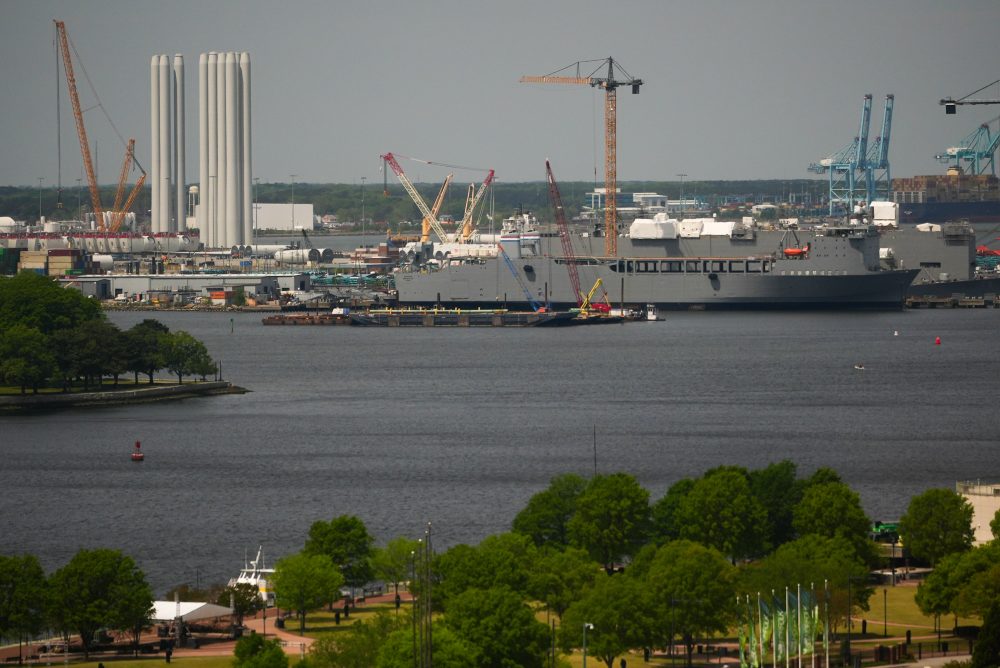
Despite Trump’s criticism of offshore turbines as unsightly, the Coastal Virginia Offshore Wind development sits approximately 27 miles offshore, making it barely visible from land. During a recent visit to the Portsmouth Marine Terminal where construction activities are coordinated, the turbines could not be seen on the horizon.
Dominion Energy, the project operator, announced that electricity generation began last month. The development, first unveiled in 2013, is projected to create 1,000 jobs and produce roughly $2 billion in regional economic impact.
Upon completion, the 176-turbine installation will have capacity to generate 2.6 gigawatts of electricity — sufficient to power more than 660,000 households — addressing Virginia’s increasing energy needs driven by expanding artificial intelligence data center operations.
“There’s an opportunity here for Hampton Roads to be a national leader in offshore wind,” said Andrew Nissman, representing the Hampton Roads Workforce Council, which has provided training for maritime workers on the project.
Nissman avoided commenting on the congressional race, stating, “as with any stop-and-start challenge, it’s important the project is moving forward.”
Dan Taylor, Southeast regional field manager for the BlueGreen Alliance, which represents labor unions and environmental organizations, criticized Kiggans despite the project’s current progress.
“Kiggans nearly cost her constituents this project by standing with an administration dead set on dismantling the offshore wind industry and voting to repeal critical clean energy tax credits last year,” Taylor said.
“Kiggans claims to prioritize jobs, lower energy costs for Virginians and reducing emissions,” Taylor continued. “Yet she voted to kill jobs, skyrocket energy costs to families and increase the emissions driving climate change.”