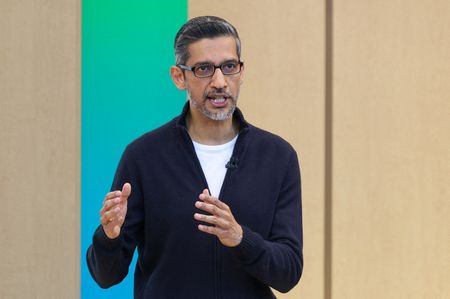

Alphabet CEO Sundar Pichai took a firm stand Wednesday during a quarterly earnings call, defending Google’s artificial intelligence strategy against mounting criticism that the tech giant is losing its competitive edge in the AI industry.
The concerns stem largely from Google’s decision to push back the release of Gemini 3.5 Pro, a highly anticipated model that was originally expected to launch in June. The model was seen as a key tool for strengthening Google’s position in AI coding and so-called autonomous “agent” tasks — two of the most hotly contested areas in the AI industry right now.
The delay has intensified fears that Google is losing momentum at a time when rivals including OpenAI, Anthropic, and several Chinese competitors have been releasing new models at a rapid pace. Analysts on Wednesday’s call pressed Pichai on whether Google’s top-tier models can still hold their own at the cutting edge of AI development.
Responding to a question from JPMorgan analyst Doug Anmuth — who questioned whether Google’s Gemini model line could stay competitive and noted the company’s slower model release pace — Pichai acknowledged areas needing improvement. “We’ve had clearly frontier models. There are many attributes on which we are still at the frontier; there are areas where we’ve acknowledged we need to improve and coding and agentic coding is an example of that,” he said.
Rather than focusing on the Gemini 3.5 Pro delay, Pichai repeatedly pointed to Gemini Flash, a faster and more affordable model that he described as a “workhorse” powering a wide range of applications, including cybersecurity, customer-service tools, data analytics, and enterprise software.
He highlighted Gemini 3.6 Flash, released this week, noting it improved by more than 10 points on a coding benchmark compared to its predecessor while requiring fewer computing resources. On Tuesday, the company also introduced Gemini 3.5 Flash-Lite and a cybersecurity-focused model called Flash Cyber, while Gemini 3.5 Pro remains in testing with select partners.
Looking ahead, Pichai expressed confidence in the company’s next major release. “I think people will be pleased” when Google unveils Gemini 4, he said, calling it a “very ambitious effort.” He added that Google is training a significantly larger model intended to compete at the frontier of AI, saying the company remains “very committed and very confident” about staying at the leading edge of the technology.
When Barclays analyst Ross Sandler raised similar concerns about the pace of Google’s model releases, Pichai revealed that the Gemini 4 roadmap includes rolling out models “almost at a monthly cadence.”
Pichai’s strong defense highlights a broader challenge the company faces: convincing investors to look beyond the delay of a single model and instead evaluate Google’s AI ambitions through the lens of its broader ecosystem, which includes cloud infrastructure, custom AI chips, and a range of Gemini models woven into its products and services.
Google did report impressive cloud growth for the quarter — up 82%, well ahead of the average analyst estimate of 64%. However, Wall Street remains focused on whether the company can reclaim leadership in AI coding and advanced reasoning, especially as its spending continues to climb. Alphabet raised its capital expenditure plans by $15 billion, bringing the range to between $195 billion and $205 billion.
Despite the strong cloud numbers, Alphabet’s stock fell more than 3% in after-hours trading. Combined with concerns over model delays and several high-profile executive departures, the company’s shares are down roughly 9% since the end of April.