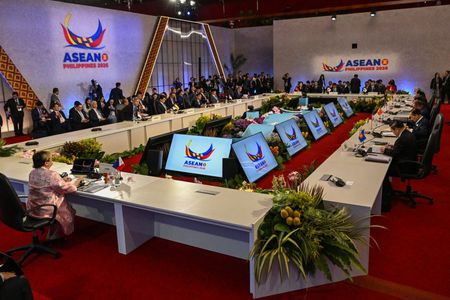

Senior diplomats representing nations across Asia, Europe, and North America descended on Manila Thursday for the security-focused ASEAN Regional Forum, where officials were widely expected to call for a peaceful resolution to the escalating conflict in the Middle East.
The ongoing war in Iran and the blockade of the Strait of Hormuz emerged as central issues at the gathering, which drew U.S. Secretary of State Marco Rubio, Russian Foreign Minister Sergei Lavrov, European Union foreign policy chief Kaja Kallas, and senior representatives from China, Australia, India, Japan, Britain, and several other nations.
The forum is hosted by the 11-nation Association of Southeast Asian Nations, a bloc with a combined economic output of roughly $3.8 trillion that depends heavily on Middle Eastern oil. The region has been particularly hard hit by the fallout from the conflict, which has helped drive inflation higher around the globe.
China’s Vice Foreign Minister Hua Chunying set the tone in opening remarks at a separate forum Thursday involving ASEAN, Japan, South Korea, and China. “The world has entered a new period of turbulence and transformation,” she said.
She went on to warn that the Middle East crisis was rippling outward: “The situation in the Middle East has spilled over into energy and food supply chains, and security and resilience have been disrupted … demand for maintaining peace and stability has become more urgent.”
The ceasefire in the Middle East collapsed 12 days ago, and U.S. military forces carried out strikes for a 12th consecutive night on Thursday. Meanwhile, Iranian-aligned Houthi forces claimed they struck two Saudi oil tankers as part of a blockade that threatens to create a second major chokehold on global oil supplies — alongside the Strait of Hormuz — at the Red Sea.
Rubio addressed ASEAN ministers on Wednesday, saying Washington favors a diplomatic path forward but that Iran has not been cooperative. “The problem we’re having right now is that they’re not serious about talks,” he said.
Rubio was also scheduled to sit down with Lavrov on Thursday. He indicated the two would address the war in Ukraine, saying the United States is seeking to play a constructive role in bringing that conflict to an end.
The South China Sea also commanded significant attention at the Manila forum. Longstanding friction between China and the Philippines — a U.S. treaty ally that Washington is obligated to defend if its vessels come under attack — flared again Monday when Chinese coast guard personnel were involved in a brief confrontation with Philippine navy members near a disputed reef within Manila’s exclusive economic zone. Both countries responded by summoning each other’s ambassadors.
China asserts sovereignty over nearly all of the South China Sea through a boundary line on its maps that overlaps with the exclusive economic zones of Brunei, Indonesia, Malaysia, the Philippines, and Vietnam. Beijing continues to reject a 2016 international arbitration ruling that found its claims lacked legal standing.
Chinese Foreign Minister Wang Yi, speaking to ASEAN counterparts Wednesday, described the South China Sea as “our common home” and called for cooperation and friendship to define the relationship among regional nations. He urged those countries to “resist the incitement of foreign forces, oppose individual countries using the sea to make trouble, and firmly take the leading position to maintain peace and stability in the South China Sea in their own hands,” according to an official statement.