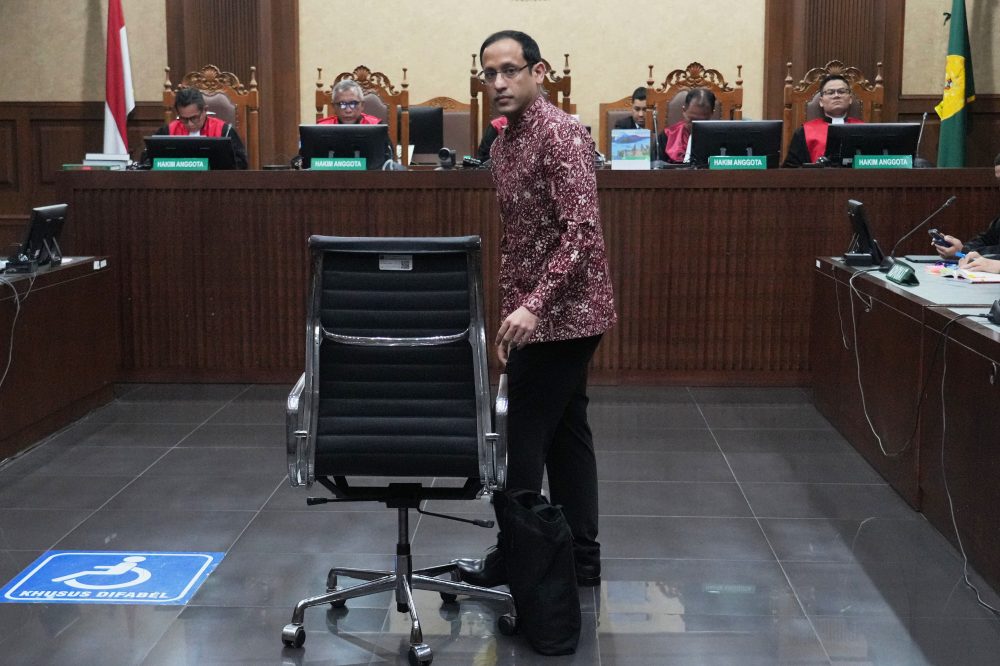

JAKARTA, Indonesia — Government prosecutors in Indonesia announced Wednesday they are pursuing an 18-year prison term for Nadiem Anwar Makarim, who helped establish the ride-hailing and payment service Gojek, in connection with corruption charges related to a school laptop purchasing program implemented during the coronavirus pandemic.
During court proceedings at Jakarta’s Corruption Court, prosecutors additionally requested a financial penalty of 1 billion rupiah (approximately $57,180) and demanded the confiscation of Makarim’s property should he fail to return 809 billion rupiah (roughly $48.2 million) connected to the educational program, plus 4.8 trillion rupiah (around $275.4 million) in what they termed unexplained assets.
According to the prosecution’s proposal, Makarim would serve an extra nine years behind bars if he doesn’t meet these requirements within 30 days following a final judicial decision.
Authorities took Makarim into custody in September following an inquiry into the procurement process, which prosecutors claim resulted in approximately $125 million in government losses. This week, court officials granted a modification to his detention conditions, allowing house arrest after he underwent medical surgery.
The legal proceedings have captured widespread public interest, with hundreds of “ojek” motorcycle taxi operators frequently attending court sessions to demonstrate support for the individual who transformed Indonesia’s gig-based economy.
The charges focus on claims that Makarim, who held the education ministry position from 2019 through 2024, “enriched himself” via the government’s Chromebook acquisition initiative spanning 2020-2022. Prosecutors informed the three-member judicial panel that he misused his official authority to sway policy choices and business transactions.
They claimed Makarim coerced Google into investing in PT Aplikasi Karya Anak Bangsa (PT AKAB), Gojek’s parent organization, which subsequently merged into the GoTo Group.
Throughout the hearings, prosecutors dismissed statements from three former Google leadership figures who testified that Google’s GoTo investment had no connection to the Indonesian government’s choice to purchase Chromebooks for educational institutions.
“Google’s investment in GoTo is considered a mutually beneficial relationship that may have influenced Chromebook procurement policy,” prosecutors declared to the court, maintaining that the Chromebook acquisition and Google’s investment — valued at roughly $787 million through Google Asia Pacific — were linked.
The judicial panel is anticipated to announce a decision within the next few weeks. Should Makarim be found guilty, he would receive one of the most severe corruption penalties in Indonesia’s recent legal history.
In response to the sentencing request, Makarim rejected any misconduct and condemned what he characterized as disproportionate punishment.
“These are lawful earnings from building a company and creating jobs,” he stated to media representatives following the court session, referencing his ownership in Gojek. “I am effectively being charged with 27 or 28 years in prison, far more than many violent criminals.”
He maintained there was “no administrative violation and no element of corruption” in his conduct, noting that the financial restitution demanded by prosecutors greatly surpassed his genuine wealth.
The Chromebook initiative began during the health crisis to facilitate distance learning. Prosecutors stated Makarim promoted Chromebooks despite warnings they were inefficient in regions with poor internet connectivity.
Makarim has insisted that purchasing choices were handled by technical staff members, not himself. His legal representatives contend he sold his PT AKAB holdings when assuming office and that his financial worth decreased during his government service.