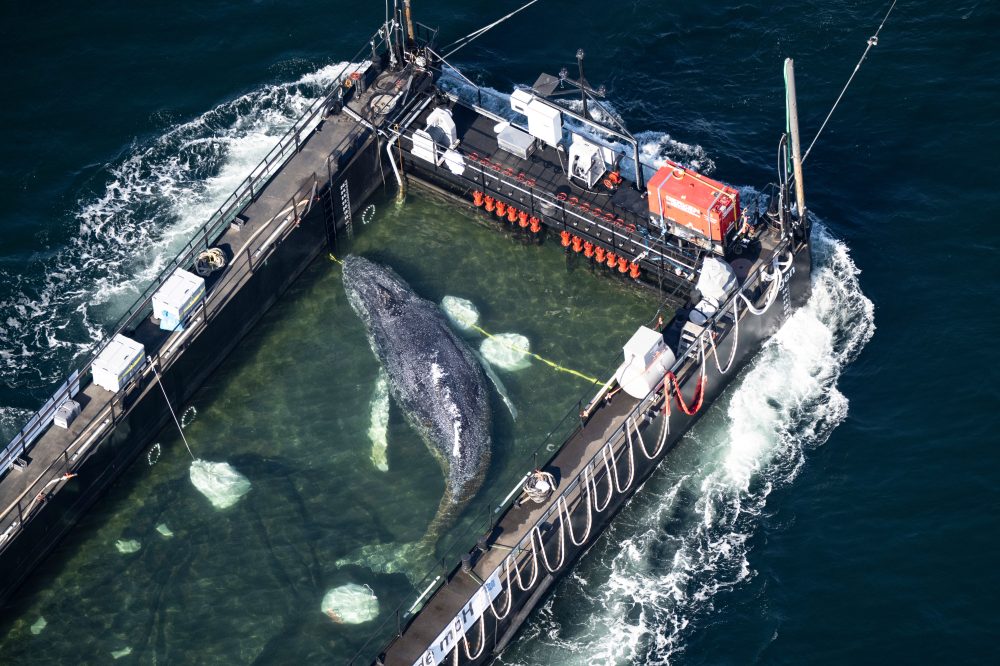

German rescue teams have launched an ambitious operation to save a stranded humpback whale, loading the massive marine mammal onto a specially designed barge for transport to deeper waters. The whale, dubbed Timmy by local media outlets, has been trapped in shallow Baltic Sea waters near Germany’s coastline since early March.
The marine giant was first observed swimming off Germany’s Baltic coast on March 3, thousands of miles from its natural Atlantic Ocean environment. Since then, the whale’s condition has worsened as it repeatedly became stuck in shallow areas, with global audiences watching failed rescue attempts through live video feeds.
Rescue crews worked for several hours on Tuesday to guide the whale onto the flooded transport vessel using specialized straps and a specially excavated channel leading to the barge, according to Germany’s dpa news agency.
By early Wednesday morning, the transport vessel had reached Fehmarn island in northern Germany, positioned near Danish territorial waters, German newspaper Bild confirmed.
The planned route will take the barge around Denmark’s northern coastline, passing through the Skagerrak strait before reaching the North Sea.
Mecklenburg Vorpommern Environment Minister Till Backhaus, whose state had been hosting the stranded whale, expressed his personal investment in the rescue effort on Tuesday, stating he was “on the verge of jumping into the water to help the whale get through the last few meters.”
Despite scientific community concerns that the transport might prove too stressful for the animal, Backhaus approved the privately proposed rescue operation.
The appropriate response to the whale’s situation has sparked weeks of public debate, with some advocating for allowing the animal to die peacefully while others push for continued rescue efforts. Beach demonstrations in Wismar have featured activists demanding the whale’s freedom, while other groups have proposed alternative transportation methods to return the animal to ocean waters.
Greenpeace marine biologist Thilo Maack previously told The Associated Press that rescue attempts have inflicted significant stress on Timmy.
“I believe the whale will die very soon now. And I would also like to raise the question: What is actually so bad about that?” he said. “Yes, animals live, animals die. This animal is really, really very, very, very sick. And it has decided to seek rest.”
Scientific experts remain uncertain about the whale’s survival prospects during transport. Some researchers theorize the whale deliberately sought shallow waters due to weakness and exhaustion. However, veterinarians working with the private rescue group believe the animal is strong enough to endure the journey.