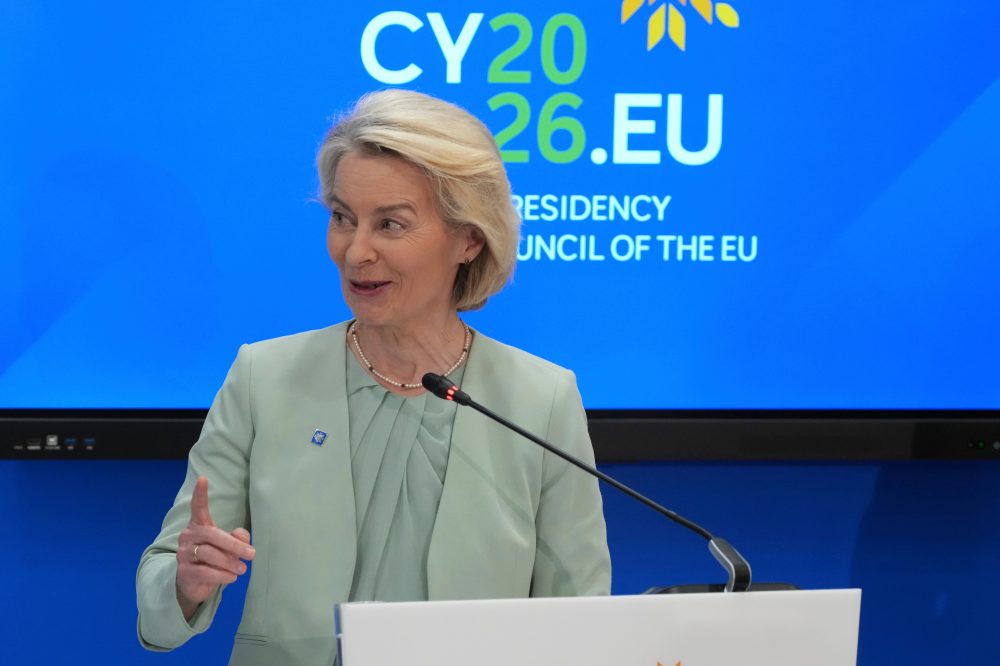

BRUSSELS (AP) — The head of the European Commission cautioned Wednesday that member nations must carefully direct energy assistance to those most in need, or risk squandering enormous sums as the Middle East conflict drives up fuel costs.
European Commission President Ursula von der Leyen addressed lawmakers about the financial strain from the U.S.-Israel conflict and Iranian responses, including potential disruption of the Strait of Hormuz shipping lane. These developments are draining nearly $600 million daily from EU coffers while driving up gasoline costs and creating concerns about jet fuel availability in coming weeks.
Speaking to European Parliament members in Strasbourg, France, von der Leyen emphasized learning from previous energy emergencies. She referenced the 2022 fuel shortage when Russia weaponized energy supplies against European nations supporting Ukraine.
“More than 350 billion euros were spent on untargeted measures and this had a huge impact on member states finances,” von der Leyen stated. “So let us not make the same mistake again, and let’s focus our support where it matters most.”
The Commission President stressed the need to break free from foreign energy dependence, advocating for greater reliance on domestic renewable resources including wind, solar, and nuclear power – similar to how Europe reduced its Russian energy ties.
“Our over dependency on imported fossil fuels makes us vulnerable,” she declared.
Data shows dramatic shifts since 2022, with Russian natural gas imports dropping from 45% to just 12% last year across the 27-nation bloc. Coal purchases were eliminated through sanctions, while oil imports fell from 27% in 2022 to 2%, with only Hungary and Slovakia maintaining Russian petroleum ties.
Von der Leyen predicted lasting consequences from the current Middle East crisis, saying the effects “may echo for months or even years to come.” She identified the solution as developing “homegrown, affordable, clean energy supply from renewables to nuclear.”
Her recommendations included expanding electricity use from renewable and nuclear sources for transportation, aviation, home heating, and industrial applications to reduce fossil fuel dependence. Currently, electricity accounts for less than 25% of the bloc’s total energy consumption.
EU Energy Commissioner Dan Jørgensen issued stark warnings last week about the crisis severity, describing it as more than “a short-term, small increase in prices. This is a crisis that is probably as serious as the 1973 and the 2022 crises combined.”
Jørgensen noted Europe’s limited influence over Middle Eastern developments, saying the continent has been pushed into a reactive position with minimal control over unfolding events.
“Even in a best-case scenario, it’s still bad,” Jørgensen explained. “Whether or not we will be in a security of supply crisis is primarily a result of what goes on in the Middle East. What we can do is to try and prevent, and limit” the damage.