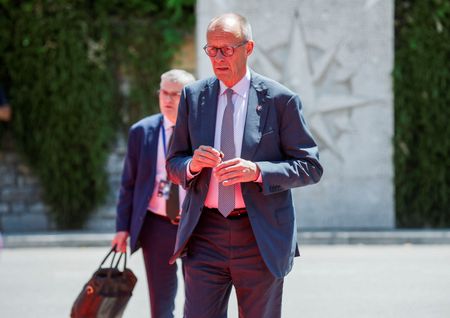

German Chancellor Friedrich Merz called on the European Union to demonstrate its capacity and commitment to welcoming new member states during a Friday gathering with Western Balkan officials in Montenegro’s coastal city of Tivat.
The drive for EU expansion has gained renewed urgency following Russia’s military action in Ukraine, as Kyiv seeks membership to solidify its place in Europe’s political center, while EU leadership views expansion as a way to limit foreign influence in neighboring regions.
However, the membership process typically involves lengthy and complicated procedures, requiring extensive negotiations and legal changes, with unanimous approval from all 27 existing EU nations needed at each stage.
“The European Union has to show that it is capable of enlarging and willing to enlarge and we want to discuss that here,” Merz stated to journalists at the Montenegro summit.
“There are, of course, a whole range of questions that we must answer, that we must answer together, but above all else, it must be clear that this part of Europe belongs within the European Union’s future,” Merz continued.
“The fact that we have not admitted any new members for 13 years now shows that there have also been shortcomings on the part of the European Union.”
Six nations from the Western Balkans are seeking EU membership – Albania, Bosnia, Serbia, Montenegro, North Macedonia and Kosovo – though each country stands at varying points in the admission process.
Montenegro, home to only 630,000 residents, is generally viewed as leading the pack and would be relatively straightforward to integrate into the EU, which encompasses 450 million people.
However, Montenegro still confronts challenges, particularly concerning judicial reform and anti-corruption efforts, with many experts considering its 2028 membership target overly optimistic.
Before the summit began, Germany and France put forward a proposal to provide prospective EU members with increased access to EU programs and the single market prior to full membership.
Last month, Merz also floated the idea of granting Ukraine “associate member” status, which would permit Ukrainian representatives to participate in EU summits and ministerial gatherings – without voting privileges – as a transitional step toward complete membership.