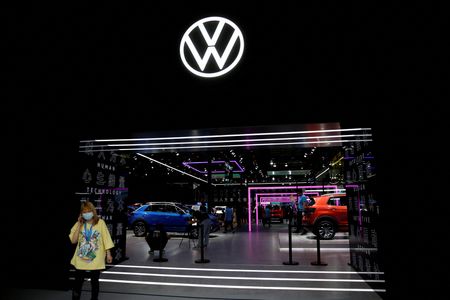

BEIJING – Four decades after Volkswagen made a splash at its debut Chinese automotive exhibition, the German manufacturer has watched its innovative reputation fade as domestic Chinese brands capture the attention of younger, technology-focused car buyers.
The traditional combustion-engine reputation that “Made in Germany” once carried has diminished in influence within what is now the globe’s biggest automotive marketplace, where Chinese manufacturers are introducing eye-catching, budget-friendly electric cars that function like smartphones with wheels.
“Maybe some younger customers perceive us as the brand for the parents,” Volkswagen brand’s China CEO Robert Cisek explained to Reuters.
Caught off guard by Chinese brands’ rapid ascent, sales figures for Volkswagen and its luxury divisions Porsche and Audi, plus competitors BMW and Mercedes-Benz, have all declined sharply, forcing these companies to fight desperately to stop losses in a market that previously represented one-third of their total sales.
Following 25 years as China’s top automotive manufacturer, Volkswagen fell behind electric vehicle leader BYD in 2024 and dropped to third position after Geely in 2025.
The shift in China’s automotive landscape for these manufacturers – from a growth engine to a competitive battlefield – has been “beyond imagination,” Cisek noted.
When Volkswagen participated in its inaugural Chinese auto exhibition in Shanghai during 1985, attendees were struck by the superior quality of the German company’s promotional materials.
“We were met by an unimaginably huge crowd and our brochures flew off the shelves,” former CEO Carl Hahn, who led the company’s Chinese market entry, documented in his autobiography. “For people at that time, it was enough simply to marvel at the quality of the paper and print and to dream about owning a car.”
Today, the German automotive corporation requires more than attractive printed materials to mount a recovery at this year’s Beijing Auto Show, beginning Friday.
After excelling in traditional combustion-engine vehicle manufacturing, companies like Volkswagen now find themselves hurrying to compete in a marketplace where over 25% of new automobiles are completely electric.
While China’s automotive sector expanded and local manufacturers introduced numerous consumer-oriented EVs, German carmakers surrendered market share. Combined, their sales dropped by 25% across five years to 3.9 million units in 2025, based on S&P Global Mobility statistics.
The difficulties have grown more severe this year as Chinese manufacturers penetrate the luxury market segment, pursuing affluent buyers who previously desired German engineering excellence, industry experts noted.
Operating from their distant corporate offices in Wolfsburg, Stuttgart and Munich, German automotive leaders misjudged Chinese manufacturers’ capacity to achieve EV development superiority so rapidly.
“They didn’t see this big change coming, and they didn’t see the speed at which it came,” automotive consultant Felipe Munoz observed.
Germany’s established automakers must revitalize their Chinese operations or become irrelevant in a nation that executives like Volkswagen CEO Oliver Blume consider essential for developing tomorrow’s vehicles.
Under Blume’s leadership, Volkswagen Group intends to launch 20 “new energy vehicle” models in China this year, encompassing fully electric cars, plug-in hybrids and EVs with small combustion engines called range extenders.
The corporation will unveil four new EVs in Beijing on Tuesday before the auto show begins, including mainstream models created with Chinese partners FAW and EV manufacturer Xpeng, plus the newest China-exclusive AUDI, a fresh brand where the luxury nameplate’s capitalized letters replace its globally recognized rings. This was co-developed with China’s SAIC.
Yale Zhang, managing director at Shanghai-based research company Automotive Foresight, stated German brands are being “murdered” by their historical reputation and unwillingness to change quickly.
“You can’t really rely on your chrome metal strips, your Napa leather seats and your ‘one-hundred-year’ history to convince the consumers,” Zhang explained.
German manufacturers have sometimes hesitated to adopt technology from emerging Chinese competitors.
Currently, Volkswagen, Mercedes and BMW are increasingly depending on Chinese suppliers to close the gap, including self-driving technology leader Momenta and vehicle software developer ECARX.
Although “Made in Germany” continues as a globally respected symbol, younger buyers – including those in China – are more inclined to avoid German vehicles, according to consumer research by Berylls by AlixPartners conducted in January.
“The good thing is, of course, there is this credibility when it comes to the Volkswagen’s safety, reliability and quality,” Cisek said. “At the same time, it’s also a little bit of a burden.”