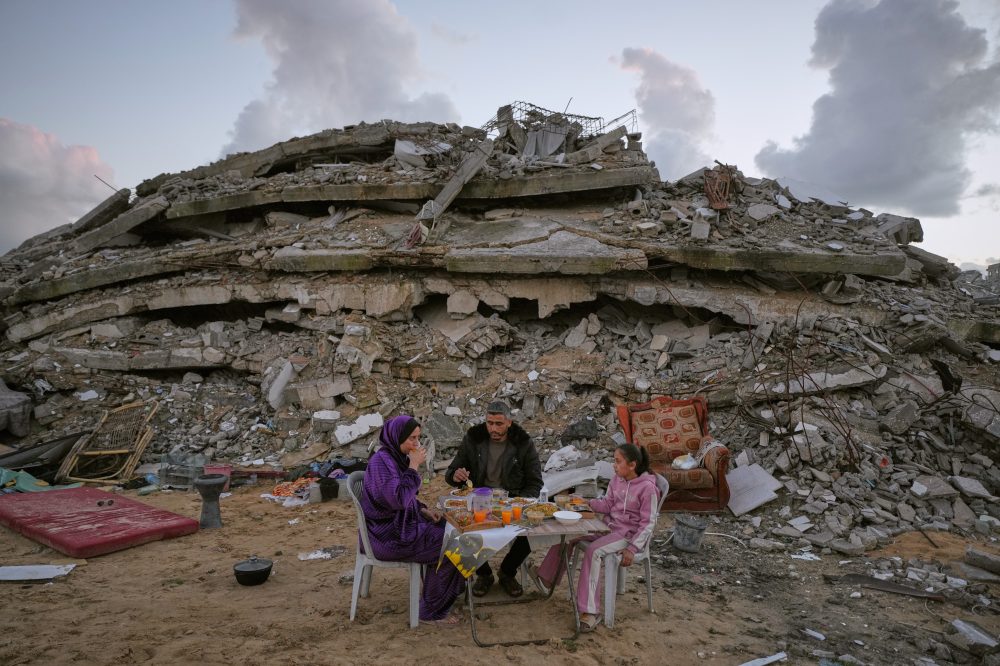

GAZA CITY, Gaza Strip — When evening arrives, Saddam al-Yazji sits with his wife and daughter to share a simple noodle soup, ending their daily Ramadan fast in Gaza City. Their makeshift dining spot consists of a portable table placed in the dirt beside a massive heap of debris, mangled steel, and concrete chunks — the remains of what was once their family home.
Beneath this wreckage lie the remains of most of their loved ones.
These three individuals represent nearly all who remain of their once-large family. In December 2023, an Israeli bombing attack on their residence claimed the lives of al-Yazji’s mother and father, three brothers, one sister, most of their children, plus his wife’s parents and siblings — a devastating total of 40 family members lost in one strike.
Ramadan, the sacred Islamic month, typically centers around family connections, featuring large celebratory iftar meals at sunset to conclude each day’s fasting period. Throughout the Gaza Strip, this holy season has transformed into a time when wartime casualties create particularly profound grief for countless families mourning relatives killed during the ongoing conflict between Israeli forces and Hamas, which has continued for over two years.
“I look at photos of our gatherings in Ramadan and cry,” said the 35-year-old al-Yazji. “Where is my family? All are wiped out.”
“It’s the third Ramadan without them.”
Before the conflict began, al-Yazji’s father, Kamel al-Yazji, would gather all his children and grandchildren for iftar around a massive table loaded with meat, rice, and various other foods, remembered Saddam’s wife, Heba al-Yazji.
The month of Ramadan, during which Muslims abstain from food and drink between sunrise and sunset, serves as a period focused on spiritual contemplation and prayer. The observance also strengthens community bonds through charitable giving.
The elder al-Yazji had previously served as a judge within the Palestinian Authority and was recognized as a prominent athletic leader in Gaza, holding the position of chairman for the Palestinian Athletics Federation. Saddam al-Yazji made his living operating a grocery store located on the first floor of their four-story family residence in Gaza City’s Rimal district.
The deadly air attack occurred just months after Israel began its intense bombing campaign following the Hamas-led assault on southern Israel in October 2023. The building collapsed completely, trapping everyone who was inside.
“We were in the same house, in other part of the house,” Saddam al-Yazji said. “We survived miraculously.”
The sole additional survivors included one brother’s daughter and his expecting wife. The fatalities included 22 children.
Rescue workers recovered some victims immediately after the attack. One of al-Yazji’s brothers lies in a makeshift grave marked with wooden sticks near the destroyed residence. Approximately 20 family members continue to remain trapped beneath the rubble.
Following the bombing, the couple and their 11-year-old daughter Maryam spent most of the conflict living in a temporary shelter elsewhere in Gaza City. During the two previous Ramadan observances, they made efforts to return to their destroyed home’s location for iftar meals whenever possible.
After a ceasefire agreement took effect in October, the three relocated to a tent positioned adjacent to their former residence.
“Life is empty,” Heba al-Yazji said. “The war took everything from me. We wish we had died with them rather than remain alone.”
During the entire conflict, Israel has conducted strikes against Palestinian residences and temporary shelter areas, frequently resulting in multiple family casualties simultaneously. Israeli officials state they focus on Hamas fighters, although they seldom identify specific intended targets.
Israel’s military operations have resulted in more than 72,000 deaths, with nearly half being women and children, based on Gaza Health Ministry statistics. The ministry, operating under Hamas-led governance, keeps comprehensive casualty documentation that U.N. agencies and independent analysts generally consider reliable, though it doesn’t distinguish between civilian and militant deaths.
Approximately 8,000 additional victims remain trapped under destroyed building debris, according to ministry reports. Recovering most bodies proved impossible during active bombing and ground combat operations. The ceasefire has allowed increased recovery work, though efforts remain limited due to insufficient heavy machinery.
Israel’s military response followed the Hamas attack that resulted in approximately 1,200 Israeli deaths and the capture of more than 250 hostages. The hostages have been freed, primarily through ceasefire negotiations.
Nearly every Gaza resident has experienced the loss of at least extended family members. Almost the complete population of 2.1 million lacks permanent housing, with most residing in expansive temporary encampments. More than 80% of the territory’s structures have sustained damage or complete destruction.
A vast landscape of destruction that once comprised the Rimal neighborhood surrounded the small Ramadan table where the three remaining al-Yazji family members shared their evening meal.
Saddam al-Yazji remembered the “great dining table” from their family’s previous Ramadan celebrations and how everyone eagerly anticipated the annual gathering.
“I feel like I have betrayed them by being alive,” he said.