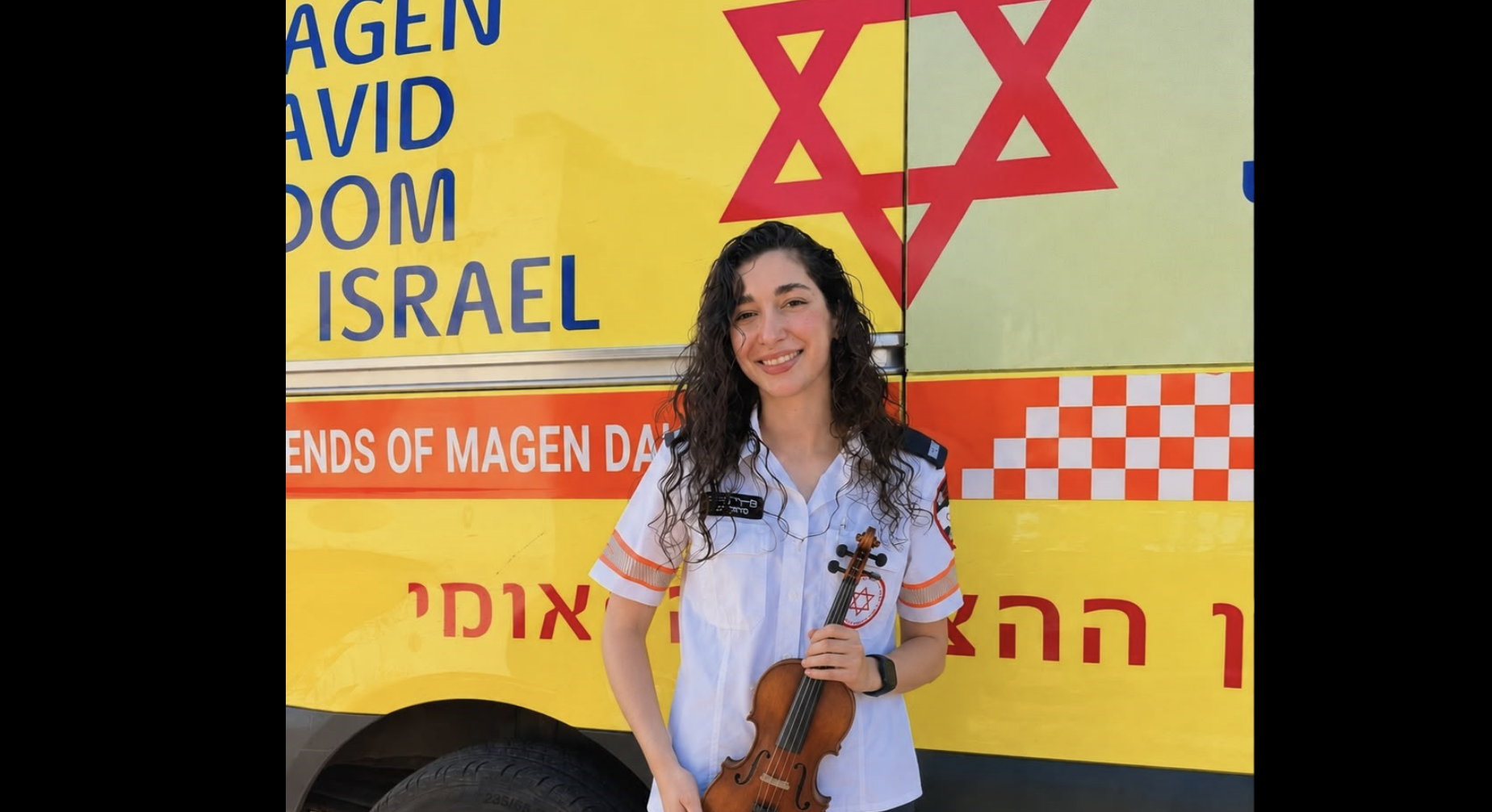

Israel’s national emergency medical organization, Magen David Adom, chose to mark National Paramedic Day on Thursday by shining a spotlight on one of its own — 20-year-old Druze paramedic Ghadir Saleh, a young woman whose life took an unexpected turn from concert stages to ambulance calls.
Saleh grew up in the northern Druze city of Maghar and is now a volunteer on Magen David Adom Mobile Intensive Care Units, a role she stepped into after finishing the organization’s paramedic training program through her National Service.
Before emergency medicine became her focus, music was her world. She began playing the violin at age nine and went on to represent Israel in multiple international delegations. After finishing high school, she gave back by teaching violin to at-risk youth and children on the autism spectrum through the Ministry of Education.
Her path toward a musical career began to shift after a doctor recommended she ease the physical demands on her hands. But an earlier experience had already planted the seed for a different calling.
“I’ve been playing since I was nine years old. I represented Israel on several international delegations around the world, and I never imagined I would pursue anything other than music,” Saleh said.
A serious accident when she was 16 years old proved to be another turning point. Watching those around her struggle to respond — not even knowing to call 101, MDA’s emergency hotline — left a lasting impression during her long recovery.
“When I was injured in the accident, the people around me didn’t know how to help. They didn’t even know they should call 101, MDA’s emergency hotline. Throughout my recovery, which involved countless hospital visits and medical examinations, I kept thinking about how important it is to know what to do in situations like that,” she said.
Saleh went on to enroll in MDA’s intensive paramedic training course, which she described as both rigorous and transformative — helping her grow not just as a medical professional, but as a person.
She now responds to emergencies on mobile intensive care units across Israel and says she has been met with overwhelming support from her family and the broader Druze community.
“I want to help people and save lives. The Druze community is known for being traditional, but in the end, it doesn’t matter what religion I am or what religion my patient is. It’s about one person helping another,” she said.
While Saleh still picks up her violin from time to time, she says emergency medicine has given her a deeper sense of purpose. Serving others and her country, she added, has become the most fulfilling chapter of her life so far.