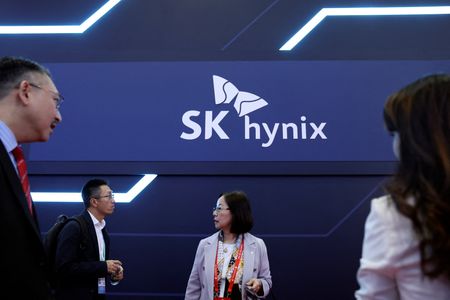

South Korean chipmaker SK Hynix officially launched a U.S. share offering on Monday, seeking to raise 43 trillion won — roughly $28.07 billion — as the company looks to capitalize on the worldwide boom in artificial intelligence technology.
Three major investment firms — Baillie Gifford Overseas, investment funds run by Coatue Management, and Situational Awareness Partners — have each separately indicated they are interested in purchasing a combined total of up to $7 billion worth of SK Hynix’s American depositary receipts, known as ADRs. None of the three firms responded to requests for comment.
SK Hynix plans to sell 17.79 million new shares through ADRs listed on the Nasdaq. Under the structure, every 10 ADRs will represent one common share. A filing submitted Monday set a reference price of 242,500 won per ADR, based on the company’s closing stock price in Seoul on July 3.
The offering arrives at a time when Asian semiconductor companies are moving to tap into strong global appetite for AI-driven stocks. Taiwan’s Unimicron Technology is also pursuing a roughly $1.4 billion share sale through global depositary shares.
SK Hynix’s stock in Seoul fell 3.4% on Monday to close at 2,343,000 won, though shares have still gained approximately 260% so far this year. South Korea’s broader KOSPI index was down 0.5% on the same day.
Memory chip stocks have experienced significant price swings in recent trading sessions, partly due to growing investor uncertainty about how much longer the current boom will continue.
Di Zhou, a portfolio manager at Thornburg Investment Management — a Santa Fe, New Mexico-based firm with $60 billion in assets that holds SK Hynix’s Korean ordinary shares — described the current environment as a major industry milestone. “We are in the midst of a memory super cycle, with all three major suppliers — Samsung, SK Hynix, and Micron — riding the AI driven demand wave,” Zhou said. She added that the ADR listing was a positive development because it would expand the company’s investor base and could potentially close the valuation gap between SK Hynix and its U.S. rival Micron.
Albert Yong, a managing partner at Petra Capital Management, expressed confidence in the offering despite recent turbulence. “While market volatility has been quite high recently, I would expect demand for SK Hynix shares to remain relatively robust,” he said.
The listing comes just days after South Korea unveiled a sweeping national strategy focused on semiconductors and AI, including a $576 billion chip investment program in the country’s southwest. The South Korean government said SK Hynix and Samsung Electronics will serve as anchor participants in that investment effort.
South Korean President Lee Jae Myung on Monday directed officials to move swiftly on the major chip and AI initiatives announced last week, warning that delays in permitting, land acquisition, and securing power and water supplies could jeopardize the country’s ambitions to lead in advanced industries.
SK Hynix has emerged as one of the biggest beneficiaries of the global AI investment surge, outpacing rivals Samsung and Micron in recent performance.
Dave Mazza, the chief executive officer of Roundhill Investments in New York — which manages an exchange-traded fund that tracks DRAM manufacturers and is among the most common ways U.S. investors access SK Hynix stock — said the listing carries broader significance. “This is more than a liquidity event,” Mazza said. “SK Hynix has been one of the most important companies in the world that most U.S. institutions could not easily own.” He added: “The listing removes an accessibility discount, not a quality discount.”
Steve Sosnick, chief strategist at Connecticut-based Interactive Brokers, said the U.S. listing would primarily benefit individual investors and smaller institutions rather than large ones. “The new listing will make it easier for capital-hungry Hynix to directly access a new group of momentum-hungry investors,” Sosnick said.
SK Hynix said money raised through the ADR listing will go toward constructing chip manufacturing facilities in South Korea and purchasing chipmaking equipment, including an extreme ultraviolet scanner produced by Dutch equipment maker ASML.
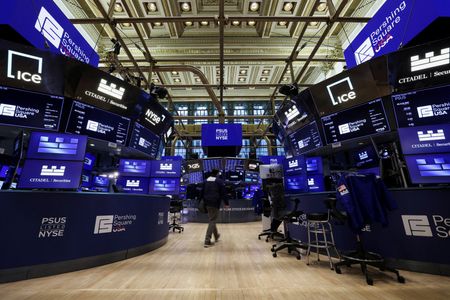
The final price for the New York listing is set to be determined on Thursday, with trading expected to begin on Friday, according to regulatory filings. Company leadership will be meeting with global investors throughout the week as part of a roadshow.
The deal is projected to become the second-largest share sale on record, trailing only a record $85.7 billion initial public offering by SpaceX last month. It would surpass Saudi Aramco’s $25.6 billion IPO in 2019 and a similarly sized offering by Alibaba in 2014.
Some investors have raised concerns that rising memory chip prices could eventually slow spending on AI infrastructure, mobile devices, and personal computers. “We expect better access, but timing of the memory cycle is equally important,” said Sundeep Gantori, Standard Chartered’s chief investment officer of equities. “We believe memory cycle is beyond the early phase and now in the mid-cycle stage.”
SK Hynix is a critical supplier of high-bandwidth memory chips used in AI systems by major technology customers including Nvidia and Alphabet’s Google. Analysts say the company is expected to be added to the chip-heavy Philadelphia SE semiconductor index, a move that could trigger a significant wave of passive investment into the stock.
Last month, HSBC announced it would raise its valuation of SK Hynix by applying a 20% premium to its previous price-to-book multiple of 2.8 times, bringing it to a multiple of 3.4 times, citing “more proactive shareholder-friendly initiatives and improved accessibility to global investors.”