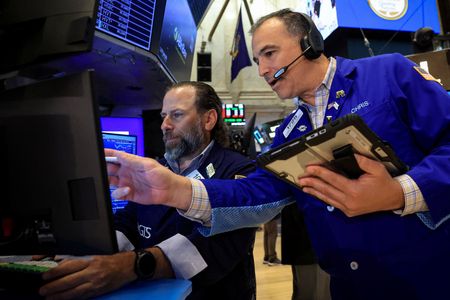

Financial markets kicked off the new week with a mixed performance Monday, as Asian stocks dipped while U.S. futures edged higher ahead of the first round of second-quarter corporate earnings reports.
Investors coming back from the July 4th holiday weekend and the nation’s 250th anniversary festivities are now turning their attention to company profits, while also processing last week’s surprisingly weak U.S. jobs report. That report helped dial back expectations for interest rate increases and pushed global stocks to their best weekly showing in two months.
Tech stocks and the ongoing artificial intelligence boom remain a central focus for Wall Street this week as trading returns to normal. Chip stocks, which had surged in the first half of the year even as the broader group of top tech companies struggled, got caught up in last week’s tech selloff and could face additional pressure in the days ahead.
The chip-heavy KOSPI index slipped 0.5% Monday ahead of Samsung Electronics reporting earnings on Tuesday. The South Korean tech company is expected to show an 18-fold increase in profit, driven by soaring demand for AI memory chips — though large bonus payouts to employees could put a dent in those results.
In other tech developments, rival chipmaker SK Hynix is moving forward with a U.S. stock listing Monday, aiming to raise $28 billion, with shares expected to begin trading on the Nasdaq on Friday. Additionally, Elon Musk’s SpaceX is set to join the Nasdaq on Tuesday.
The broader earnings season is getting underway, with companies in the S&P 500 expected to report profit growth exceeding 24% for the second quarter. Among the first major U.S. companies to release results later this week are Delta Air Lines and PepsiCo — both considered useful indicators of how American consumers are holding up financially.
That consumer health check takes on added significance following last week’s headline market story: a June jobs report that came in well below expectations. Nonfarm payrolls rose by just 57,000 jobs — far fewer than the 110,000 analysts had predicted. Payroll numbers for April and May were also revised downward by a combined 74,000 jobs.
The disappointing employment figures led investors to scale back their expectations for Federal Reserve rate increases as early as September. U.S. stocks received some lift Thursday as a result, though continued weakness in tech stocks kept pressure on the Nasdaq. Globally, stocks posted their strongest weekly performance in two months, with a broad international index climbing roughly 2%.
Notes from the Federal Reserve’s June meeting, which took a more aggressive tone on rates, are due out Wednesday. These could give investors additional insight into policymakers’ thinking, though the comments largely predate recent changes in oil flows through the Strait of Hormuz.
On the energy front, oil prices fell further to below $72 a barrel Monday morning. Prices were relatively flat last week as concerns about supply eased with oil flows returning through the Strait of Hormuz. That picture was further supported by OPEC+ announcing a new production quota increase on Sunday.
Whether that increased output actually materializes depends on tankers continuing to safely pass through the strait — which in turn hinges on ongoing negotiations between the U.S. and Iran toward a lasting peace agreement.
In currency markets, the U.S. dollar lost some of its recent strength following last week’s jobs report but nudged higher again early Monday. Gold, which tends to benefit when interest rates are lower, recovered some ground last week but eased slightly Monday as the dollar strengthened. The Japanese yen continued to weaken toward 40-year lows, moving past 162 per dollar, keeping traders on alert for possible government intervention.
On the geopolitical front, Turkey is hosting a NATO summit Tuesday and Wednesday. President Trump is expected to meet with Ukrainian President Volodymyr Zelenskiy in an effort to push forward a resolution to the nearly four-and-a-half-year-old conflict. Ukrainian drone strikes have continued to damage Russia’s oil refining infrastructure, forcing the world’s third-largest oil producer to import gasoline. Russia has also carried out two deadly attacks on the Ukrainian capital of Kyiv within the span of less than a week.
Key events to watch Monday include the U.S. ISM services index for June at 10 a.m. Eastern time, and remarks from Federal Reserve official Christopher Waller.