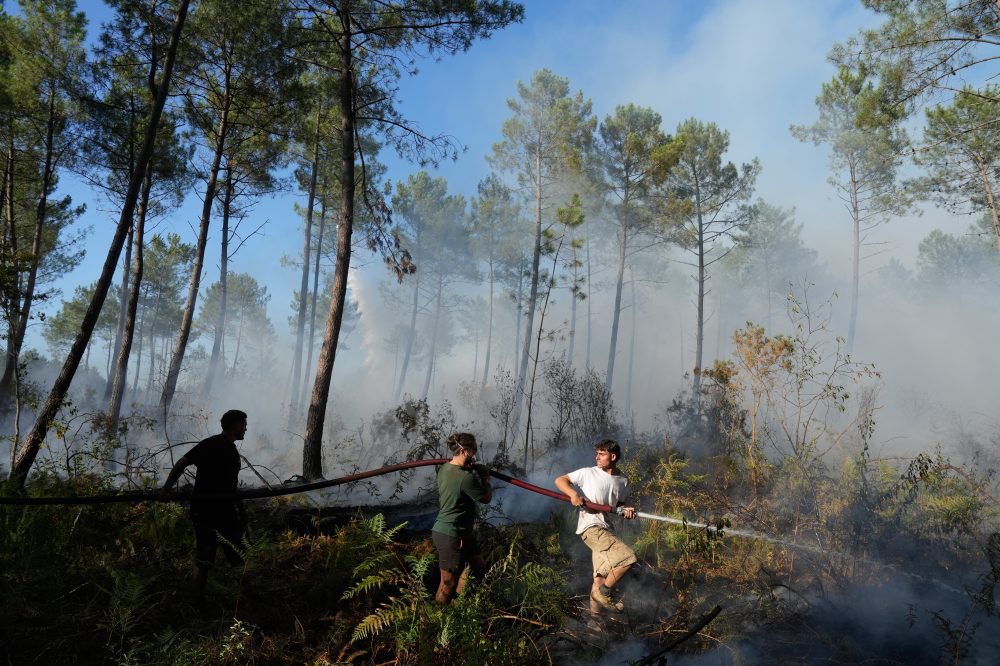

Crews battling a massive wildfire in southwest France successfully prevented the blaze from expanding overnight Tuesday, knocking down flare-ups along Atlantic coast dune areas — but climbing temperatures and dropping humidity are now threatening to undo that progress.
As of 6 a.m., the fire remained stabilized with the burned area holding at 420 square kilometers (162 square miles), according to the Gironde prefecture. Firefighters described the overnight hours as relatively calm.
Authorities reported several flare-ups that ignited overnight north of Le Porge and in dune areas north of Cap Ferret, but crews managed to bring each one under control. Those areas sit along the Atlantic coast to the west of Bordeaux, where firefighters have been battling the blaze since it broke out near Saumos last week.
The fire has been dangerously unpredictable since it began, at times turning into a self-sustaining firestorm as it scorched an area four times the size of Paris and drove 220,000 residents from their homes.
Even with the fire’s advance halted, officials have repeatedly warned that smoldering ground vegetation and dropping moisture levels could spark new outbreaks at any time.
Early Tuesday, firefighters and military engineers got back to work constructing strategic firebreaks intended to stop the flames from pushing further. Authorities reported that 103 kilometers — roughly 64 miles — of these barriers have now been built.
The toll on emergency personnel has been significant: 93 firefighters have been injured during the operation, the prefecture confirmed.
Travel disruptions continued as well, with a stretch of the A63 highway still shut down and train service south of Bordeaux suspended, with the exception of routes heading toward Toulouse.
The cautious gains in Gironde came alongside encouraging news from the neighboring Landes region, where a separate wildfire had displaced more than 30,000 residents and vacationers. Thousands of those residents began making their way back home.
French President Emmanuel Macron announced Monday evening that the Landes fire had been contained, and regional officials described it as “fixed” — meaning its spread had been stopped and no new fires were igniting.
Starting Monday night, roughly 15,000 people were given the green light to return to Sanguinet, Parentis-en-Born, and portions of Biscarrosse. Residents of Biscarrosse’s aviation village and a large campground were among those permitted back, though several neighborhoods in the area remained off-limits.
The homecoming was a meaningful moment for communities that had emptied out as flames tore through forests and tourist destinations during the peak of the summer vacation season. Roads connecting Biscarrosse, Parentis-en-Born, and Sanguinet were reopened on a limited basis for residents and necessary travel.
Officials cautioned, however, that the Landes fire has not been fully put out. Lingering hot spots, wind, and drought conditions could still produce flare-ups, and monitoring and suppression efforts are expected to continue for days or potentially weeks.
The improving situation in both areas faces a fresh test this week as temperatures began rising again Tuesday. France’s national weather service issued a yellow heat warning for Gironde starting at midday, with inland temperatures forecast to reach between 33 and 35 degrees Celsius — roughly 91 to 95 degrees Fahrenheit.
Southeast winds were expected to move through the department, with westerly sea breezes developing along the coast.
A string of heat waves has left forests and scrubland across France and other parts of southern Europe extremely dry, providing conditions that have helped fuel the ongoing fires.