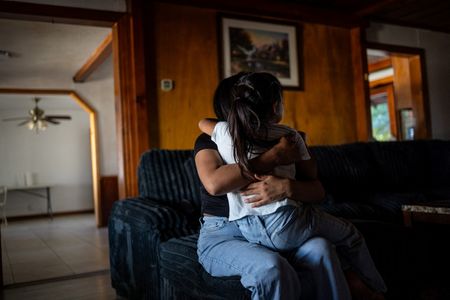

A 24-year-old woman named Aurora spent months working through a federal vetting process to be reunited with her 6-year-old daughter, who had crossed the U.S. border alone and spent more than half a year in a migrant children’s shelter. The two were finally brought back together at the end of March.
“We were overjoyed,” said Aurora, who, like others interviewed for this story, agreed to speak only on the condition that she be identified by her first name.
The joy was short-lived. Within days of their reunion, both mother and daughter were taken into custody by Immigration and Customs Enforcement and transferred to a family detention facility in Texas, according to records.
Their case is not unique. More than 12,000 people have been arrested by U.S. immigration authorities based on tips provided by the Office of Refugee Resettlement during President Donald Trump’s second term, according to internal government data reviewed exclusively by Reuters.
ORR was established in 1980 with the mission of helping refugees who had fled war and persecution. Since the early 2000s, the agency has also taken on the responsibility of caring for unaccompanied migrant children — those who arrive at the U.S.-Mexico border without a parent or guardian, like Aurora’s daughter.
Historically, the care of those children was kept strictly separate from immigration enforcement. A 2008 law was designed to ensure children were placed in the least restrictive environment and released from custody as quickly as safely possible, regardless of whether their sponsors were in the country legally. That framework allowed migrant families to reunite without fear of being targeted by ICE, even if they had entered the U.S. illegally.
The Trump administration has taken a fundamentally different approach. Since January 2025, ORR has passed along more than 460,000 so-called “leads” to ICE — information about unaccompanied children, their sponsors, and other members of their households. This is the first report to detail the full scope of that information sharing, according to Reuters.
Jen Smyers, who served as deputy director of ORR under the Biden administration, said the protections that once prevented this kind of data sharing have been “completely reversed.”
“They are weaponizing a child welfare program for the purposes of more deportations,” she said.
In a statement to Reuters, ORR said it “plays no role in the apprehension of children,” and directed questions about immigration enforcement to the Department of Homeland Security, which oversees ICE. DHS, in turn, confirmed that during Trump’s second term, “ORR has provided ICE Homeland Security Investigations with potential investigative leads,” as part of an effort to locate children placed with “unvetted sponsors,” including some with criminal histories.
Aurora had entered the United States illegally two years ago, seeking work and safety. She left her young daughter behind with relatives in a rural village in Mexico, worried the child was too small for the perilous desert crossing. Aurora found work as a house cleaner in Mississippi.
Last August, a relative brought Aurora’s daughter to the border and left her to turn herself in to immigration agents — a tactic commonly used by families hoping to be reunited. The girl was placed in a migrant children’s shelter, and Aurora began the lengthy sponsor approval process.
Over six months, she submitted extensive documentation, including a DNA test. Records show she had no criminal record. Under the Trump administration, the vetting process for sponsors now includes additional steps, such as requiring fingerprints from all household members. As a result, the average time unaccompanied children spend in custody has risen sharply — from about 30 days in fiscal year 2024 to 194 days as of June 2026, according to ORR data.
The day before she was reunited with her daughter, Aurora said immigration agents showed up at her home, asked about the girl, and told her to appear at an ICE office the following week. At that appointment, she recalled, agents “asked me if I had any problems in the U.S. and I said ‘no, because I haven’t done anything wrong. All I do is work.’”
She and her daughter were detained at that meeting and sent to a family detention center in Dilley, Texas, where they remained for three weeks. After their release, Aurora was fitted with an ankle monitor and required to check in regularly while her immigration case proceeds. DHS confirmed the details of her detention and release, noting she had admitted to being “illegally smuggled across the border.”
While Aurora was detained, her Mississippi landlord evicted her and discarded her belongings. She and her daughter then traveled to California, where a friend offered them a place to stay. Aurora says she fears deportation is coming. At night, her daughter sometimes “gets up and cries, thinking she is still detained,” Aurora said.
Other families have faced even more painful outcomes — being separated all over again after their reunions.
A woman named Marleny and her youngest son fled violence in Guatemala in 2023, crossed into the U.S. illegally, and settled in Texas, where she worked cleaning construction sites. Her older son, Victor, had remained with relatives back home. After his uncle was killed, Victor also decided to head north and turned himself in to U.S. border agents.
After four months in ORR custody, Victor was released in late April — the night before his 18th birthday, records show. The family celebrated with a party.
“I was so happy,” Marleny said. “I didn’t know then what God had in store for me.”
To secure Victor’s release, Marleny had provided ORR with extensive documentation for herself and her partner, including tax records and fingerprints. Since neither had a criminal record — they were “clean clean clean,” she said — she had no hesitation about sharing the information.
Two months after Victor came home, ICE agents arrested Marleny and her partner at gunpoint as they were heading to their car to go to work. DHS told Reuters that ICE was executing a criminal search warrant related to Marleny’s “roommate” — an apparent reference to her partner — but did not respond to follow-up questions about the alleged crime or how authorities had located him.
The sight of the weapons was deeply traumatic for Marleny, she said, bringing back memories of the violence she had fled in Guatemala.
A neighbor who saw the arrest alerted Victor, who was inside the family’s apartment with his 6-year-old brother. In tears, Victor called a legal assistant at the Galveston-Houston Immigrant Representation Project.
“We’ve seen so many sponsors arrested and collateral arrests with them,” said Alexa Sendukas, a managing attorney with the organization.
Victor is now solely responsible for caring for his little brother. He missed a scheduled court appearance in the chaos following his mother’s arrest and is now facing a deportation order. He hopes to find an attorney who can help him reopen his immigration case.
“I need to keep moving forward,” he said.