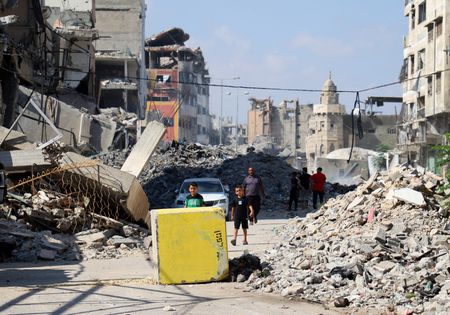

CAIRO/GAZA — In Gaza City’s Zeitoun district, a Palestinian man named Assem Dawla was loading mattresses and bags onto a truck, with concrete yellow blocks — the edge of Israel’s growing military zone — visible among the surrounding rubble.
Dawla said this was somewhere between the seventh and eighth time he and his family had been forced out of a shelter since the war started, each time pushed out by Israeli evacuation orders and the advance of what local residents call the yellow line.
Zeitoun is one of at least five locations across Gaza where residents and Hamas officials say Israeli forces have pushed the yellow line forward in recent days. The yellow line is a military boundary that was established under a U.S.-brokered ceasefire reached in October.
“We are taking our belongings out and going to leave the place because the occupation (Israel) has moved the yellow line all the way to Salah al-Din Street,” Dawla said, as men hoisted household items onto a waiting truck and elderly family members picked through the debris around them.
The October ceasefire was part of a peace framework put forward by President Donald Trump, which largely brought major combat operations to a halt after two years of devastating conflict that was triggered by Hamas’ attack on southern Israel.
That plan envisioned a large increase in humanitarian aid, a civilian Palestinian administration taking over governance, Hamas disarming, Israeli forces pulling back, and an international security force moving in. However, the process has largely stalled.
By late April, Israel effectively controlled around 64% of Gaza. Nearly all of the roughly 2 million people living in the territory have been pushed into a narrow coastal strip still under Hamas control, where many are living in damaged buildings or improvised shelters under severe humanitarian conditions.
Hamas has refused to give up its weapons. Israeli Prime Minister Benjamin Netanyahu stated on May 28 that Israel plans to extend its control to 70% of the territory. Israeli forces have continued carrying out near-daily military strikes throughout Gaza.
WARNINGS SENT BY TEXT AND DRONE
Residents from several areas — including Deir al-Balah, Khan Younis, Gaza City’s Zeitoun, Tuffah, and Shejaia neighborhoods, as well as northern Rafah — told Reuters that Israeli forces have been moving the yellow block markers forward over the past 10 days, setting off new waves of displacement in communities already torn apart by months of fighting.
At least seven people interviewed said that in some areas, residents received advance warnings through text messages or loudspeakers mounted on drones before they were required to leave.
The Israeli military stated that its troops are in Gaza to defend Israel against attack, and that the yellow line is being clearly marked on the ground to reduce the chances of soldiers and civilians coming into contact with one another.
“IDF’s (Israel Defense Forces) defensive posture in the area includes a security zone, a physical barrier, intelligence capabilities, technological means, and operational activity by IDF troops,” the military said in a statement.
For many Palestinians being told to move, the experience has become a grim routine: gathering whatever survived the last evacuation — a few blankets, a cooking pot, a child’s schoolbag — and heading out, often after nightfall, toward whatever area the Israeli military has designated as safe.
FORCED TO MOVE AGAIN AND AGAIN
Near the ruins of buildings in Zeitoun, Dawla’s mother, Umm Sami, moved slowly through what remained of the family’s property, picking up anything still usable.
“Why am I leaving? They (Israeli army) became close, they put the yellow line here. The day before, they struck there, and we left,” she said.
Like the vast majority of Gaza’s population, Dawla’s family has been uprooted multiple times throughout the war, piecing together temporary shelters only to be ordered out again days or weeks later.
In a statement dated July 20, the United Nations Office for the Coordination of Humanitarian Affairs said an Israeli displacement order in Zeitoun forced 30 families out of their tents, which residents say were later destroyed.
As trucks carrying what remained of people’s household lives drove away, and a child walked past yellow blocks jutting out from the wreckage, residents prepared for yet another uncertain journey.
“The whole war is displacement, displacement. You can’t stay anywhere without (Israel) telling you, ‘Get out of here, we want to come in,’” Dawla said.