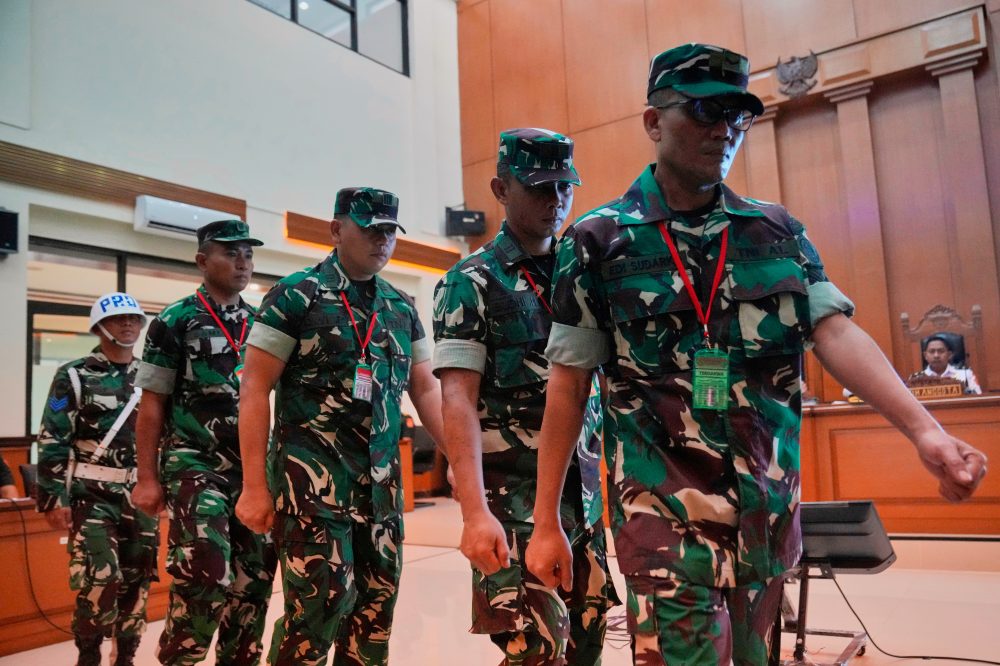

JAKARTA, Indonesia — Four members of Indonesia’s military faced their first day in court Wednesday on charges stemming from an acid attack that left a prominent human rights lawyer partially blind and severely burned.
The defendants include three navy marines and one air force officer, all working in military intelligence roles. They stand accused of premeditated assault for the March attack on Andrie Yunus, a 27-year-old attorney who works with the Commission for the Disappeared and Victims of Violence, an organization known as KontraS.
Facing trial at Jakarta’s military court are Sgt. Edi Sudarko, First Lt. Budhi Hariyanto Widhi Cahyono, Capt. Nandala Dwi Prasetya, and Air Force First Lt. Sami Lakka. Each could receive up to 12 years behind bars if found guilty.
Military prosecutors claim the four worked in coordination but maintain their actions were driven by personal grievances. According to the prosecution, the defendants wanted “to teach him a lesson and deter him from making disparaging remarks about the TNI.”
“The actions of the defendants who threw chemical liquid on Andrie Yunus, resulting in the loss of sight in his right eye and severe burns with no hope of complete recovery, were inappropriate actions for members of the TNI,” prosecutor Iswandi stated during court proceedings.
Human rights organizations have expressed strong criticism regarding both the characterization of personal motivation and the choice to conduct proceedings in military rather than civilian court.
“This case has been narrowed to just four individuals, without transparency, while the motive is framed as personal,” stated Usman Hamid, who leads Amnesty International Indonesia. Hamid pointed out the lack of any clear personal or professional connections between Yunus and those accused, while noting that official military resources appeared to have been utilized in the assault.
“It is difficult to accept that state facilities were used solely for personal revenge,” Hamid warned, expressing concern that the case’s handling could damage public confidence.
Following Wednesday’s reading of charges, the four defendants chose not to challenge the accusations. Two of the accused also suffered minor facial and eye injuries from acid exposure during the incident. The judge scheduled the next hearing for May 6 to hear witness testimony.
The investigation initially fell under Jakarta police jurisdiction before authorities revealed military personnel were involved. Six days following this announcement, military police took four suspects from the Indonesian National Armed Forces’ Strategic Intelligence Agency into custody.
The attack occurred on the evening of March 12 when Yunus was traveling by motorcycle through central Jakarta. Attackers threw hydrochloric acid at his face, causing chemical burns across approximately 20% of his body and damaging roughly 40% of his right cornea, according to prosecutors.
Multiple surgical procedures have been required for Yunus’s ongoing recovery, preventing his attendance at the trial’s opening session, military prosecutor Mohammad Iswandi reported.
Yunus has gained recognition for his work challenging impunity in Indonesia, particularly regarding security sector reform and civil liberties protection. He participated actively in demonstrations last year opposing proposed changes to Indonesia’s military law that would have expanded armed forces involvement in civilian matters. Associates report he has faced ongoing intimidation related to this advocacy work.
The incident has drawn parallels to the 2004 killing of Munir Said Thalib, a prominent human rights advocate and KontraS founder who died from arsenic poisoning during a flight to Amsterdam. While convictions were secured, activists maintain the true orchestrator was never identified.
Growing pressure from civil society organizations demanding disclosure of who authorized and funded the attack on Yunus has prompted a response from President Prabowo Subianto, a former army general.
Prabowo has committed to pursuing those responsible and indicated he may establish an independent investigative team. Rights advocates view the Yunus trial as a crucial test of the military’s post-reform dedication to accountability.
Following the 1998 fall of dictator Suharto, Indonesia’s military officially stepped back from political involvement, leading to reforms designed to enhance civilian oversight.