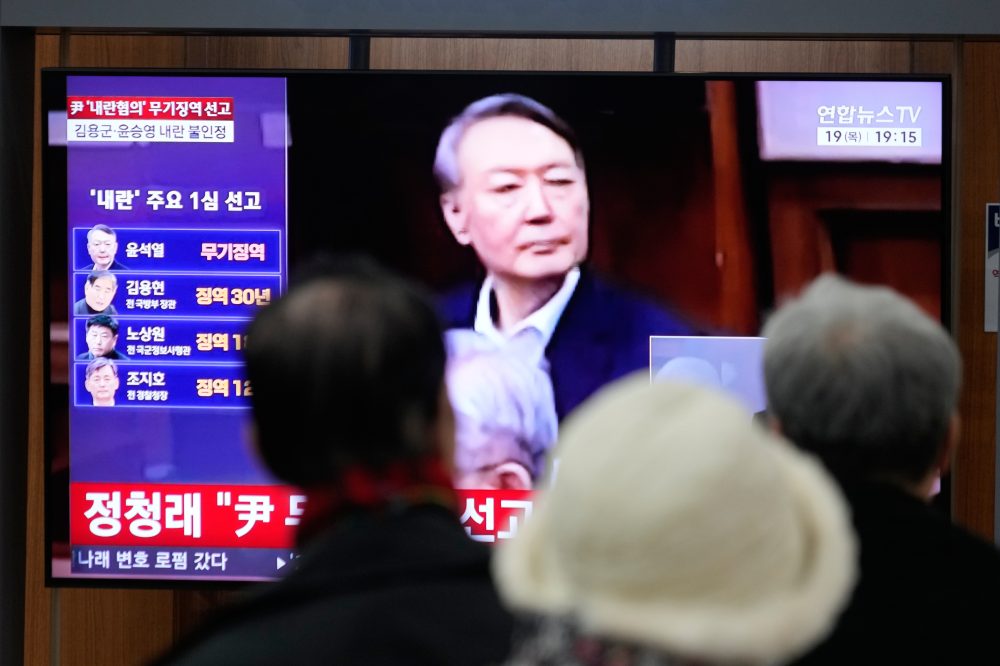

SEOUL, South Korea — Former South Korean President Yoon Suk Yeol showed no signs of backing down Friday after a Seoul court sentenced him to life in prison for rebellion charges stemming from his failed martial law attempt.
Through a statement issued by his legal team, Yoon continued to defend his controversial December 2024 martial law declaration, claiming it was implemented “solely for the sake of the nation and our people.” He also criticized the Seoul Central District Court, alleging it held prejudice against him.
The former president, who lost his position during the political turmoil that followed his unsuccessful power grab, has consistently fought back against eight separate criminal charges that prosecutors say amount to an attempted coup and other offenses.
Throughout the legal proceedings, Yoon has taken an combative approach — holing up in the presidential compound for weeks, refusing to cooperate with investigators after his detention, failing to show up for court hearings, and confronting witnesses during his rare appearances.
When delivering Thursday’s rebellion conviction, Judge Jee Kui-youn criticized Yoon for displaying “no sign of apology for the staggering social costs incurred by the emergency martial law” and noted he “refused to appear in court without any justifiable reason” on multiple occasions.
Outside the courthouse, hundreds of police officers kept opposing groups of demonstrators apart as Yoon’s conservative backers voiced frustration and anger over the decision, while his critics celebrated the outcome in nearby areas. No significant confrontations occurred between the groups.
Yoon’s Friday statement challenged the legitimacy of the court’s decision.
“In a situation where the independence of the judiciary cannot be guaranteed and a verdict based on law and conscience is difficult to expect, I feel deep skepticism whether it would be meaningful to continue a legal battle through an appeal,” the 65-year-old said from jail, where he has been held since last July.
However, attorney Yoo Jeong-hwa clarified that Yoon was “merely expressing his current state of mind” and wasn’t suggesting he would give up his appeal rights. The former president has one week to challenge Thursday’s ruling.
While expressing regret for military personnel, law enforcement officers and government workers now under investigation or facing charges related to his martial law order, Yoon also told his supporters “our fight is not over.”
The court determined Yoon was guilty of leading a rebellion by deploying military and police units in an unlawful attempt to take control of the liberal-controlled parliament, detain political rivals and create unlimited authority indefinitely. Yoon has justified his authoritarian actions as necessary to combat the opposition-dominated legislature, which he characterized as “anti-state” elements.
The independent counsel team, which had sought the death penalty for Yoon, may also file their own appeal and has the authority to request a higher court modify the punishment. Investigation team member Jang Woo-sung told media following the verdict that prosecutors have “reservations” about the court’s factual conclusions and the punishment’s severity.
The Seoul court additionally found five former military and police leaders guilty for their roles in implementing Yoon’s martial law order. Among them was former Defense Minister Kim Yong Hyun, who received 30 years in prison for his key involvement in developing the plan, deploying troops and directing military intelligence agents to detain prominent politicians, including current liberal President Lee Jae Myung. Kim has filed an appeal.
Conservative People Power Party leader Jang Dong-hyuk argued at Friday’s press briefing that the court didn’t make a compelling argument that Yoon’s martial law constituted rebellion and, alluding to a potential appeal, emphasized that “the right to be presumed innocent applies to everyone without exception.”
Yoon’s martial law announcement, made during late evening hours on December 3, 2024, remained in effect for roughly six hours before lawmakers managed to penetrate military barriers and voted unanimously to reverse it, compelling his administration to rescind the order.
Legislative action suspended Yoon from his duties on December 14, 2024, following his impeachment, and the Constitutional Court officially terminated his presidency in April 2025. He has been defending himself in several criminal proceedings while in custody, with the rebellion charge carrying the harshest potential consequences.
Despite its brief duration, Yoon’s martial law declaration triggered South Korea’s most serious political upheaval in decades, bringing government functions and international relations to a standstill while disrupting financial markets. The leadership crisis ended when Lee secured victory in an emergency election held in June of last year.