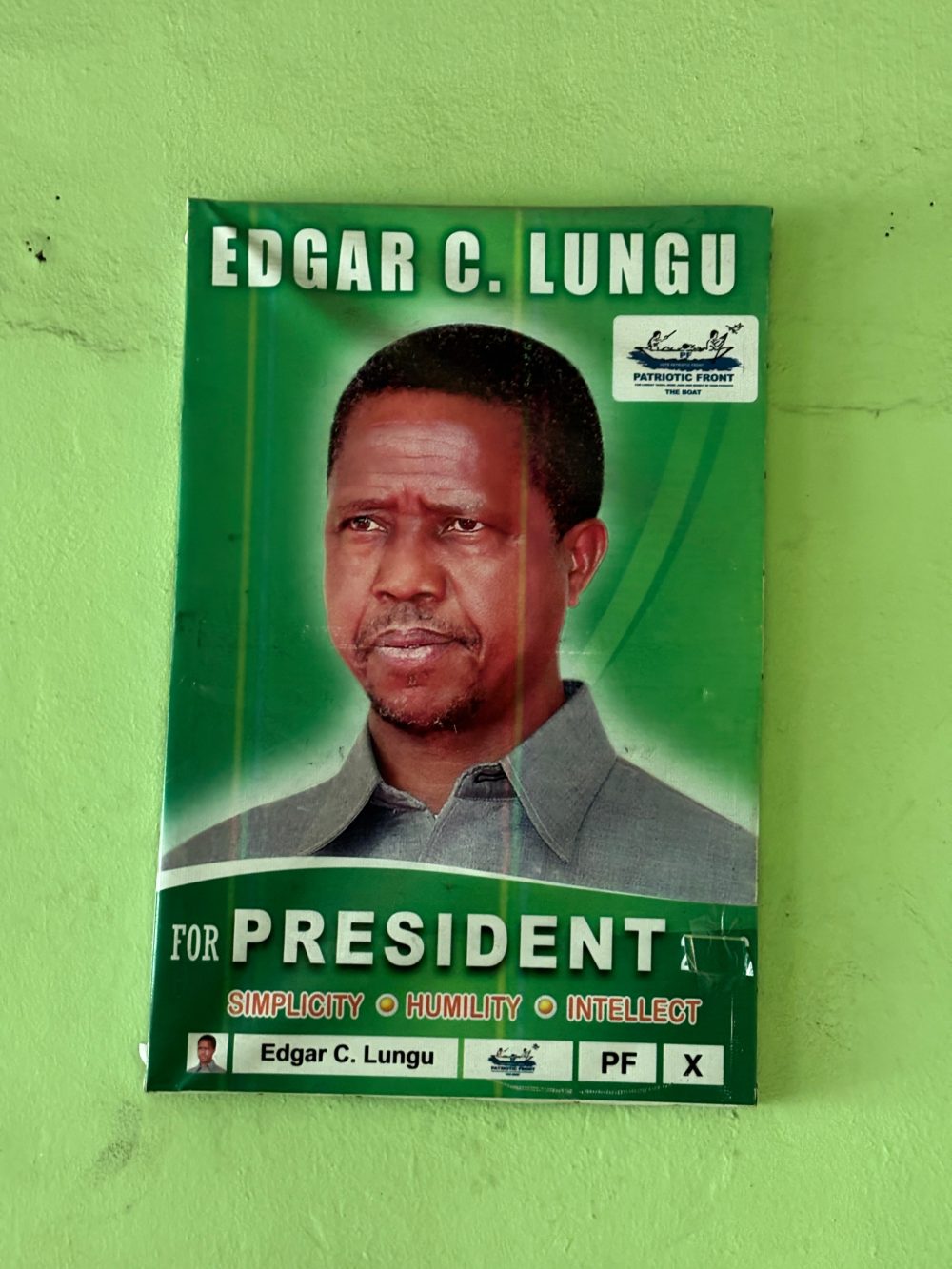

LUSAKA, Zambia — Eight months have passed since former Zambian President Edgar Lungu died, yet his body remains stored in a South African funeral home, caught in the middle of a bitter feud between his family and his political successor.
The disturbing conflict has created a haunting image: an empty grave the size of a coffin sits unfilled in a Lusaka cemetery, where current President Hakainde Hichilema planned to hold a state funeral. However, Lungu made his final wishes clear to relatives before his death — his longtime political opponent should never be allowed near his remains.
Courts have consistently ruled in favor of Zambian government officials against Lungu’s family’s desires. Despite these legal decisions, the deceased president’s relatives continue fighting for a burial ceremony that would exclude Hichilema entirely.
The corpse remains preserved in South Africa, where Lungu passed away, while Zambia faces a shocking controversy that violates cultural customs and sparks numerous concerns in a nation where failing to bury deceased individuals quickly and respectfully is considered deeply offensive.
This standoff stems from years of animosity between two political enemies. Religious leaders and academics who spoke with The Associated Press describe it as a supernatural conflict between Hichilema, who faces reelection in August, and Lungu, who appears to be continuing his fight beyond death.
“It has shifted from the physical, it has shifted from politics, and it is now a spiritual battle,” said Bishop Anthony Kaluba of Life of Christ congregation in Lusaka.
Those who support Hichilema view Lungu’s final instructions as placing a hex on the current leader, while they argue that allowing Hichilema to attend a state funeral would demonstrate kindness toward Lungu and his relatives.
While the battle over a deceased person’s body may appear strange to outsiders, Lungu’s final command strikes a chord with many Zambians.
Citizens sometimes prevent their adversaries from participating in their funeral services, frequently holding them responsible for their troubles. These conflicts typically remain personal matters, unlike this public spectacle involving a former president who, while dying, struck back at his opponent using the powerful words of ancestral tradition.
Throughout Africa, final statements carry “vital force” that can either promote life or obstruct it, explained Chammah J. Kaunda, a Zambian professor of African Pentecostal theology who leads the Oxford Center for Mission Studies as academic dean.
Elderly people approaching death possess the power to place curses or offer blessings, and Lungu’s situation demonstrates that curses “can acquire a life of their own,” he noted.
Zambia operates as a thriving democracy. The nation’s first president was the cheerful, handkerchief-waving Kenneth Kaunda, who lost power through elections in 1991, despite his reputation as a hero of independence.
Similar to Kaunda, later presidents have been civilians without the military backing of various dictators found elsewhere across Africa, providing Zambia’s presidential candidates the chance to campaign based on their individual qualifications.
Nevertheless, many believe that certain political figures — like numerous fellow citizens — fear they could fall victim to witchcraft. This concern is common in a country where ancestral beliefs flourish alongside Christianity, and verbal curses are feared by many as spiritually binding when triggered by unfairness.
“It is a weapon,” said Herbert Sinyangwe of WayLife Ministries in Lusaka. “We believe in our culture that curses work.”
Regarding three recent presidents — Michael Sata, Lungu and Hichilema — mistrust was widespread. The official presidential residence is now believed by many to be cursed with death because all six former presidents have died. Hichilema conducts business there but spends nights elsewhere.
Sata, who served as president from 2011 to 2014, feared that Hichilema, then in opposition, was targeting him while claiming that protective charms from his own area were more powerful. Zambian officials convicted and imprisoned two men last year for allegedly attempting to assassinate the president through magical means. Lungu’s family remains suspicious of Hichilema.
The burial site in Lusaka intended for Lungu was rapidly excavated and prepared before officials learned of the family’s objections, stated cemetery caretaker Allen Banda. He cautioned that a tomb lacking a body was like digging “your own grave.”
“If nobody goes there, culturally it’s your body that’s going to go there,” he said.
Hichilema’s willingness to risk public backlash by opposing Lungu’s family has strengthened the beliefs of those who perceive a supernatural conflict between him and Lungu.
“On the one hand, nearly everything done by the Lungu family so far seems to have been designed to deny Hichilema access to Lungu’s body,” said Sishuwa Sishuwa, a Zambian historian who is a visiting scholar at Harvard. “On the other, Hichilema’s conduct so far suggests that he will do whatever it takes to secure access to Lungu’s corpse, perhaps because the president sees the issue as a matter of life and death.”
Lungu passed away on June 5, 2025, from complications following surgery. He was 68 years old and had received treatment for esophageal narrowing.
To arrange a state funeral, Zambian officials needed to take possession of Lungu’s body until burial. However, Lungu’s relatives opposed Hichilema’s plans during discussions about funeral arrangements.
They wanted to transport the remains via private aircraft and hoped to keep the body at Lungu’s home overnight. They selected three individuals to oversee it during the state funeral that ultimately never occurred.
After Lungu’s family realized their requests would likely be denied, they chose to hold a private funeral in South Africa. They were proceeding with that ceremony when they discovered Zambian authorities had prevented it.
A South African court decided in August that Zambian officials could bring Lungu’s body back home for burial.
Bertha Lungu, the former president’s sister, became distraught in the courtroom following the decision, crying and cursing at Mulilo Kabesha, Zambia’s attorney general, who stated it was time to bring the body home. She claimed that Hichilema wanted the corpse for ceremonial purposes.
Hichilema denies any ill intentions toward Lungu, and has stated his Christian beliefs prohibit acceptance of traditional religious practices.
Lungu assumed power following Sata’s death in 2014. Sata’s vice president, Guy Scott, was unable to run for president in a 2015 election, and Lungu was chosen to complete Sata’s term.
His primary challenger was Hichilema, a successful businessman. The race was extremely tight — Lungu prevailed by fewer than 28,000 votes.
Following the 2016 election, which Lungu won again, Hichilema faced treason accusations and spent four months in prison for allegedly refusing to give way to the presidential convoy.
Five years later, Lungu was defeated by Hichilema and announced his political retirement. He reversed this decision in 2023, and Zambian authorities revoked Lungu’s retirement benefits.
Lungu faced additional pressure when his wife and daughter were detained in 2024 on fraud charges related to property purchases.
When Lungu became ill, he struggled to leave Zambia. The government limited his travel. He managed to escape to South Africa early in 2025, purchasing a ticket at the airport counter. Local media reported this incident as a security failure that resulted in an airport manager’s dismissal.
Lungu is “still influencing our politics from the grave,” said Emmanuel Mwamba, a Zambian diplomat who represents Lungu’s party. “His issues remain. How he was treated in life and how he was treated in death.”