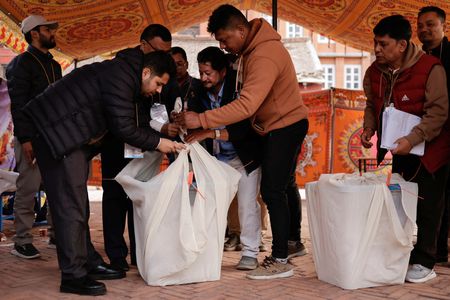

Initial ballot counting from Nepal’s general election shows a former rapper’s political party building a commanding early advantage over traditional political establishments.
Balendra Shah, age 35, who previously served as mayor of Nepal’s capital Kathmandu, sees his centrist Rastriya Swatantra Party holding leads in 37 parliamentary seats based on preliminary tallies released Friday morning by election officials.
The results represent a striking shift from Nepal’s established political order. Former Prime Minister K P Sharma Oli’s Communist Party of Nepal (Unified Marxist-Leninist – UML) currently leads in just three constituencies, while the historic Nepali Congress party under 49-year-old Gagan Thapa shows strength in five races.
Shah’s three-year-old party appears positioned for a potential upset victory as counting continues across the Himalayan nation. Election authorities expect complete results by Friday night or Saturday.
Nepal’s parliamentary system includes 275 total seats in the lower chamber. Direct voting determines 165 positions, with the remaining 110 allocated through proportional representation.
During campaign events, Shah successfully mobilized younger demographics seeking political transformation, drawing substantial crowds throughout the country. His appeal resonated particularly with voters frustrated by decades of governmental instability and economic stagnation.
The 35-year-old candidate even challenged 74-year-old Oli directly in the Jhapa 5 district near the Indian border, demonstrating his party’s national ambitions.
Nepal’s 30 million citizens have endured persistent political turmoil that has undermined the predominantly agricultural economy while increasing joblessness. Widespread corruption has worsened these fundamental challenges.
These longstanding problems sparked massive street protests last September after authorities imposed social media restrictions. The demonstrations resulted in violent confrontations and deaths, ultimately forcing Oli’s resignation from the prime minister’s office.
The South Asian nation, situated between regional powers China and India, now faces the possibility of significant political realignment under Shah’s leadership.