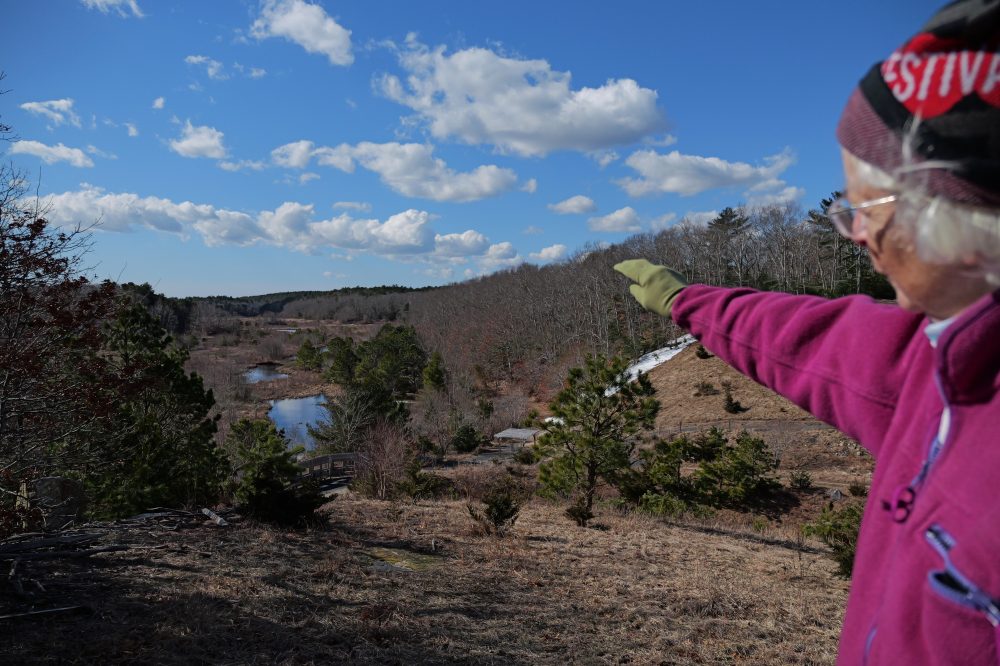

PLYMOUTH, Mass. — Standing amid hundreds of acres of thriving wetlands, Glorianna Davenport holds old photographs showing what this land used to be: neat rows of bright red cranberry bogs connected by straight irrigation channels. The contrast is remarkable — where geometric farm plots once existed, winding streams now flow through diverse habitat teeming with wildlife and towering trees.
This dramatic transformation, monitored by an extensive network of cameras and sensors, provides a roadmap for restoring wetlands as cranberry operations across New England and Wisconsin face declining profits. Climate change poses particular challenges to cranberry cultivation, which depends on cold winters and abundant water supplies. Rising temperatures and extended dry periods are making successful harvests increasingly difficult.
Plymouth settlers were among the earliest to cultivate this indigenous New England fruit, establishing family farming traditions that have endured for generations.
“For many of these farmers, it’s their life savings and what they want to pass on to their children,” Davenport explains. “It’s very complicated.”
The property Davenport chose to sell for conservation purposes has become the Tidmarsh Wildlife Sanctuary, representing Massachusetts’ most extensive freshwater habitat restoration effort. Working alongside scientists, technology experts and artists, she established a functioning research facility dedicated to wetland conservation studies. The monitoring equipment generates real-time, publicly accessible information demonstrating how the ecosystem is regaining its natural diversity.
Researchers studying both the sanctuary and a neighboring town preserve on Davenport’s former agricultural land have produced scientific papers documenting the environmental changes. Knowledge gained at Tidmarsh influenced the state’s decision to create a cranberry bog restoration initiative that pairs farmers with conservation organizations, either purchasing properties for restoration or assisting landowners with their own habitat projects.
The collected data has inspired unexpected applications among nature enthusiasts: birdwatchers once used audio recordings from multiple microphones to pinpoint a specific bird’s position. Others stream the wetland sounds as background ambiance for their homes or workplaces.
Creating the restored habitat at Tidmarsh required planting more than 20,000 native plant varieties, dismantling old dams and creating new waterways. Heavy machinery worked through sandy soil that had been degraded by over a century of cranberry farming, which had created a dense, impermeable layer above the original freshwater wetlands.
Scientists who had considered cranberry farmland “ecologically dead” watched a vibrant wetland system emerge. Just one year after restoration work commenced in 2010, the sandy earth began producing new growth.
Research published in 2025 examining sites including Plymouth’s Foothills Preserve, another section of Davenport’s former farm, conducted by teams from the Woodwell Climate Research Center and the University of Connecticut revealed that Tidmarsh’s sand contained dormant native seeds requiring only mixing with peat to begin growing. A 2021 study examining Tidmarsh and other restored locations — including an earlier, smaller Plymouth restoration called Eel River Headwaters — documented rapid improvements in water retention, soil quality and microbial ecosystems within just a few years.
“We discovered that former cranberry farms were actually highly restorable,” states Beth Lambert, who directs the Massachusetts Division of Ecological Restoration.
Mass Audubon, the conservation group that purchased and oversees most of Tidmarsh, showcases these restoration results through guided tours. Education coordinator Kim Snyder leads diverse groups from bird enthusiasts to student field trip participants.
“A lot of Plymouth residents who have been here a long time remember it as a cranberry farm,” Snyder notes.
Lambert credits Tidmarsh with inspiring the state’s Cranberry Bog Restoration Program, which offers technical support and connects farmers with federal funding and conservation-minded purchasers. The state has now completed construction on nine restoration projects covering approximately 500 acres and 10 miles of stream habitat. Eleven additional projects spanning another 500 acres are currently being planned. Lambert hopes to restore an additional thousand acres over the next 10 to 15 years.
Data from the United States Department of Agriculture shows Massachusetts cranberry farm retirements increased by roughly 40% from 2017 to 2022.
Farmers don’t automatically choose conservation when leaving agriculture. They may sell to developers or simply abandon the land, which could take decades to naturally return to productive wild habitat.
“If we don’t conserve, if we don’t protect these lands that … owners are walking away (from), we lose it forever,” Davenport warns.
The retired filmmaker believes that supporting more wetland restoration research will help communicate valuable knowledge to the public — potentially inspiring similar restoration efforts in other locations.
This philosophy motivated her to establish the Living Observatory, a nonprofit organization that calls itself a “learning collaborative” for researchers, artists and others documenting former cranberry farm recovery.
Using the sensor network — which tracks everything from soil moisture to temperature — plus live cameras, the Living Observatory has compiled extensive data on cranberry farm restoration techniques. The project’s website now contains information from multiple restoration sites throughout the state beyond Tidmarsh.
Gershon Dublon, a data and systems researcher who serves as Living Observatory board director, said researchers appreciated having a straightforward resource: a centralized location to access data and contribute their own findings. Following Tidmarsh’s success, ecologists from locations as distant as the Amazon rainforest contacted Living Observatory seeking advice on implementing similar custom sensor networks for their projects, Dublon reports.
Wetland restoration projects and their generated knowledge serve as valuable tools in addressing climate change, according to climate scientist Christopher Neill at the Woodwell Climate Center. Wetlands function as natural barriers that absorb flood and storm water, Neill explains. Scientists report that extreme precipitation events are becoming more frequent in the Northeast.
At Tidmarsh, sphagnum moss growing alongside a mile-long boardwalk demonstrates this resilience. Snyder enjoys explaining its antimicrobial qualities to visitors. The moss also captures and stores carbon dioxide that contributes to global warming.
“It’s a great property to show … the scope of restoration work,” she says with a smile.
The changes at Tidmarsh fill Davenport with optimism. Native pitcher plants flourish in clusters throughout the wetlands. Insects buzz over flowing streams. Her boots sink into the soft, saturated ground. These were sounds absent from the farm where she spent her childhood.
“The quiet goal is, can we make a dent in the amount of land that’s put in conservation?” Davenport asks.