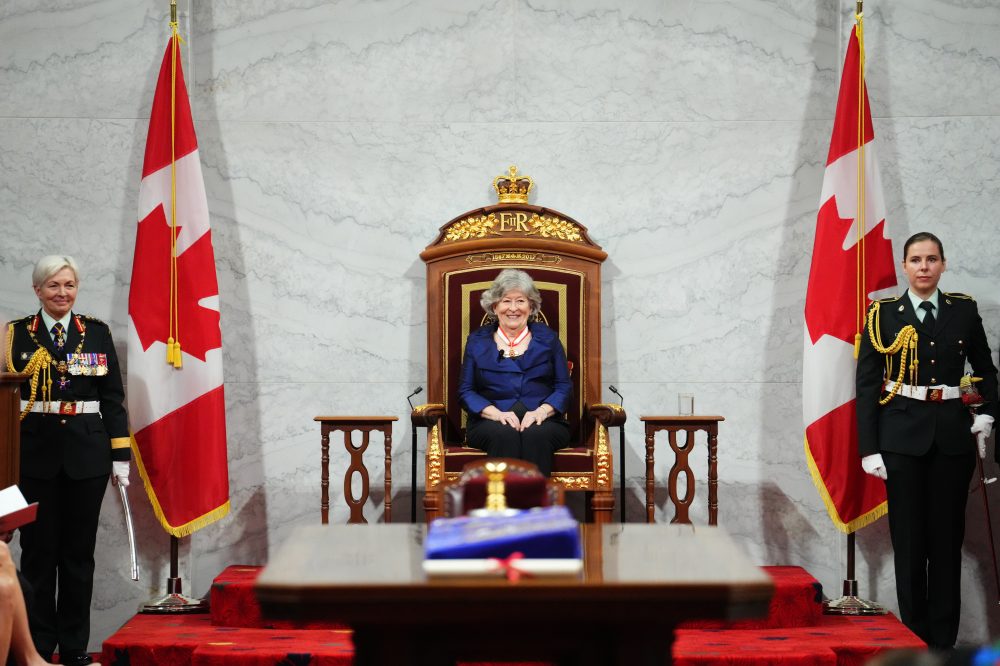

TORONTO (AP) — Former Supreme Court Justice Louise Arbour officially assumed her duties as Canada’s governor general following Monday’s installation ceremony.
In her new role, the governor general serves as the official representative of Britain’s King Charles III. Canada remains part of the Commonwealth, with the British monarch serving as the nation’s head of state.
At 79 years old, Arbour takes over from Mary Simon, who made history in 2021 as Canada’s first Indigenous person to hold the position. While the governor general carries significant constitutional responsibilities, the role functions primarily in a ceremonial and symbolic capacity. Prime Minister Mark Carney selected a Francophone candidate for the position.
The installation was marked by the Central Band of the Canadian Armed Forces performing “God Save the King” while the Governor General’s Flag was hoisted above Parliament Hill.
Arbour brings extensive credentials as an internationally recognized legal expert, judicial leader, and champion of human rights and justice. Her judicial career included appointments to the Supreme Court of Ontario, Ontario’s Court of Appeal, and Canada’s Supreme Court.
The United Nations appointed her in 1996 to serve as Chief Prosecutor for the International Criminal Tribunals addressing crimes in the former Yugoslavia and Rwanda. Under her leadership, these efforts achieved the first genocide conviction since the 1948 Genocide Convention and marked the first time war crimes charges were brought against a serving head of state.
From 2017 to 2018, she held the position of U.N. Special Representative for International Migration.
During her inaugural address as the monarch’s Canadian representative, she emphasized that peaceful coexistence amid differences remains essential for preserving a society governed by law and established rules.
Arbour addressed concerns about artificial intelligence’s expanding influence, warning against excessive dependence on such technology. She pointed out that immediate access to enormous volumes of information creates a strong temptation to ignore the credibility of information sources.
“The lines between knowledge and belief, between truth and falsehood, between facts and assumptions are increasingly blurred,” Arbour said. “AI could be threatening not only the way we live and work, but also the control we exercise over our own destiny.”
She highlighted Canada’s significant global resources, noting the country encompasses nearly 7% of the world’s land area and contains 20% of global freshwater reserves, while representing just half of 1% of the world’s population.
She said the world “looks at us with justifiable envy.”
Last week, Arbour held a meeting with King Charles at Buckingham Palace.
While the United States broke away from British rule, Canada maintained its colonial status until 1867 and continues operating as a constitutional monarchy featuring a British-modeled parliamentary government.