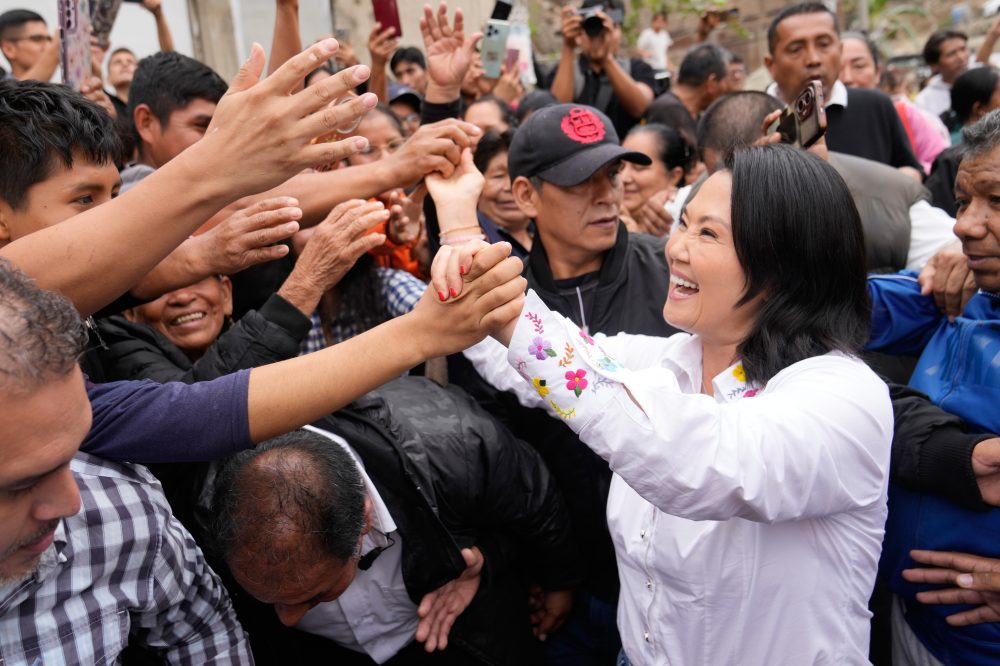

LIMA, Peru — Peru’s presidential runoff election has left the nation without a clear leader as counting continues in an extremely tight race between conservative Keiko Fujimori and nationalist congressman Roberto Sánchez.
Current tallies from 93% of counted ballots show Fujimori leading with 8.75 million votes representing 50.095%, while Sánchez trails closely with 8.73 million votes at 49.905%.
The eventual victor will become Peru’s ninth president within a decade. Both candidates — Fujimori, whose father was a disgraced former president, and Sánchez, who supports an incarcerated ex-president — advanced to this runoff after defeating 33 other contenders in April’s initial election, though neither secured even 20% support in that contest. Election officials required over a month to confirm their advancement.
Roberto Burneo, the nation’s top election official, urged voters and political groups to “act with democratic responsibility” during the ongoing count. He indicated final results would be announced within 30 days.
Voter participation in Lima, the capital, seemed reduced compared to the earlier election, with minimal waiting lines at most polling locations despite mandatory voting requirements. The extended counting timeline stems from regulations requiring every ballot and summary sheet from each polling station to be transported to over 100 counting facilities. Ballots and tally sheets must also be shipped to Lima from 63 countries for inclusion in the count.
Criminal activity, especially extortion, dominated voter concerns. A 2025 survey by the state’s National Institute of Statistics and Informatics revealed 84% of urban respondents feared becoming crime victims within the next year.
Analysts connect Peru’s growing organized crime influence to profits that established criminal organizations generate from unauthorized gold mining operations in the Andes and Amazon regions.
Neither candidate’s anti-crime platforms resonated strongly with voters, many of whom connect both potential presidents to problematic Peruvian political figures.
Fujimori carries associations with her deceased father Alberto Fujimori’s authoritarian and corrupt administration from the 1990s. She assumed Peru’s first lady role in 1994 following her parents’ divorce.
Sánchez maintains close ties to jailed former President Pedro Castillo, widely viewed as corrupt and disorganized. Castillo’s 16-month presidency featured over 70 Cabinet personnel changes.
April’s official election results showed Fujimori capturing 17% of votes while Sánchez earned 12%. An Ipsos poll conducted one week before the election found comparable support levels for both candidates, with approximately 30% of voters remaining undecided.
Food vendor Magali Quiquia chose to submit a blank ballot, explaining she found neither candidate appealing.
“Five years ago, I was disappointed by Castillo with his corruption, and … Roberto Sánchez is the same,” said Quiquia, 44. She continued that she believes “Fujimori hasn’t done anything either” despite her party holding multiple Congressional seats.
Peruvians between ages 18 and 70 must vote or face fines reaching $32.
Over 27 million citizens are registered voters. Approximately 1.2 million were projected to vote internationally, primarily from the United States and Argentina.
Throughout her fourth presidential bid, the 51-year-old Fujimori focused on crime reduction promises. Her platform included deploying tracking technology against extortion, militarizing national borders, and expanding police and military presence in dangerous zones. She also proposed requiring prisoners to work and “repay society” under her leadership.
During the sole pre-runoff debate, Fujimori supported her father’s administration and vowed to eliminate crime as effectively as he defeated the Shining Path extremist organization. Sunday evening, she counseled supporters to stay patient.
“So far, there is no winner in this race,” Fujimori stated from a Lima hotel.
Sánchez, a 57-year-old former minister with strong rural support, committed to fighting police corruption and advancing reforms allowing military assistance in security operations. The wide-brimmed peasant hat wearer, a gift from Castillo, told debate audiences he would welcome “all options to generate jobs and progress” while emphasizing support for Chinese investments.
Sunday evening, he appeared on a Lima hotel balcony, thanking Indigenous communities, farmers and other supporters “who have decided to come and reclaim the government for the people.”
The runoff winner will begin a five-year term on July 28.