
PALATKA, Fla. — More than five decades after Florida abandoned an ambitious waterway project meant to rival the Panama Canal, environmental groups are pushing to undo the lasting damage left behind.
The Cross Florida Barge Canal was designed to create a shipping shortcut across the state, connecting the Atlantic Ocean to the Gulf of Mexico. Construction halted in 1971 due to environmental opposition, but not before builders completed a dam and reservoir in northeastern Florida.
The Kirkpatrick Dam and Rodman Reservoir have since flooded portions of the Ocala National Forest, submerged 20 natural springs, and blocked wildlife migration routes that manatees and other animals depend on.
Periodically, state officials drain the 9,500-acre reservoir for maintenance, temporarily revealing what lies beneath the surface. The most recent drawdown began in October and concluded in early March — the first such event in six years.
When the water recedes, buried springs resurface and young cypress trees start sprouting on the exposed lake bottom. For a few months, the landscape returns to something resembling its original condition.
Environmental advocates want to make this restoration permanent by dismantling the 7,200-foot dam and reconnecting the St. Johns and Ocklawaha rivers with Silver Springs, among America’s largest spring systems.
“By removing the dam, we would reunite the waters,” explained Nina Bhattacharyya, who leads Florida Defenders of the Environment. “We would have springs reemerge. Wildlife would be able to move back and forth — migratory fish, manatees and so much more. Removal of the dam would really fix a wrong that was created decades ago.”
Their latest attempt to secure funding hit a roadblock last week when Florida’s legislative session concluded without passing a bill that would have allocated $70 million for a four-year dam removal and river restoration project.
Despite the setback, restoration supporters remain hopeful after coming closer to success than in previous years. The House had approved the measure, which was awaiting a Senate vote when the session ended.
“While the bill did not receive a final vote in the Senate this session, the strong bipartisan support it earned reflects growing momentum for restoration,” Bhattacharyya said Monday.
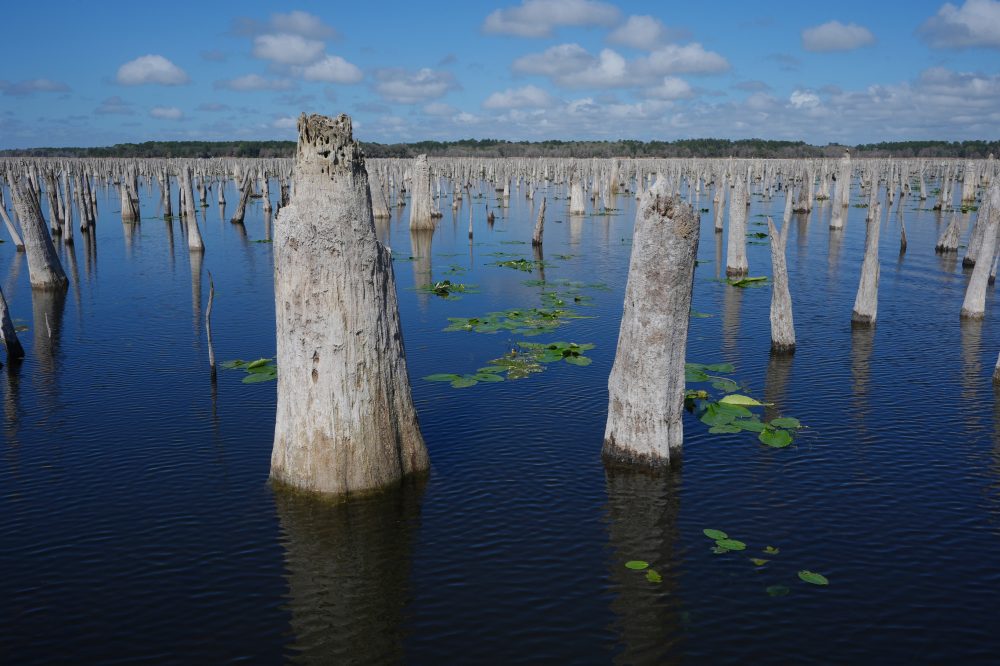
The periodic reservoir drainings offer glimpses of what permanent restoration might accomplish. Wildlife tracks from bears and deer appear on the dried ground. Wild turkeys and sandhill cranes return to areas they cannot access when flooded. Thousands of dead trees — cypress, palm, and maple — emerge like monuments to the submerged ecosystem.
“It’s haunting, like a graveyard,” observed Karen Chadwick, a charter boat captain, as she navigated between the weathered tree trunks protruding from the water.
Safety concerns add urgency to the restoration debate. The aging dam has exceeded its expected lifespan, and advocates warn that structural failure could threaten hundreds of nearby residences.
“Something is going to happen, maybe next year, maybe in a couple of years,” warned Republican state Sen. Jason Brodeur, who sponsored the restoration legislation, during a committee hearing last month. “Something has to be done.”
Nature filmmaker Mark Emery recently testified to state lawmakers about the ecological damage caused by the dam. He explained that Silver Springs historically fed the Ocklawaha River, but the dam has reduced water flow and eliminated the large schools of mullet and catfish that once thrived in the springs.
“This system is a national treasure,” Emery told legislators. “Hundreds of millions of gallons of fresh water feed and cool the river. Before the dam, you had a direct waterway to the ocean with small springs all along the way.”
However, some fishing organizations oppose permanently draining the reservoir, arguing it has become a premier destination for largemouth bass fishing that supports the local economy in rural Putnam County, one of Florida’s most economically disadvantaged areas. The reservoir also attracts campers and birdwatchers.
Steve Miller, who heads Save Rodman Reservoir, told lawmakers in February that the reservoir helps filter nutrients from the water and could serve as an alternative water source as Florida’s population continues growing.
“There’s a bigger picture than what is being shown,” Miller argued during legislative hearings. “Don’t gamble away on speculative outcomes.”
Putnam County Commissioner Joshua Alexander acknowledged that while the dam’s construction was problematic, local residents have built tourism businesses around the reservoir.
“We have created chicken salad out of chicken,” Alexander told lawmakers. “We are not a rich economy, and I believe it would affect our economy.”
Restoring the Ocklawaha River would continue Florida’s pattern of repairing environmental damage from misguided infrastructure projects.
The Everglades had shrunk by half due to Army Corps of Engineers water management and flood control systems before a multi-billion-dollar restoration effort began this century. Similarly, the Corps straightened and channeled the Kissimmee River in the 1960s to prevent flooding, but disrupted the ecosystem that supported numerous bird and fish species. That river’s restoration took two decades to complete, finishing in 2021.
“Nature is very resilient,” Chadwick reflected, “if you just get out of the way and let it do its thing.”