
A federal appeals court decision this week has strengthened efforts by several states to mandate Ten Commandments displays in public school classrooms, marking a significant development in the ongoing debate over religion’s place in education.
The most extensive effort to place the Ten Commandments in every classroom started in Texas last year, where a federal appeals court on Tuesday rejected a legal challenge to the state’s requirement. Although the matter is far from resolved, the decision represents a win for conservative advocates who dismiss claims that such displays promote religion to students or infringe on parental rights, including those of non-Christian families.
The mandate has sparked both support and opposition, energizing school board discussions and leading to official guidance for educators on how to respond to student inquiries. Several teachers have chosen to resign rather than comply with posting the Ten Commandments in their rooms.
Southern Republican legislators have spearheaded this movement. Louisiana led the charge by becoming the first state to enact such a requirement in 2024, with Arkansas and Texas following suit.
Alabama represents the most recent addition, where Republican Governor Kay Ivey this month approved legislation mandating Ten Commandments displays in grades 5-12 public school classrooms where American history is regularly taught, plus shared spaces including cafeterias and libraries.
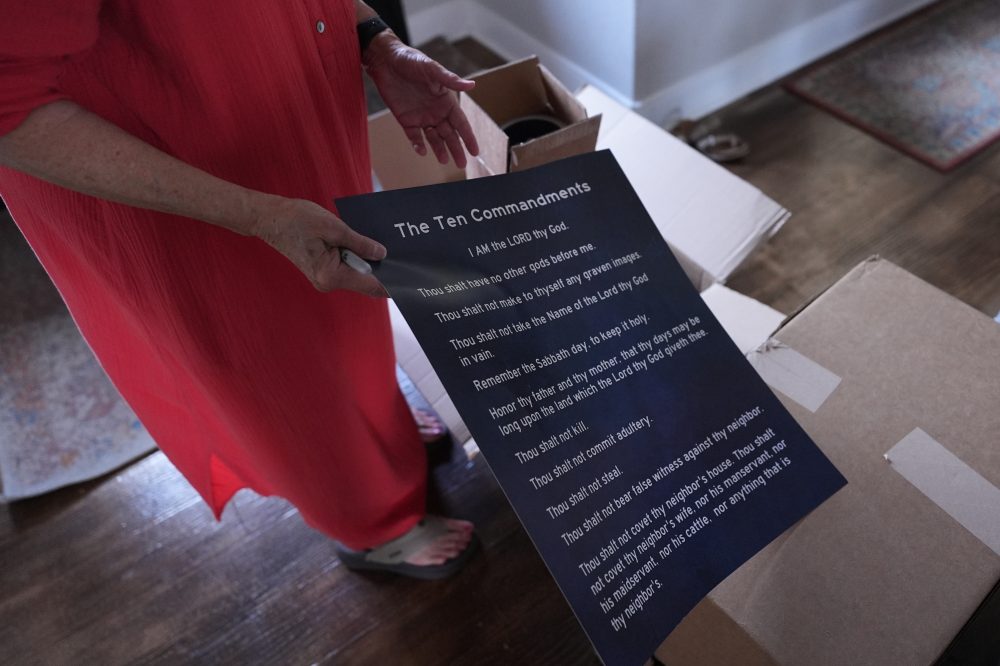
Texas Governor Greg Abbott signed his state’s measure, which mandates Ten Commandments postings in all public school classrooms and became effective in September. Since the legislation only obligates districts to display them when donated, conservative organizations and supporters began delivering boxes of posters to schools statewide as the academic year commenced.
An Associated Press review of state legislation using bill-tracking software Plural identified at least 30 proposed measures in current legislative sessions that would mandate displaying the document in schools. Republican lawmakers introduced all these bills, with nearly every one originating in states under GOP control.
Only a handful have received legislative committee approval. Additional bills in various states would either permit displays or mandate instruction incorporating the document.
For several months, a lower court decision prevented approximately twelve Texas school districts from installing the posters. However, the 5th U.S. Circuit Court of Appeals in New Orleans overturned that ruling in a narrow 9-8 vote, determining the requirement doesn’t violate student or parental rights.
“No child is made to recite the Commandments, believe them, or affirm their divine origin,” the ruling says.
The American Civil Liberties Union and other organizations that contested the Texas law representing parents expressed being “extremely disappointed” with the appeals court’s ruling.
“The First Amendment safeguards the separation of church and state, and the freedom of families to choose how, when and if to provide their children with religious instruction,” they said in a statement. “This decision tramples those rights.”
In February, the same appeals court authorized Louisiana to implement its own statute. Louisiana’s Republican Attorney General Liz Murrill praised the Texas case outcome, stating it “adopted our entire legal defense.”
Texas’s Ten Commandments requirement represents just one aspect of the broader struggle over religious content in classrooms. In 2024, the state authorized optional biblical curriculum for elementary schools, and a June proposal would incorporate Bible stories into mandatory reading assignments.
In adjacent Oklahoma, the former state education leader mandated that public schools integrate Bible content into lesson plans for grades 5-12, triggering legal action from parents and educators. Many schools simply disregarded the directive.
Last year, Oklahoma’s Supreme Court prevented the state’s attempt to establish the nation’s first publicly funded religious charter school. The case awaits consideration by the U.S. Supreme Court.
The ACLU and other groups challenging the Texas law indicated they plan to appeal the 5th Circuit’s decision to the U.S. Supreme Court.