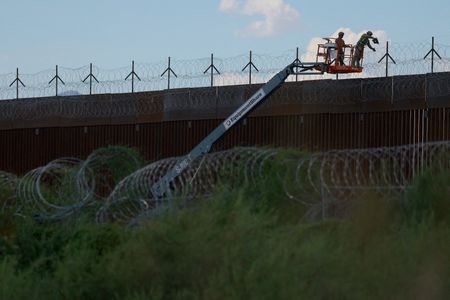

Texas officials received approval Friday from a federal appeals court to begin implementing a contentious state immigration law that grants local authorities power to arrest individuals suspected of crossing the border without authorization.
The New Orleans-based 5th U.S. Circuit Court of Appeals voted 10-7 to reverse a 2024 court order that had prevented implementation of the legislation, which the previous Biden administration had legally contested.
While President Trump’s team withdrew the federal challenge, opposition to the Texas measure designated as SB4 has continued from immigration advocacy organizations Las Americas Immigrant Advocacy Center and American Gateways, along with El Paso city officials.
Governor Greg Abbott signed the legislation into law in December 2023, establishing illegal border crossing or re-entry into Texas as a state offense. The measure grants state judges authority to order deportation of violators, with potential prison terms reaching 20 years for those who fail to comply.
Following a February 2024 preliminary injunction that blocked implementation, the matter reached the Supreme Court, which temporarily permitted enforcement before the 5th Circuit quickly suspended it again for additional consideration.
A three-judge panel from the 5th Circuit maintained the injunction in July 2025, determining the state legislation would conflict with federal immigration enforcement authority.
However, the complete appeals court, recognized as among the nation’s most conservative, decided to review the case again following pressure from Republican Texas Attorney General Ken Paxton.
In Friday’s decision, U.S. Circuit Judge Jerry Smith stated that immigration advocacy groups voluntarily choosing to expand their representation of affected immigrants did not establish their legal standing to contest the law.
“When enterprising plaintiffs repackage a generalized grievance as an ‘injury,’ courts should rightly exercise caution,” Smith wrote in an opinion joined by all but two of the court’s Republican-appointed judges.
Paxton celebrated the decision in a public statement. “Texas’s right to arrest illegals, protect our citizens, and enforce immigration law is fundamental,” he said.
Legal representatives for the challenging parties have not yet provided responses to requests for comment.
Seven judges issued dissenting opinions, including U.S. Circuit Judge Priscilla Richman, appointed by Republican President George W. Bush, who argued that a 2012 Supreme Court precedent established federal law’s supremacy over Texas legislation.
“Texas cannot enact its own immigration regime,” she wrote.